


The conversation usually starts at a kitchen table. One parent says the stairs are getting harder. An adult child notices missed medications, spoiled food in the fridge, or a house that suddenly feels too big to manage. Nobody wants to rush the decision, but nobody wants a crisis to make it for them either.
That's why senior living in Mission BC is rarely just a housing question. It's a care question, a financial question, and for many Fraser Valley families, a real estate question at the same time. The hard part isn't only finding the right level of support. It's coordinating that move with the sale of a long-held family home, sorting through timelines, and making sure the next place fits daily life, not just a brochure.
Navigating the Next Chapter in Mission
A family in this position often has three conversations happening at once. One is emotional. Can Mum stay independent? Another is practical. What kind of support is needed now? The third is financial. If the current house is in Mission, Hatzic, or on a larger lot that made sense years ago, is it still helping, or is it now creating work, cost, and stress?

Families often feel like they're late to this conversation. They usually aren't. They're responding to a reality that has been building for a long time. Historically, the number of seniors aged 65 and over in British Columbia grew from 4,017 in 1901 to 848,985 in 2016, a major shift that affects housing demand in communities like Mission and across the Fraser Valley, as outlined by Healthy Aging CORE British Columbia.
Why this feels harder now
Mission still offers the appeal many seniors want. Familiar streets, access to shopping, established neighbourhoods, and family nearby. But demand, care needs, and housing types no longer line up neatly. That's one reason many local families benefit from reading broader context on population aging and understanding its impact on families before they make a rushed decision.
The best transitions usually start before there's an emergency. Families make better choices when they still have time to compare care, costs, and housing options calmly.
There's also a real estate layer that generic care guides usually miss. If the senior owns a detached home, condo, or townhouse, the next move affects equity, timing, possession dates, storage, and estate planning. A move into senior housing can't be treated like a separate project from the sale of the current home. They're connected.
For readers weighing both care and property decisions, local market context helps. A practical starting point is this look at real estate in Mission BC, especially if the current plan involves selling first and choosing housing second.
Understanding Your Senior Living Options
Most families don't need more jargon. They need a simple way to sort options by how much support a person needs each day. In practice, it helps to think of senior housing as different levels of assistance, not just different buildings.

Independent living
Independent living suits seniors who can manage most of their day on their own but want less maintenance and more convenience. That often means meals, housekeeping, social activities, and a community setting without the burden of yard work or home upkeep.
This option works best when the main problem is the house itself, not complex health care. Someone may be tired of stairs, snow shovelling, driving for every errand, or cooking every night. They may still be fully capable of making decisions and handling personal routines.
A useful bridge for families considering staying put a bit longer is reviewing essential home modifications for seniors. Sometimes a safer bathroom, better lighting, and simpler layout can buy meaningful time before a move is necessary.
Assisted living
Assisted living fits seniors who remain fairly independent but need regular support with certain daily tasks. That might include medication help, personal care assistance, meals, or staff availability through the day and night.
This is the category families need to watch closely because availability has tightened. British Columbia had 12 assisted living units per 1,000 residents aged 75 and older in 2018, and that dropped to 10 units by 2022, according to the Office of the Seniors Advocate review. That doesn't tell you exactly when a space will open in Mission, but it does tell you waiting until the last minute is risky.
Practical rule: If a parent is safe today but showing steady decline, start researching assisted living before the situation becomes urgent.
Memory care and higher-support settings
Families often use memory care as a catch-all term, but what matters is the need level. If dementia, wandering risk, confusion, or significant supervision needs are present, standard independent living usually isn't enough. The decision then becomes less about amenities and more about safety, routine, and trained support.
A quick way to sort the options is this:
| Option | Best fit | Main priority |
|---|---|---|
| Independent living | Senior is largely self-sufficient | Convenience and social connection |
| Assisted living | Senior needs regular help but not full nursing care | Support with daily routines |
| Memory care or higher-support care | Senior needs close supervision and structured support | Safety and specialised care |
For broader market context around supply and demand, this overview of the seniors housing sector after the 2025 recovery is useful if you're trying to understand why availability can feel uneven across the Fraser Valley.
How to Evaluate Local Mission Residences
Once a family has narrowed the care level, the next mistake is choosing based on appearance alone. Nice furniture, a cheerful lobby, and a polished tour don't tell you how a residence operates. The better test is whether the place is organised, transparent, and consistent.

Use a local example as your benchmark
A practical Mission example is The Cedars. A Fraser Health regulated site like The Cedars in Mission has 24-hour staff, medication management, and building-code-driven accessibility features, with applications managed centrally through the Mission Association for Seniors Housing and aligned with BC Housing criteria, as described by Fraser Health's assisted living information for The Cedars.
That single description gives families a solid evaluation framework. Don't just ask whether a residence “has support.” Ask what support means in daily operations.
What to check beyond the brochure
When comparing residences in or near Mission, look at these operational details:
- Staff coverage: Is help available around the clock, or only during set hours?
- Medication systems: Ask who manages medications, how they're tracked, and what happens if a dose is missed.
- Application path: Some residences have direct intake. Others involve a central process or eligibility review.
- Accessibility standards: Look for practical features like easy entry, safer bathrooms, and common areas that support mobility aids.
- Communication: Ask how staff update families when needs change.
A good residence can explain its process clearly. If answers feel vague during the tour, daily life may feel vague too.
Signs that usually matter more than décor
A residence doesn't need to feel luxurious to be a strong fit. It does need to feel competent. Watch how staff respond when interrupted. Notice whether residents seem oriented and comfortable in common areas. Pay attention to whether the building feels easy to move through without confusion or hazards.
The most reliable families I work with compare homes on three filters. First, is it safe? Second, is the care structure clear? Third, can the senior picture living there, not just visiting for half an hour?
Decoding the Costs and Funding for Senior Care
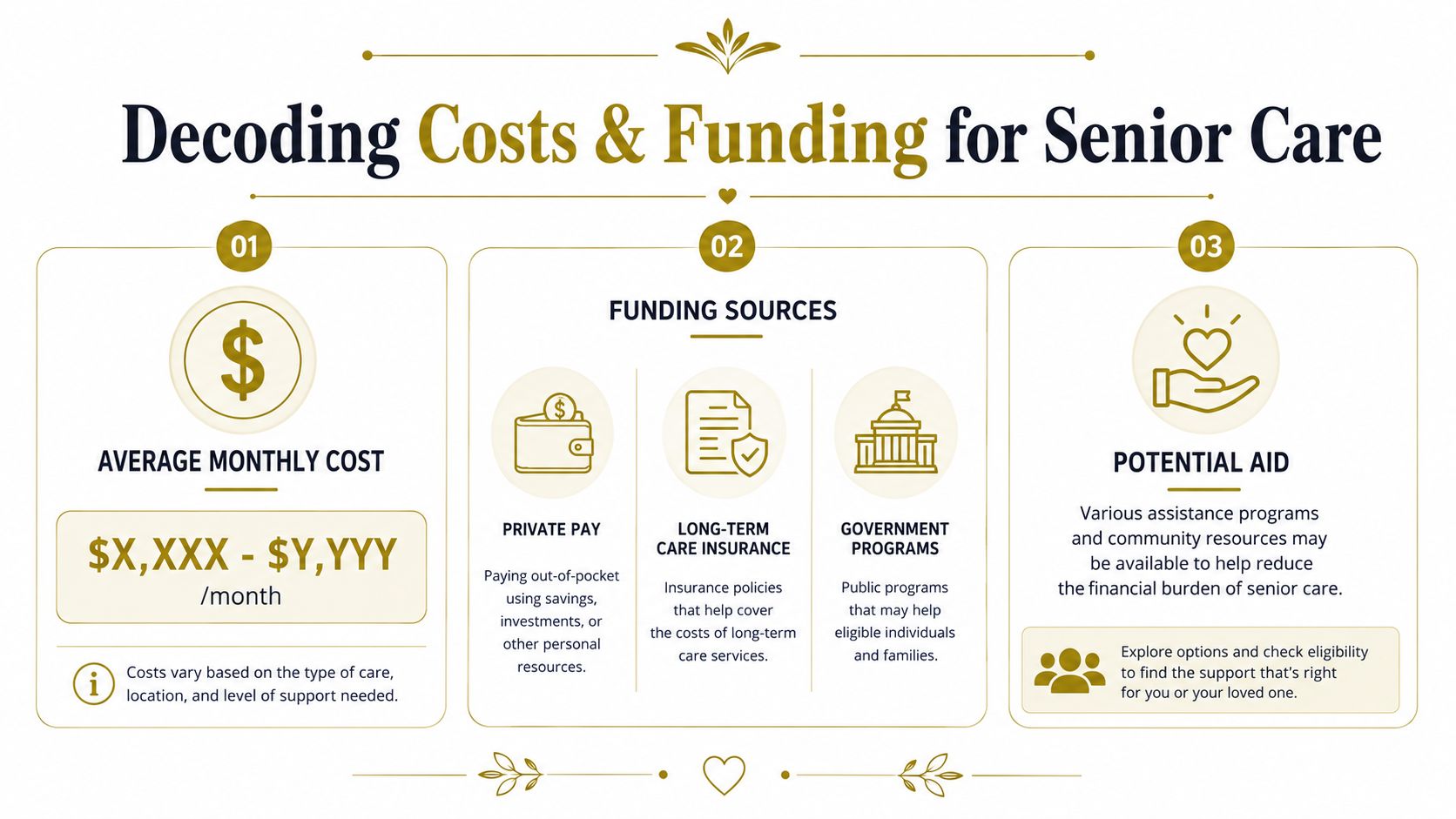
Cost is where many families get stuck. Not because they don't expect senior housing to cost money, but because the pricing structures aren't always easy to compare. One path is private pay. The other is subsidised or rent-geared-to-income housing. Those are very different conversations.
The real difference between private pay and subsidised options
In Mission, new affordable senior housing includes rent-geared-to-income rates from $375 per month for a studio to $710 per month for a two-bedroom, while market-rate assisted living in the Fraser Valley often exceeds $2,500 per month, according to BC Housing's update on affordable homes under construction for seniors in Mission.
That gap changes the entire planning process. A family selling a longtime home may have flexibility in the short term, but monthly carrying costs still matter. If one parent is moving alone after a spouse passes away, preserving cash flow can be just as important as accessing sale proceeds.
A practical way to budget
Families usually do better when they stop asking “What does senior living cost?” and start asking “Which category are we pursuing?”
| Financial path | What it usually means | Main planning concern |
|---|---|---|
| Private pay | More flexibility in timing and building choice | Ongoing monthly affordability |
| Subsidised or RGI housing | Lower rent tied to program rules or income criteria | Eligibility, intake, and waiting time |
If the senior owns a home, sale proceeds can help. They don't replace the need for a monthly budget that still works a year from now.
Where real estate decisions affect care choices
Downsizing strategy becomes more than a housing exercise. A rushed sale can create pressure to accept the wrong residence. Waiting too long can leave a family carrying the old house while also trying to secure a senior housing placement.
The right sequence depends on the person's health, mobility, and whether the move is immediate or planned. Some families sell first to simplify finances. Others secure the next housing option before listing the home. Neither approach is automatically better. The better option is the one that fits the care timeline.
When you're working through net proceeds, move-related expenses, and sale planning, a BC closing costs calculator helps bring the property side into the same conversation as care costs.
Choosing a Mission Neighbourhood for Your Lifestyle
The residence matters. The location matters almost as much. A good suite in the wrong area can make daily life harder, quieter, and more isolated than it needs to be.
Daily routines matter more than the map
In Mission, I'd tell families to think in terms of errands, appointments, and visits. If regular medical access is part of life, being reasonably close to Mission Memorial Hospital can reduce stress for both seniors and adult children. If the senior still enjoys getting out, proximity to shopping at The Junction and familiar services can help preserve routine and confidence.
For some people, that means staying near central Mission where trips feel simpler. For others, a quieter setting is the better fit, especially if they value slower streets, less noise, and easy family pick-ups for outings.
Lifestyle fit is local, not generic
Broad senior housing guides tend to miss the mark. A senior who loves short walks, local parks, and seeing familiar faces may care more about the feel of the surrounding area than about an extra lounge in the building. Mission has that advantage. Established neighbourhoods, nearby green space, and the Fraser Valley's more grounded pace can still support a meaningful day-to-day routine.
Consider questions like these:
- Visits from family: Is it easy for children or grandchildren to stop by after work or school?
- Neighbourhood rhythm: Does the area feel calm, or does it feel inconvenient and disconnected?
- Practical access: Are shops, appointments, and services manageable without an exhausting drive?
Families comparing smaller-footprint housing before a larger move sometimes benefit from reviewing townhouses for sale in Mission, especially when the senior isn't ready for a care residence but can no longer manage a detached home.
The right neighbourhood supports independence in small ways. Easier visits, shorter errands, and familiar surroundings often matter more than people expect.
Your Checklist for Visiting a Senior Living Facility
A tour can be misleading if you don't know what to watch for. Families often leave remembering the paint colour, the dining room, or whether the suite had a nice window. Those details matter, but they shouldn't decide the move.
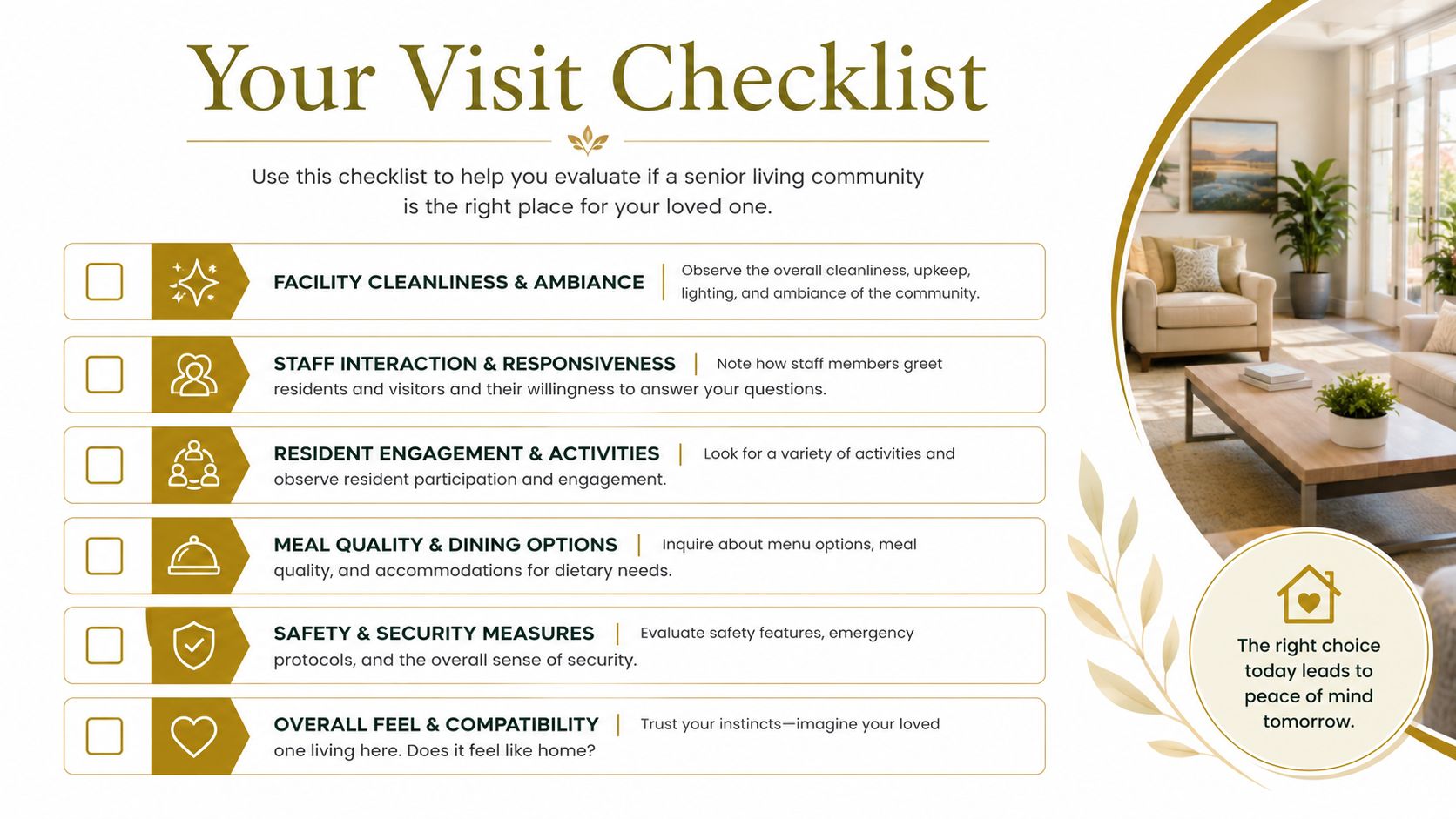
A helpful companion before tours is this guide to compare senior care facilities. It pairs well with local questions you'll want answered in Mission and the surrounding Fraser Valley.
What to observe during the visit
Use the tour to test how the residence feels in real life, not just how it presents itself.
- Cleanliness and upkeep: Look beyond the lobby. Check hallways, dining spaces, washrooms, and corners where neglect usually shows first.
- Resident mood: Do people seem comfortable and engaged, or parked and passive?
- Staff interactions: Watch how staff speak to residents when nobody is “performing” for the tour.
- Noise level: Some activity is healthy. Constant confusion, shouting, or long stretches of silence can tell you a lot.
- Meal setting: If possible, see the dining room during a real meal rather than a staged tour time.
Questions worth asking on the spot
Bring a written list. Families remember more when one person asks and another takes notes.
- How do you handle a resident whose needs increase over time?
- What does a typical day look like here for someone at my parent's care level?
- How are family updates handled if there's a concern?
- What is included in the monthly cost, and what usually costs extra?
- What is the application process and current intake reality?
Don't ask only whether a place is available. Ask whether it will still fit six months from now.
What not to ignore
Trust your reaction if something feels off. A beautiful suite won't compensate for unclear answers, rushed staff, or residents who look disconnected from daily life. The strongest tours leave families with specifics, not just impressions.
Planning Your Downsize A Realtor's Perspective
A smooth move into senior housing usually depends on what happens before the boxes come out. Families often focus on the destination and underestimate the complexity of leaving a home that may have been lived in for decades. Downsizing isn't just a clean-up job. It's a timed real estate project wrapped around a major life change.
Timing the sale properly
The first question is rarely “When should we list?” It's “What has to happen before we can list well?” That can include confirming the next housing option, sorting legal and financial documents, deciding what furniture is moving, and making sure the seller has support for decision-making if the process becomes stressful.
A strong downsizing plan usually includes:
- A realistic calendar: Build around care deadlines, not ideal conditions.
- Room-by-room decisions: Keep, gift, donate, store, or sell. Families get stuck when everything stays in the “decide later” pile.
- Pre-listing preparation: Some homes need only cleaning and small repairs. Others need a more strategic refresh to present properly.
- Clear possession planning: The move-out date should support the senior, not just the market.
Why local building knowledge matters
Working with a realtor who understands nearby senior-oriented housing rules becomes practical, not theoretical. As of March 2025, Maple Ridge requires 100% of units in new senior-oriented housing to be accessible and adaptable, according to the City of Maple Ridge adaptable housing requirements. Even though your move may centre on Mission, regional knowledge matters because many Fraser Valley families compare options across community lines.
That kind of local awareness changes advice. It affects which newer developments are worth watching, which buyers may be interested in the current home, and how to judge future suitability if a senior is moving into a condo, apartment, or age-targeted project rather than a care residence.
Good downsizing advice connects two properties at once. The home being sold, and the home that needs to work for the next stage of life.
What works and what doesn't
What works is starting earlier than feels necessary, keeping decision-makers aligned, and treating the home sale as part of the care transition. What doesn't work is waiting for a hospital event, trying to sort a full estate in one weekend, or listing a house before the family agrees on where the senior is going next.
For families in Maple Ridge weighing their own next step, this guide to downsizing in Maple Ridge and the best home types and areas can help frame the property side of the conversation with more clarity.
If you're preparing to sell a family home, downsize, or coordinate a move tied to senior living in Mission or the wider Fraser Valley, Royal LePage Brookside Realty Property Management offers practical guidance rooted in local market knowledge. Whether you're comparing timing options, pricing a longtime property, or planning a move into a more suitable home in Maple Ridge, it helps to have a calm, experienced team beside you.