
If you're on a strata council in Maple Ridge right now, there's a good chance your evening looks familiar. You're answering emails after work, trying to sort out a repair request from a hallway leak, reviewing minutes from the last meeting, and wondering whether that owner complaint in Cottonwood is a bylaw issue, a neighbour issue, or both.
That workload sneaks up on councils. What starts as volunteer service can turn into bookkeeping, contractor coordination, conflict management, document control, and legal risk, all at once. In a place like Maple Ridge or Pitt Meadows, where building types, neighbourhood expectations, and rental pressure vary from Albion to Silver Valley, the difference between organised management and reactive management shows up quickly in owner satisfaction and long-term property value.
The Challenge of Self-Managed Condos in Maple Ridge
A lot of councils begin with good intentions. A small building near Kanaka Creek or West Maple Ridge may think self-management will keep costs down and give owners more direct control. On paper, that sounds reasonable. In practice, one missed invoice, one poorly documented bylaw issue, or one delayed repair can create more friction than anyone expected.
The usual pattern looks like this. One council member becomes the unofficial operations lead. Another handles banking. Someone else tries to chase unpaid strata fees between school pickups and a full-time job. Then a roof quote comes in, an owner wants records, and a meeting agenda has to go out properly. The work doesn't stay small for long.
Where volunteer effort starts to crack
The hardest part isn't that council members care too little. It's that they often care a lot, but don't have enough time, systems, or distance from the conflicts inside the building.
A self-managed strata usually struggles in a few predictable areas:
- Collections: Following up on late payments is awkward when you're dealing with neighbours.
- Repairs: Urgent issues don't wait for the next council meeting.
- Records: Minutes, notices, contracts, and correspondence need to be stored consistently.
- Bylaw enforcement: Councils can become inconsistent when rules involve friends, long-time owners, or vocal residents.
- Vendor oversight: The cheapest quote often isn't the best quote, especially when a contractor doesn't understand multi-family buildings.
Practical rule: If your council spends most of its time putting out fires, you're not managing the property. The property is managing you.
Professional support isn't just for large towers in big cities. Across Canada, the property management industry, which includes condo management, reached a $10.7 billion market in 2026 according to IBISWorld's Canada property management industry profile. That reflects a clear shift toward using professional help for maintenance, finances, and security because the day-to-day demands have become too complex for volunteer-only oversight.
Why this matters to owners and buyers
Management quality affects more than council workload. It shapes how a building feels to live in and how it's viewed by buyers comparing similar homes in Maple Ridge. Someone browsing condos for sale in Maple Ridge may never meet the manager, but they'll notice the results. Clean common areas, organised records, prompt repairs, and a council that communicates clearly all influence confidence in the property.
That confidence matters. Buyers don't just assess the unit. They assess the building behind it.
What Condo Management Services Actually Cover
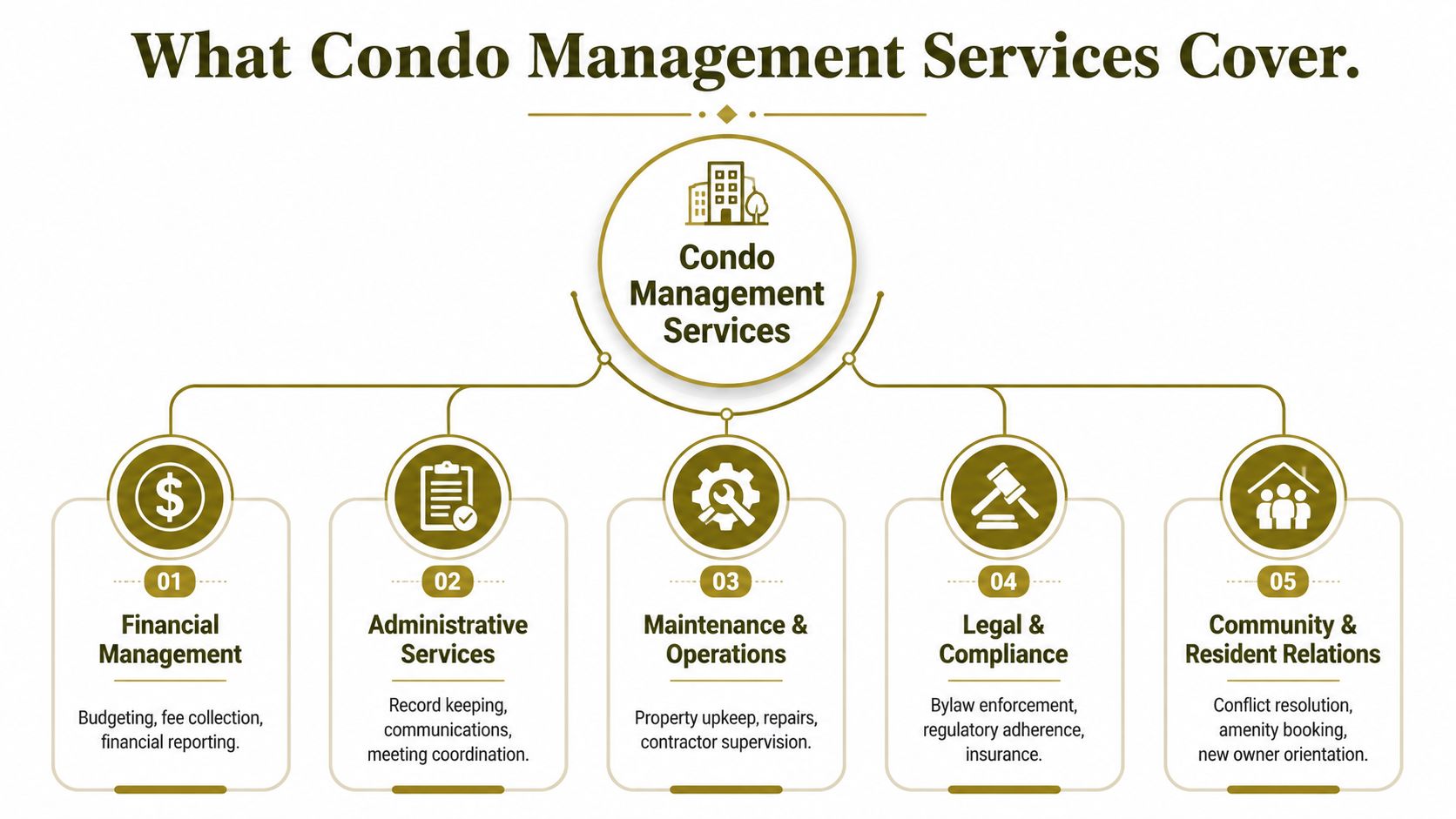
When councils hear "condo management services," they sometimes picture someone collecting strata fees and calling a plumber. Its actual scope is broader. A strong manager works more like a CFO, an operations supervisor, a records administrator, and a community buffer rolled into one.
Financial stewardship
This is the least visible part of management, but it's often where weak systems do the most damage. The manager handles routine collection, tracks expenses, prepares reports, and helps council understand what the numbers are saying before a problem gets expensive.
That includes tasks such as:
- Budget support: Building a realistic operating plan based on actual expenses, not guesswork.
- Fee collection: Following a consistent process so arrears don't become personal disputes.
- Invoice control: Making sure bills are reviewed, coded, approved, and paid on time.
- Reporting: Giving council clear statements that support decisions, not just satisfy filing requirements.
Financial work should help a council make decisions earlier. If landscaping is over budget, if insurance costs are shifting, or if a repair category is trending up, council should know before the annual meeting.
Physical asset management
The building itself needs systems. Hallways, roofs, drainage, elevators, lighting, access controls, and shared mechanical components all age on their own schedule. Good condo management services don't wait for things to fail.
A capable manager should coordinate:
- Routine inspections
- Preventive maintenance calendars
- Emergency response
- Trade scheduling
- Scope review for repair quotes
- Follow-up after work is complete
If your building has experienced water ingress, major damage, or a complex insurance issue, outside specialists can help council and management sort through the process. In those situations, expert assistance for condo claims can be a useful reference because insurance work often involves documentation, access coordination, and contractor sequencing that go beyond a standard repair call.
A manager shouldn't be judged only by how they respond to emergencies. Judge them by how many avoidable emergencies never happen under their watch.
Administrative governance
Many volunteer councils underestimate the workload inherent in the BC strata environment, which runs on records, notice requirements, meeting procedures, owner communication, and consistent bylaw administration.
A management company typically supports:
| Area | What competent support looks like |
|---|---|
| Meeting preparation | Agendas, notice packages, document circulation, minute support |
| Records management | Organised storage of bylaws, correspondence, contracts, reports, and minutes |
| Owner communication | Clear, neutral responses that reduce confusion and conflict |
| Rule enforcement | Consistent process instead of selective enforcement |
| Compliance support | Helping council follow governing documents and legal obligations |
The best managers also know where their role ends. They don't replace council. They support council so elected volunteers can make informed decisions without having to run every detail themselves. For a fuller look at the operational side of the role, this overview of property manager responsibilities in Maple Ridge is worth reviewing.
Professional Management Versus Self-Management
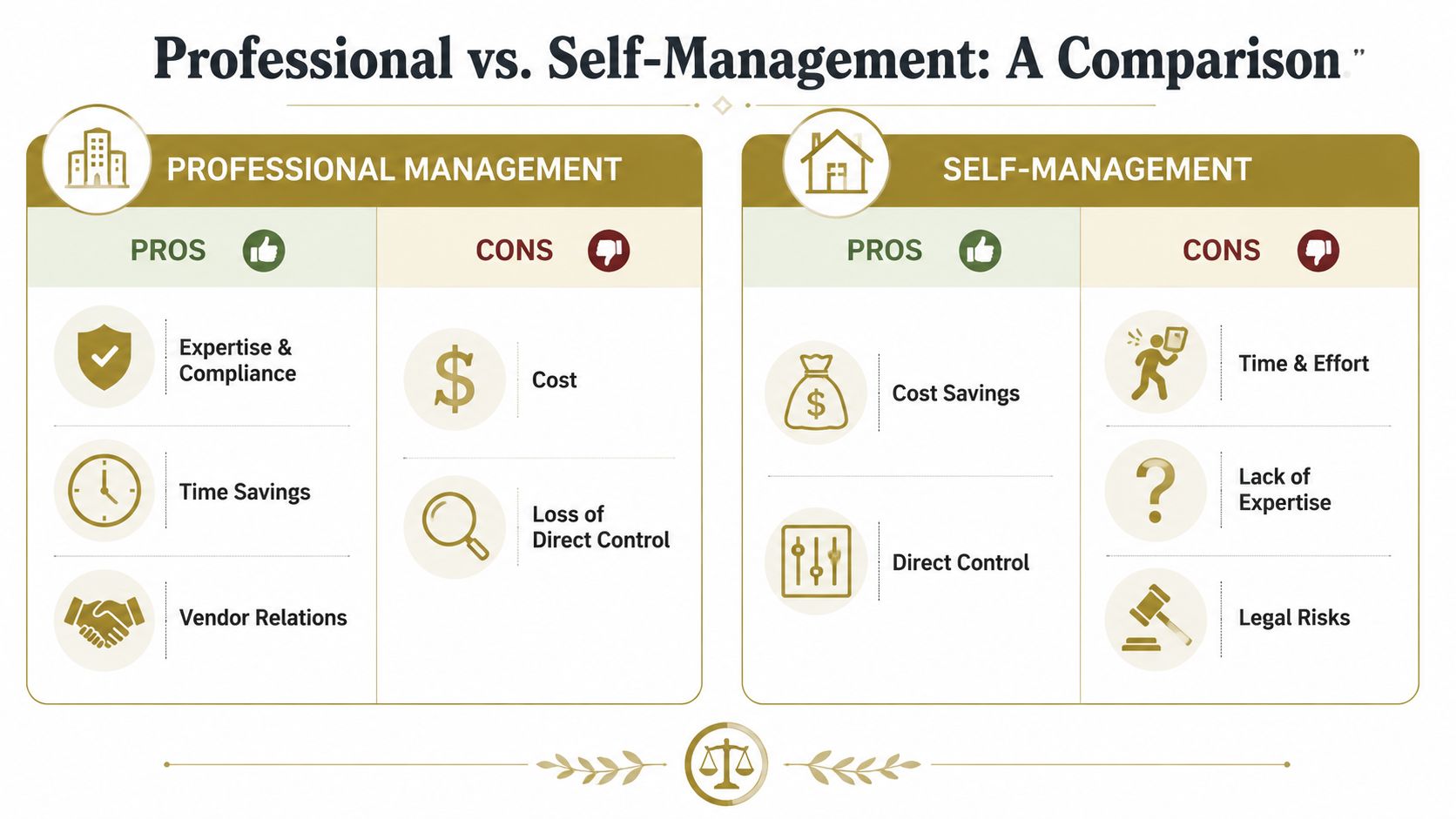
Councils often frame this as a simple cost question. It isn't. The actual comparison is between direct savings on one side, and time, consistency, liability exposure, and decision quality on the other.
Where self-management can work
Self-management can fit a very small, stable strata with owners who know each other well, have relevant experience, and are willing to commit time year-round. In that setting, council may appreciate the direct control and the ability to make quick decisions without going through a third party.
But that arrangement tends to work only when several conditions line up at once:
- The building is simple: Few amenities, limited contractor coordination, and low administrative volume.
- The council is steady: Turnover is low and responsibilities don't land on one person.
- Owners are cooperative: Routine issues don't become prolonged disputes.
- Records are already organised: You're not inheriting years of missing documents or loose processes.
The problem is that many councils assume they'll stay in that best-case scenario. Buildings rarely do.
Where professional management earns its keep
Professional management adds a layer of structure that self-managed stratas often can't maintain for long. The biggest difference isn't just convenience. It's consistency under pressure.
Consider a rainy winter week in West Maple Ridge. A parkade drain backs up, one owner wants immediate answers, another questions the contractor quote, and council has to issue notices for an upcoming meeting. In a self-managed building, that may all land on one volunteer. In a professionally managed building, there should already be a system for work orders, communication, vendor contact, and documentation.
This short comparison helps clarify the trade-off:
| Approach | Main advantage | Main strain point |
|---|---|---|
| Self-management | Lower direct cash outlay | Heavy volunteer workload and uneven execution |
| Professional management | Expertise, systems, vendor coordination | Ongoing management fees and less day-to-day direct control |
A lot also depends on how your council wants to spend its energy. Some councils want to act as operators. Others want to act as decision-makers. Those are very different jobs.
The video below gives a useful overview of that difference in practice.
The hidden cost most councils miss
Burnout changes building culture. When one or two volunteers carry everything, response times slip, resentment builds, and owners start to feel that rules depend on who complains the loudest.
Self-management often saves money right up until the month it doesn't.
That's why many councils eventually revisit the decision after a major repair, an owner conflict, or a records issue during a sale. If your council is weighing that choice now, this local comparison of self-managing vs hiring property management in Maple Ridge helps frame it in practical terms.
Decoding Service Models and Fee Structures
Not every management contract covers the same work. That's where councils get tripped up. One proposal may look cheaper until you realise meeting attendance, after-hours calls, vendor tendering, or owner communications are billed separately.
In Maple Ridge, property management fees commonly follow a percentage model of 8–10% of monthly rent or a flat-fee model of $150–$250/month, with important differences in whether services like tenant placement are included or billed separately, as outlined in this Maple Ridge property management fee guide. While condo and strata management contracts are structured differently from single-unit rental management, that local pricing framework is still useful because it shows how service scope changes what a fee means.
The main service models councils will see
Some firms offer broad operational support. Others focus on a narrower slice of the work. Councils need to compare scope before comparing price.
- Full-service management: Best for councils that want one main point of contact for operations, administration, and contractor coordination.
- Financial-only support: Useful when council is comfortable overseeing the property itself but wants help with bookkeeping, statements, and collections.
- Consulting or as-needed management: A fit for experienced self-managed councils that need guidance on specific problems rather than day-to-day administration.
Common Condo Management Fee Structures in Maple Ridge
| Fee Model | Typical Cost (Maple Ridge) | Best For | What's Often Included |
|---|---|---|---|
| Percentage model | 8–10% of monthly rent | Rental-focused management relationships | Ongoing administration, routine coordination, sometimes limited reporting |
| Flat-fee model | $150–$250/month | Owners or councils who want predictable monthly billing | Core management tasks, with some services billed separately |
| Custom strata contract | Varies by scope | Condos needing tailored support | Depends heavily on meeting load, building complexity, and after-hours expectations |
For strata councils, the lesson isn't that one model is better. It's that line items matter more than labels. "Full service" can still exclude project management, extra meetings, move-in administration, or major claim coordination.
What to ask before comparing proposals
Use this quick filter when reviewing management quotes:
- Ask what's excluded: Extra billings often hide in meeting attendance, document packages, and project supervision.
- Check turnover charges: If ownership changes or renters move often, admin costs can add up.
- Review maintenance handling: Clarify whether the manager marks up contractor invoices or charges separately for oversight.
- Look at major equipment realities: If your building has an elevator, reserve planning should reflect that. A practical reference point is Crane Elevator Company's cost guide, not because it sets your strata's budget, but because it reminds councils how easily specialised building systems can change the maintenance picture.
Councils also benefit from reviewing local expectations before signing anything. This breakdown of property management fees in Maple Ridge and what landlords should expect helps sharpen that lens.
How to Hire the Right Manager in Maple Ridge
The right manager for a Maple Ridge strata isn't just someone with a polished proposal. You want a company that understands how local buildings behave, how owners communicate, and how neighbourhood context changes daily operations.

A manager serving an older building closer to the town centre deals with a different reality than one supporting newer development patterns near Silver Valley. Trade access, response times, parking pressures, owner demographics, and repair priorities aren't identical. Councils should hire accordingly.
Start with local proof, not broad promises
Look for signs that a company is active in Maple Ridge and Pitt Meadows, not just "serving the Lower Mainland" in a generic sense.
Strong indicators include:
- Neighbourhood familiarity: They can speak specifically about Albion, Cottonwood, Silver Valley, Hammond, and West Maple Ridge without sounding vague.
- Building-type experience: They understand the difference between wood-frame condo issues, townhouse strata operations, and mixed-use complications.
- Trade relationships nearby: They already know which local vendors are reliable for plumbing, roofing, restoration, and routine maintenance.
- Board communication discipline: Their process for notices, minutes, and owner correspondence is clear from the start.
A top local benchmark is operational performance. In the Fraser Valley, some established firms report a 99.2% rent collection rate, a 7-point tenant screening process, and 24/7 maintenance availability, according to Brookside's property management overview. Even if your strata isn't evaluating rental management specifically, those standards tell you what disciplined systems look like.
Interview for judgement, not just availability
A manager doesn't need to have every answer on the spot. They do need to think clearly, communicate directly, and show how they'd respond in your building.
Ask situational questions tied to Maple Ridge realities:
- Silver Valley access: How do you handle maintenance dispatch when a property sits farther from major service hubs?
- Albion rental pressure: How do you manage occupancy screening and bylaw enforcement in higher-demand rental pockets?
- Older central buildings: What preventive issues do you watch for first in aging wood-frame complexes?
- Rain-heavy months: How do you document, prioritise, and communicate building-envelope concerns when multiple owners report problems at once?
Hire the manager who gives you a process, not the one who gives you the smoothest reassurance.
Watch how they handle the small things
The hiring process itself tells you a lot. Did they send documents when promised? Was the proposal readable? Did they explain service limits without being pushed? If they're disorganised while trying to win your business, that pattern usually doesn't improve once they're hired.
A good manager should make your council feel calmer after the interview, not more confused.
Essential Questions for Your Potential Manager
Most strata interviews stay too general. Councils ask how long the company has been in business, whether they "offer full service," and how many properties they manage. Those questions aren't useless, but they don't tell you how the relationship will work when an owner dispute, a leak, or a contract issue lands on a Friday afternoon.
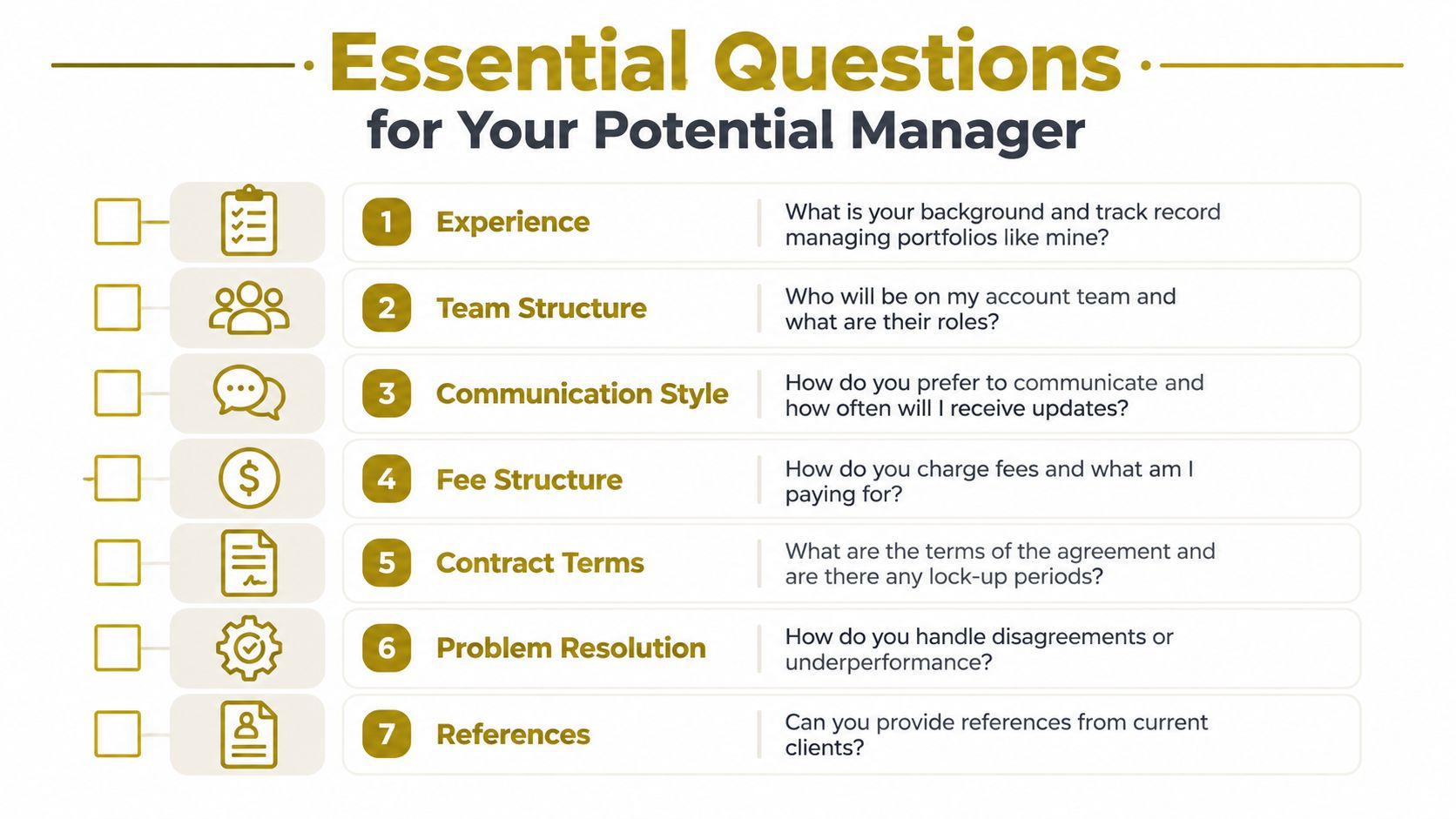
Questions that reveal how they operate
Use questions that make the manager describe process, escalation, and accountability.
- Communication and access: Who answers owner inquiries, and what happens when the assigned manager is away?
- Team structure: Is there admin support behind the manager, or does everything rely on one person?
- Financial reporting: Can they show a sample board package with statements, arrears tracking, and invoice handling?
- Meeting support: Who prepares agendas and minutes, and how are action items tracked afterwards?
- Maintenance control: How are contractors selected, supervised, and approved for non-emergency work?
The answer matters less than the clarity. If a company responds in loose sales language, expect loose execution.
Questions about risk and contractors
One of the easiest ways a strata gets exposed is through sloppy vendor oversight. Councils should ask whether trades are insured, whether documentation is checked before work begins, and whether the management company receives any referral benefit from sending repeat work to certain suppliers.
If your council wants a quick primer on the difference, this explanation of bonded vs insured is useful because many owners hear those words and assume they mean the same thing. They don't.
"Show us the paperwork" is a better question than "Do you use good contractors?"
Contract terms that deserve scrutiny
Before signing, review the service agreement with the same care you'd apply to a repair contract. Pay special attention to:
| Contract item | What to check |
|---|---|
| Scope of services | What the manager handles routinely, and what triggers extra charges |
| Termination clause | Notice period, penalties, file transfer process |
| After-hours handling | What counts as an emergency and how billing works |
| Meeting attendance | How many meetings are included each year |
| Project work | Whether major repairs or claims are billed separately |
Councils don't need the cheapest contract. They need a contract that leaves fewer surprises once the first hard issue arrives.
Navigating BC Law and Local Maple Ridge Rules
A competent condo manager in BC isn't just coordinating repairs and answering emails. They're helping council operate inside a legal framework that requires consistency, documentation, and procedural discipline.
That matters because strata problems are rarely just operational. A noise complaint can become a hearing issue. A repair delay can become an insurance issue. Poor records can become a problem when a seller, buyer, or lawyer asks for documents during a transaction. This is why management quality affects real estate value in practical terms, not just cosmetic terms.
BC compliance is part of the job
Your manager should understand how to support council under the BC Strata Property Act, the bylaws, and the rules your building has adopted. That doesn't mean they replace legal counsel. It means they help council avoid preventable mistakes in notice, record keeping, process, and enforcement.
For buyers and sellers who are newer to this world, a plain-language explanation of what a strata property is helps connect the legal structure to daily ownership reality.
Local Maple Ridge rules change how screening works
Maple Ridge has had a local wrinkle since 2018, when the city enforced specific rental regulations aimed at limiting short-term rentals. As noted in this local reference on Maple Ridge rental regulations, a manager needs to verify tenant compliance with city bylaws, especially in higher-demand areas such as Albion and Silver Valley.
That local knowledge matters more than many councils realise.
A manager who doesn't understand Maple Ridge's rental environment may approve occupancy arrangements that create bylaw conflicts later. A manager who does understand it will ask sharper questions during screening, review tenancy intent more carefully, and flag problems before council inherits them.
Good management protects saleability
When buyers compare condos near schools, parks, and commuter routes, they aren't just looking at square footage or finishings. They're also measuring how the building is run. In Maple Ridge, that affects appeal for first-time buyers, downsizers, and investors alike, whether the property sits near Samuel Robertson Technical Secondary, close to Albion Fairgrounds Park, or in a quieter pocket nearer Pitt Meadows.
Good condo management services support a cleaner paper trail, steadier operations, and fewer ugly surprises during due diligence. That's what helps preserve confidence in the building, and confidence is part of value.
If you're buying or selling a condo in Maple Ridge or Pitt Meadows, the quality of its management tells you a lot about the property's real condition and long-term appeal. Royal LePage Brookside Realty Property Management can help you look beyond the listing photos and understand the local factors that shape condo value, from neighbourhood dynamics to strata operations.