Owning a rental in Maple Ridge often starts with a sensible plan. You keep the Albion family home after a move, or you buy a condo near the town centre and expect the rent to cover the carrying costs while the property grows in value.
Then the substantive work begins. A tenant pays late. A strata complaint lands in your inbox. A plumbing issue shows up on a Sunday. You realise quickly that property management maple ridge bc isn't a generic admin task. It's a mix of pricing discipline, legal compliance, maintenance judgement, and neighbourhood knowledge.
That matters more here than many owners expect. A detached home in Silver Valley attracts a different tenant profile than a condo closer to downtown or a townhome in Cottonwood. The wrong rent, weak screening, or slow response to a tenancy issue can turn a good investment into a draining one.
At Royal LePage Brookside Realty, that’s the practical side of the conversation we have with landlords every week. Not just “can this property rent,” but “who is the right tenant, what risks come with this asset, and how do you protect value over time?”
Investing in Peace of Mind Your Introduction to Maple Ridge Property Management
A lot of landlords in Maple Ridge didn’t set out to become full-time landlords. They inherited a property, relocated for work, or decided not to sell during a market transition. On paper, renting it out looks straightforward. In practice, the gap between self-managing and managing well is wide.
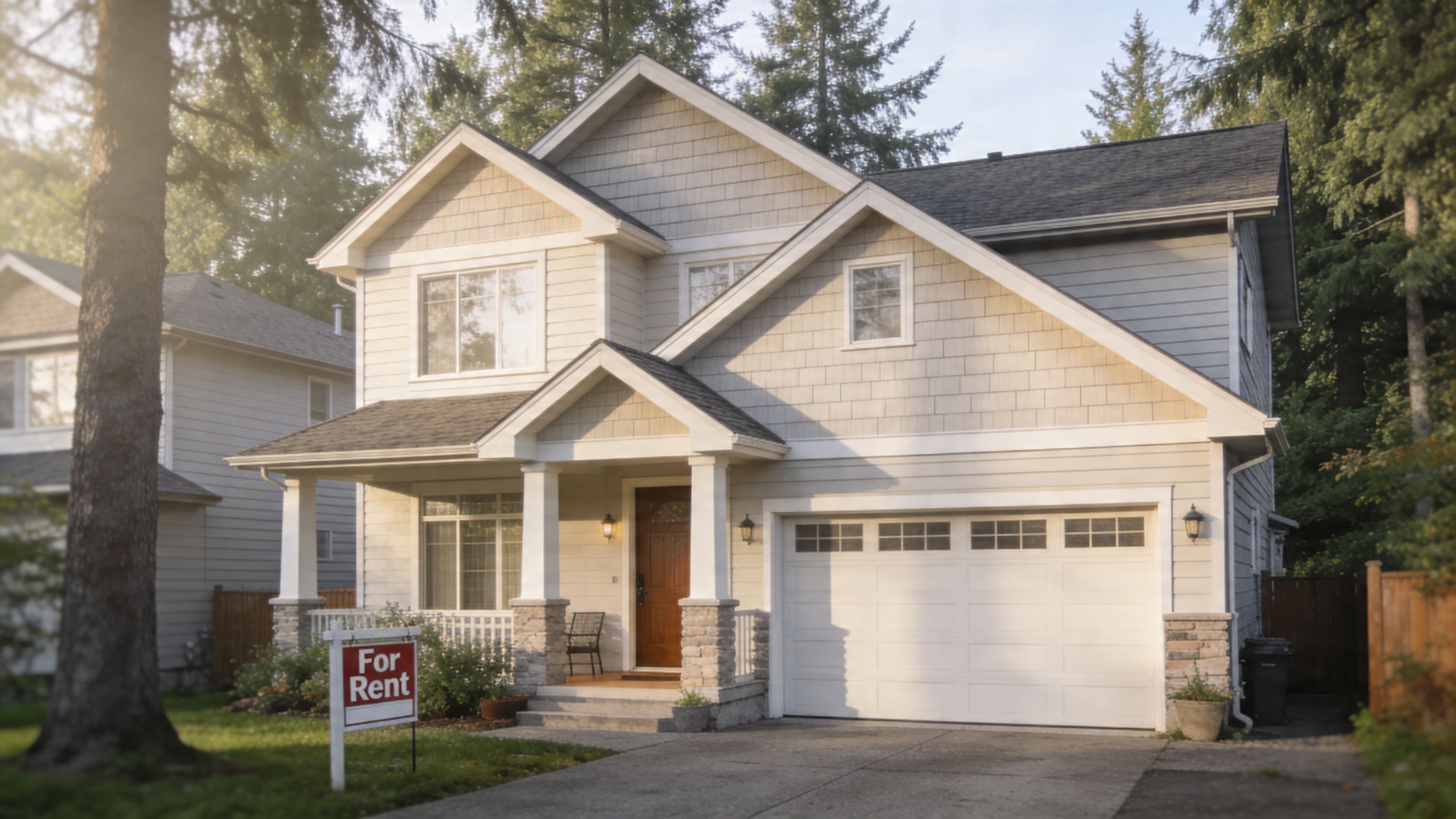
A landlord with a house in Albion usually worries about different things than an owner with a townhome near West Maple Ridge. The Albion owner often needs stable family tenants who will treat the yard and the home properly. The West Maple Ridge owner may care more about fast leasing, commuter appeal, and keeping turnover controlled because access to major routes shapes demand. If you own in that part of town, it helps to understand the local tenant profile in West Maple Ridge rentals.
The stress usually isn’t the big dramatic event. It’s the steady drip of decisions that can’t be ignored. How do you screen without violating BC rules? When is a repair urgent and when is it routine? What do you document at move-in so you’re protected at move-out?
Good management doesn’t remove every problem. It prevents small problems from becoming expensive ones.
That’s why many owners stop seeing management as a monthly expense and start seeing it as risk control. In the broader property management industry, the most useful systems are the ones that reduce friction before a dispute starts. In Maple Ridge, that means clear processes, local vendor coordination, and someone who understands how neighbourhood fit affects leasing success.
Peace of mind is the product most landlords are really buying. Not because they want distance from the property, but because they want confidence that the property is being handled properly while they get on with work, family, or the next investment decision.
The Core Responsibilities of a Property Manager in BC
The job sounds simple until BC tenancy law gets involved. A property manager isn’t just collecting rent and calling trades. Value comes from handling the parts of ownership where legal mistakes, poor documentation, or weak systems cost money.
Screening tenants properly
Most landlord trouble starts before the lease is signed. A rushed placement can look fine on day one and turn into repeated late payments, poor communication, or property damage a few months later.
In Maple Ridge, screening has to be thorough and consistent. That usually means reviewing credit, confirming income, checking landlord references, and making sure the applicant fits the property itself. A family home in Kanaka Creek needs a different screening conversation than a smaller apartment near central amenities.
A strong screening process should answer questions like these:
- Can the applicant comfortably carry the rent: Income verification matters because “good intentions” don’t pay monthly rent.
- Does the file show a pattern: One isolated issue is different from repeated payment or tenancy problems.
- Is the fit realistic for the home: Occupancy, lifestyle, and expectations should line up with the property and the neighbourhood.
Some firms also provide structured owner education and document support through practical landlord resources, which can help owners understand what should happen before keys are ever handed over.
Protecting cash flow through systems
Rent collection is one of those tasks that seems easy when payments arrive on time. It becomes very different when reminders, excuses, and legal timelines start piling up.
According to Brookside Realty’s Maple Ridge and Pitt Meadows property management overview, professional property managers in Maple Ridge use automated rent collection systems that reduce delinquency rates by up to 30%, which matters because an RTB eviction for non-payment can take 4 to 6 weeks and cost $1,500 to $3,000 in associated fees.
That trade-off is one of the clearest in residential management. Owners sometimes try to save on management fees by collecting rent manually, then lose far more in arrears, delay, and process errors once a tenancy goes sideways.
Practical rule: If your rent collection system depends on follow-up texts, exceptions, and verbal promises, it isn’t a system.
Handling the BC Residential Tenancy Act correctly
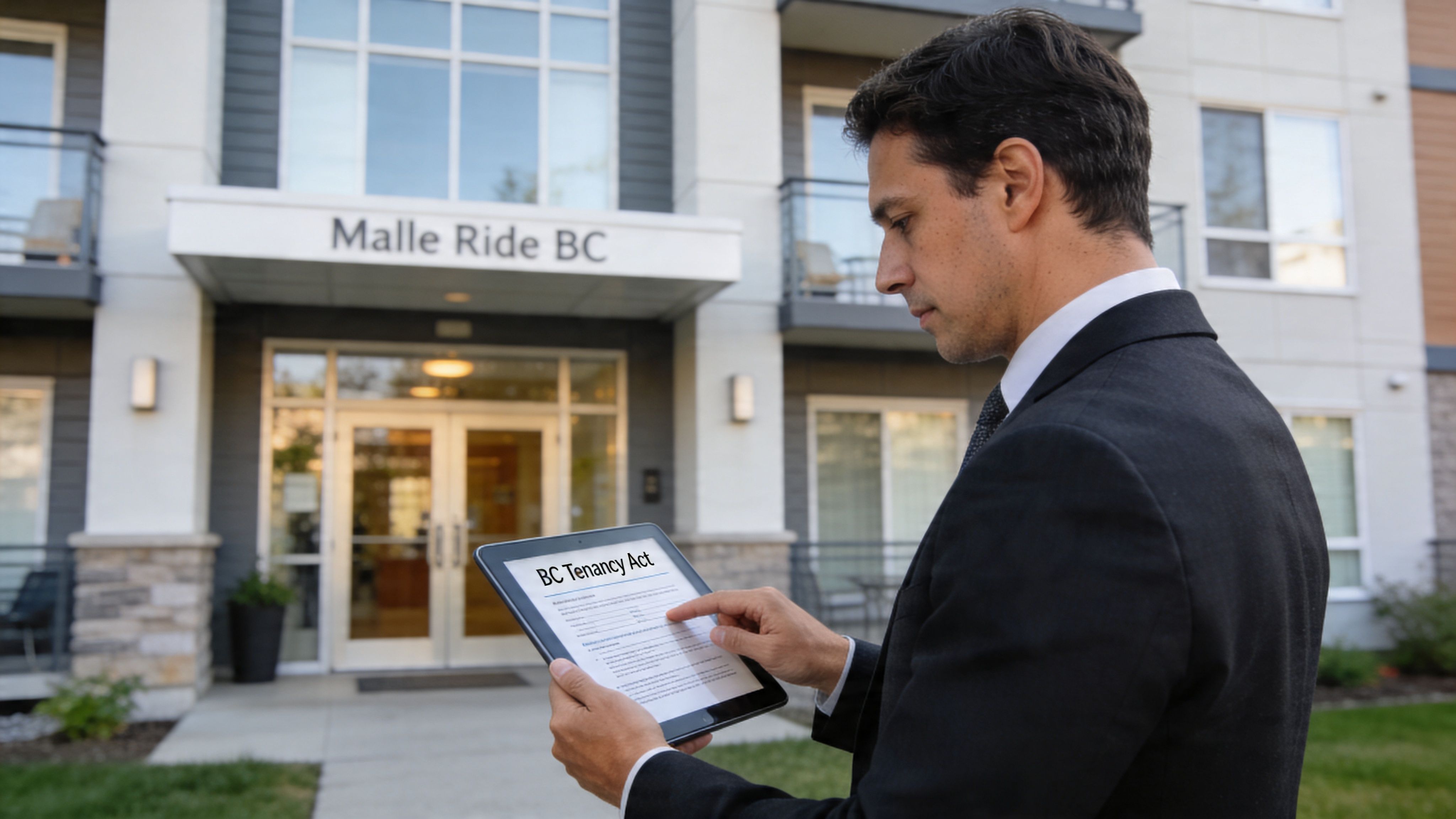
The BC Residential Tenancy Act shapes nearly every decision a landlord makes. Lease wording, notices, inspections, deposits, and dispute handling all need to line up with the rules. A manager’s role is to make sure the owner’s intentions are carried out in a legally usable way.
That includes day-to-day work such as:
- Preparing compliant paperwork so the tenancy starts on proper terms.
- Recording inspections carefully so move-in and move-out disputes have evidence behind them.
- Responding to breaches in writing rather than relying on casual phone calls.
- Managing formal notice periods properly when a tenancy issue escalates.
What doesn’t work is improvising. Owners often know what outcome they want, but the RTB cares just as much about process as outcome. If the documentation is sloppy or the notice is wrong, the landlord can end up back at the beginning.
Coordinating repairs without losing control
Maintenance is another area where “good enough” management usually fails. In Maple Ridge, detached homes, townhomes, and strata units all create different maintenance demands. Wet seasons expose drainage, roofing, and moisture issues fast. A property manager has to know which calls need immediate action, which need quotes first, and which need owner approval before any work starts.
Good maintenance coordination isn’t just speed. It’s triage, communication, and records. Owners should know what was reported, what was done, and whether the issue points to a bigger pattern in the property.
Understanding Property Management Fees A Maple Ridge Breakdown
Most landlords ask the wrong question first. They ask, “What do you charge?” before they ask, “What exactly am I paying to avoid?”
That distinction matters. A management fee isn’t just a line item. It’s tied to vacancy control, tenant quality, compliance, admin time, and how much involvement you still want after signing the agreement.
The three fee models owners usually see
The first common structure is the percentage model. This is tied to monthly rent, so the fee rises or falls with the income the property generates. It often suits owners who want the manager’s incentives tied to leasing and collection.
The second is the flat-fee model. This gives predictable monthly cost and can work for owners who value consistency more than alignment with rent level. It can also make sense for lower-touch properties with fewer moving parts.
Then there’s the à la carte approach, where leasing, inspections, repair coordination, or tribunal-related admin may be billed separately. That model can look cheaper upfront and become expensive if the property has turnover, deferred maintenance, or repeated tenant issues.
| Service | Percentage Model (e.g., 8-10% of monthly rent) | Flat-Fee Model (e.g., $150-$250/month) | What to Watch For |
|---|---|---|---|
| Monthly management | Usually included as a share of collected rent | Usually fixed regardless of rent level | Check what “management” actually covers |
| Rent collection | Often included | Often included | Confirm arrears follow-up process |
| Tenant communication | Usually included | Usually included | Ask about after-hours handling |
| Tenant placement | May be separate | May be separate | Clarify leasing-only charges |
| Inspections | Sometimes limited | Sometimes limited | Ask how many are included |
| Maintenance coordination | Often included with markup policies | Often included with limits | Review approval thresholds carefully |
| Tribunal or dispute admin | Commonly extra | Commonly extra | Make sure extra fees are disclosed in writing |
What to compare beyond the monthly fee
A lower headline fee can hide expensive gaps. Some agreements charge extra for every inspection, every maintenance dispatch, or every lease renewal. Others are broad on “included services” but vague on response times and reporting.
When owners compare proposals, these are the key pressure points:
- Leasing terms: Is tenant placement included, or billed separately each time the property turns over?
- Maintenance authority: How much can the manager approve without calling you first?
- Reporting quality: Do you get clear monthly statements, or only basic bookkeeping?
- Repair markups: Is there any additional charge on contractor invoices?
- Exit terms: How easy is it to leave the agreement if the fit isn’t right?
If you own a property and are also weighing hold-versus-sell options, a current home evaluation in Maple Ridge can be useful because fee decisions make more sense when you know the property’s broader market position.
Why borrowing commercial thinking can help
Residential landlords can still learn from how commercial owners review service contracts. This guide to commercial property management fees is useful because it trains you to look past the percentage itself and ask what tasks, risks, and reporting obligations are really bundled into the agreement.
Cheap management is often expensive management with the invoice delayed.
In Maple Ridge, the right fee structure depends on the property, your time, and your risk tolerance. A detached rental with yard care, family tenants, and more maintenance exposure calls for a different approach than a simple strata condo with stable tenancy and predictable systems.
Maple Ridge Rental Market Insights for Landlords
Maple Ridge only looks like one rental market from a distance. On the ground, it behaves like several smaller ones. That’s why pricing a property properly here takes more than checking a few active listings and splitting the difference.
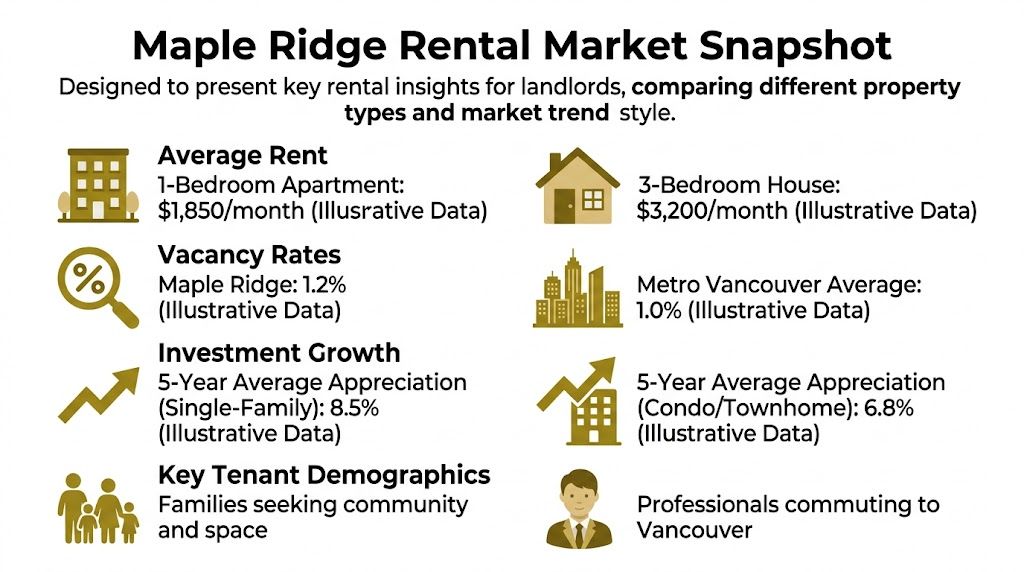
According to Zillow’s Maple Ridge rental market trends, the average rent in Maple Ridge is about $2,050 per month, which is a 14% premium over the national average, and house rents range from $980 to $4,300. That spread tells you something important right away. Broad averages don’t price individual properties well in this city.
Why neighbourhood fit changes leasing strategy
Silver Valley and Albion are often grouped together by out-of-area owners, but they don’t perform the same way. Silver Valley homes often appeal to tenants who want newer houses, extra space, and quick access to trails and the outdoor lifestyle that draws families eastward. Those tenants usually care about layout, storage, parking, and whether the home feels move-in ready without compromise.
Albion has broader variety. Some parts feel more entry-level from a rental perspective, which can widen the pool but also requires sharper pricing discipline. If an owner overprices in a more price-sensitive pocket, showings slow down quickly.
Cottonwood sits in a different lane. Townhomes there often attract families and professionals who want practical space without taking on a detached-home rent. For many landlords, that means lower maintenance exposure than a full house, but still a tenant base that expects convenience, clean presentation, and responsive management.
The commuter effect in West Maple Ridge
West Maple Ridge has long held appeal for renters who need access out of town. Proximity to commuter routes matters, but so does day-to-day convenience. Tenants often look at the whole package: shopping, schools, parks, and whether getting to work feels manageable during a normal week.
That affects leasing strategy in two ways:
- Speed matters more: Commuter-oriented renters often compare Maple Ridge against other Fraser Valley options at the same time.
- Condition matters differently: They may accept less yard space than a farther-east tenant, but they usually won’t accept poor maintenance or an awkward turnover presentation.
Owners who miss that distinction often make the same mistake. They price by square footage alone, when tenant demand is really being shaped by lifestyle friction.
Property type matters as much as postal code
A detached home, a townhome, and a condo in Maple Ridge should not be managed the same way. The tenant profile, the wear patterns, and the likely maintenance calls are different.
Here’s a practical way to consider it:
- Detached homes: Best when the manager screens for household stability, outdoor upkeep expectations, and realistic occupancy fit.
- Townhomes: Strong option for tenants who want family-friendly space with less detached-home responsibility. Strata rules need to be managed carefully.
- Condos and apartments: Leasing often moves on presentation, convenience, and clean systems. Small issues such as delayed maintenance updates can affect retention faster.
A rent price that looks slightly high on paper can still work if the property is clearly better positioned than its immediate competition. A weakly presented home at the same number usually sits.
Reading market conditions without overreacting
The local market has enough range that landlords can talk themselves into bad decisions. Some hold out for a peak rent that only applies to a better-finished home in a different pocket of town. Others underprice because they’re nervous about vacancy and end up locking in avoidable underperformance.
What works is disciplined local comparison. Look at true substitutes. A house in Silver Valley should be measured against similar family-oriented homes, not against older stock with a different tenant draw. A townhome in Cottonwood should be assessed against comparable layouts, strata quality, parking, and school access.
For ongoing perspective, local owners often benefit from following a Maple Ridge property management blog that tracks practical issues affecting leasing, maintenance, and rental strategy in the Fraser Valley.
The strategic takeaway for investors
A Maple Ridge rental performs best when pricing, marketing, and management all match the property’s actual niche. A premium home that gets bargain-basement screening is a mismatch. An affordable rental with luxury-level asking rent is another one.
That’s the local trade-off landlords need to understand. Property management maple ridge bc works best when it’s built around the micro-market, not just the city name on the lease.
How to Hire the Right Property Manager in Maple Ridge
Hiring a manager is less like hiring a contractor and more like choosing an operating partner. They’ll touch your income, your legal exposure, and your property condition. If the fit is wrong, you won’t feel it all at once. You’ll feel it through delays, vague answers, and small issues that keep getting bigger.

Start with local evidence, not brand language
A polished website doesn’t tell you much. You want proof that the manager understands the kind of property you own and the part of Maple Ridge where it sits.
If you own a strata unit, ask how they handle bylaws, notices, and communication with councils. If you own a detached rental in a family area, ask how they assess tenant fit for homes with yards, garages, and heavier wear exposure.
Reviews can help, but read them for specifics. Generic praise is less useful than comments about communication, maintenance handling, and problem-solving. This is also where owner feedback and published client testimonials from Brookside Property Management can be useful as one piece of your research, alongside interviews and agreement review.
Ask questions that reveal process
Most managers can answer “yes” to broad questions. Ask questions that force them to explain how they work.
Use prompts like these in the interview:
- Pricing question: How would you set rent for my specific property in Kanaka Creek, Cottonwood, or Silver Valley, and what competing listings would you compare it to?
- Screening question: What documents do you require before approving a tenant, and what would make you decline an otherwise interested applicant?
- Maintenance question: Who takes after-hours calls, and how do you decide whether a repair is urgent, deferred, or owner-approved first?
- Communication question: How often will I hear from you if nothing is wrong?
- Dispute question: How do you document tenant issues before they become formal legal problems?
Good answers are concrete. Weak answers are full of reassurances and very little method.
Test their maintenance thinking
Maintenance is where many owners learn whether a manager is careful or careless. In Maple Ridge, weather exposure matters. Water entry, roof wear, drainage problems, and building-envelope issues don’t wait for convenient timing.
According to VADA Property Management’s Maple Ridge multi-family management overview, specific preventive maintenance protocols in multi-family buildings can cut operational costs by 15 to 20%, and neglected issues can turn into $10,000+ emergencies. Even if you own a smaller residential asset, the principle still holds. Managers who think preventively usually protect owners better than managers who only react to complaints.
The right manager talks about maintenance in terms of inspection, triage, and documentation. The wrong one talks about maintenance only after something breaks.
Ask for examples of how they handle seasonal checks, vendor follow-up, and photo documentation. If they can’t explain their process clearly, you should assume the process is loose.
Review the agreement like an owner, not a hopeful client
A management agreement should answer uncomfortable questions before they become live issues. Read it slowly.
Focus on these points:
- Authority limits for repairs and emergency work.
- Termination terms if the relationship doesn’t work.
- Extra fees for leasing, inspections, renewals, or dispute handling.
- Reporting obligations so you know what you’ll receive and when.
- Fund handling and payment timelines.
One practical note. Some firms, including Royal LePage Brookside Realty Property Management, offer leasing, screening, rent collection, maintenance coordination, and owner reporting under one service line. That can be efficient if you want one point of accountability, but you still need to compare process quality, not just service labels.
Trust clarity over chemistry
You should absolutely choose someone you communicate well with. But trust should come from clarity, not charm. The manager who explains trade-offs clearly is usually more useful than the one who promises that everything will be easy.
A strong interview often includes a few answers you don’t love. Maybe they won’t overprice your home. Maybe they insist on more documentation than you expected. That’s often a good sign.
The Royal LePage Brookside Realty Advantage
The strongest property management relationships in Maple Ridge are built on local judgement, not generic templates. That means knowing when a Silver Valley home should be positioned as a premium family rental, when a Cottonwood townhome needs sharper pricing to lease quickly, and when a strata issue needs careful handling before it turns into a larger dispute.
That’s where a full-service local brokerage has a practical edge. Property management doesn’t exist in a vacuum. Owners also need to understand resale timing, neighbourhood shifts, and whether holding the property still makes sense compared with selling. A management team connected to active real estate work can look at the asset from both angles.
Why that matters to owners
Many landlords in Maple Ridge are accidental landlords, temporary landlords, or investors deciding what comes next. They aren’t only asking how to collect rent. They’re asking larger questions:
- Should I hold this property for a few more years
- Would the equity be better used elsewhere
- Is this rental still aligned with my goals
- What upgrades actually improve value versus just adding cost
That broader perspective changes the quality of the advice. A manager who understands local real estate can speak to tenant demand and long-term property position in the same conversation.
The best management advice is rarely just about the tenancy. It’s about the asset.
What owners actually benefit from
For most landlords, the benefit comes down to three things.
First, better decision-making. Local market context helps owners avoid overpricing, underpricing, and poor tenant fit.
Second, cleaner execution. Screening, documentation, communication, and repair coordination all need to be organised if you want fewer surprises.
Third, strategic flexibility. If your plan changes and you decide to renovate, refinance, or sell, it helps to have support from a team that already knows the property and the neighbourhood.
That’s the advantage of experienced local management. Less guesswork, fewer preventable mistakes, and a clearer line between owning a rental and being consumed by it.
Your Maple Ridge Property Management Questions Answered
Are short-term rental changes affecting long-term landlords in Maple Ridge
Yes. The shift is real, and it matters most for owners who previously saw short-term rental use as an alternative exit path.
As reported by The Ridge covering Maple Ridge Council’s support for the rental plan and provincial STR restrictions, the 2025 provincial restrictions limit short-term rentals to primary residences, and that is pushing more former Airbnb-style properties into the long-term pool. For landlords, that means more competition in some segments and less room for sloppy screening or weak presentation.
The practical response isn’t panic pricing. It’s sharper positioning. If more units are competing for the same long-term tenants, your property has to be priced correctly, marketed clearly, and matched with the right applicant rather than the fastest one.
Will new affordable housing for seniors change the local rental picture
It may, especially in specific niches rather than across the whole city.
The Province announced construction starting in 2025 on 98 affordable rental homes for low to moderate-income seniors at Royal Crescent, expected to be ready in 2027, in partnership with New Vista Society, according to the BC government release on the Maple Ridge seniors housing project. That doesn’t mean every private rental owner should expect immediate pressure, but it does suggest that landlords with properties appealing to independent seniors should watch how supply shifts in that segment.
For some owners, the better move may be to reposition toward middle-income renters or families rather than assuming the same tenant profile will remain equally strong over time.
Is professional management worth it for just one property
Often, yes. Not because one property is complex on paper, but because one problem can absorb a disproportionate amount of time and money.
A single detached rental can still involve leasing, screening, inspections, maintenance dispatch, arrears follow-up, and BC tenancy compliance. If you live out of town, work long hours, or don’t want to manage conflict directly, the value is usually in consistency and judgement rather than scale.
It’s not worth it for every owner. Some landlords are organised, local, responsive, and comfortable handling legal and maintenance detail. But many owners underestimate how much discipline self-management requires until a tenant issue, repair emergency, or documentation gap exposes it.
What should Maple Ridge landlords focus on first
Start with the fundamentals that protect the downside:
- Accurate pricing: Don’t anchor to the highest listing you’ve seen.
- Strong screening: The cheapest problem is the one you never approve.
- Clear documentation: If a dispute arises, memory won’t help much.
- Preventive maintenance: Small water or building issues rarely stay small.
- Exit awareness: Know whether this is a long-term hold or a likely future sale.
If you’re sorting through those questions and want a local read on your options, Royal LePage Brookside Realty Property Management is a practical place to start the conversation. Whether you’re preparing to rent out a current home, comparing self-management against full service, or deciding if a hold still makes sense, a local discussion can usually clarify the next move quickly.