A lot of Maple Ridge landlords end up at the same point. Rent is overdue, the tenant says they'll catch up, the lawn in Silver Valley has gone from neglected to embarrassing, or you walk into a townhome in Cottonwood and realise the issue is bigger than a quick repair and a polite text.
That's usually when the stress hits. You're not just dealing with a difficult conversation. You're trying to protect a real asset in a local market, keep the tenancy compliant, and avoid making a mistake that creates a second problem.
The good news is that RTB dispute resolution gives landlords in Maple Ridge and Pitt Meadows a formal path forward. It's structured, it's enforceable in the right circumstances, and it works well when you treat it like a legal process instead of a casual disagreement. The challenge is that many owners hurt their own case by moving too fast, serving documents the wrong way, or showing up with a pile of screenshots and no clear story.
Navigating Landlord and Tenant Issues in Maple Ridge
If you own a rental near Albion Elementary, in a newer Silver Valley detached home, or a condo close to central Maple Ridge, you already know local tenancy issues don't stay small for long. A missed rent payment can quickly turn into a hearing. A repair dispute can turn into a claim about loss of quiet enjoyment. Damage that starts as “normal use” can become a serious argument over what the tenant should pay for.
What makes this especially hard for newer landlords is that the problem feels personal, but the process isn't. The RTB doesn't decide cases based on who sounds more reasonable in a phone call. It looks at documents, service, deadlines, and evidence.
That's why I tell owners to stop thinking about the dispute as a running argument and start thinking about it as a file. Your file matters more than your frustration.
A simple shift helps:
- Stop debating by text: Once a dispute is forming, emotional back-and-forth usually weakens your position.
- Start documenting chronology: Keep the dates, notices, photos, rent records, and repair communications organised.
- Separate legal process from business stress: The tenancy issue is one problem. Your mortgage, vacancy worry, and resale plans are different problems.
Practical rule: If you wouldn't want an arbitrator reading a message aloud in a hearing, don't send it.
For landlords who want a broader sense of how formal disputes are handled in commercial and legal settings, this guide for legal teams on contract disputes is useful because it reinforces the same core lesson. Structure wins over improvisation.
Maple Ridge owners also run into tenancy changes during sales. If you're facing a dispute while thinking about listing, it helps to understand how occupancy and tenancy rights intersect with a sale. This piece on tenant rights when a landlord sells property is a practical starting point.
What Is RTB Dispute Resolution and Who Can Use It
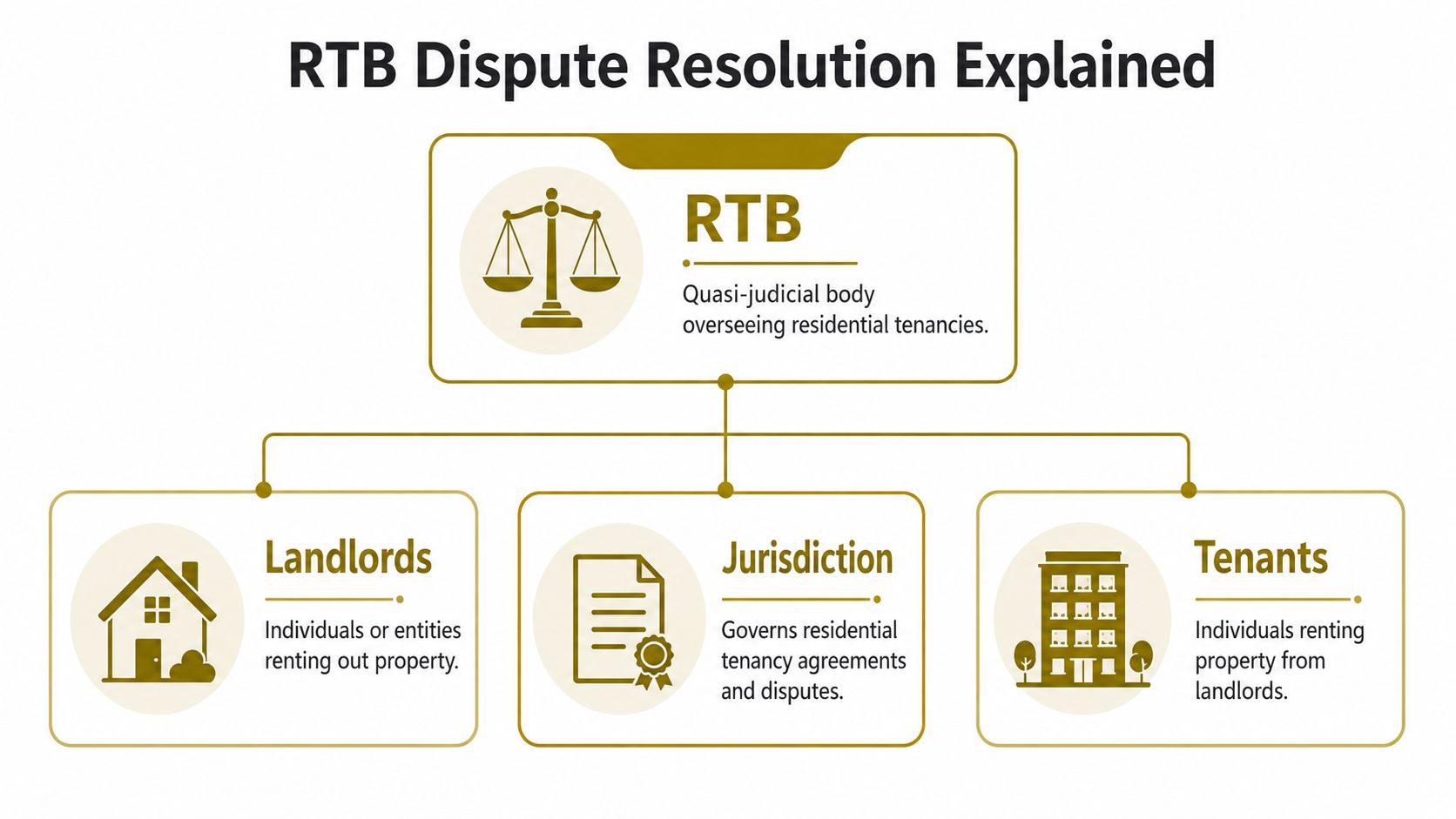
The Residential Tenancy Branch handles most landlord-tenant conflicts in British Columbia under the Residential Tenancy Act. It's a quasi-judicial process, which means it's more formal than a complaint line and less informal than many landlords expect. For Maple Ridge and Pitt Meadows owners, this is the venue for the usual disputes around rent, deposits, repairs, notices, and possession.
What the RTB does handle
The RTB exists to resolve disputes between landlords and tenants. If the issue comes from the tenancy agreement itself, the RTB is usually the right first stop.
Common examples include:
- Unpaid rent or tenancy breaches: When a landlord needs a decision tied to the tenancy.
- Deposit disputes: When the disagreement is about what should be returned or withheld.
- Repairs and compliance issues: When one side says the other hasn't met their obligations.
What the RTB does not handle
A lot of owners lose time. The RTB does not deal with every housing-related conflict.
According to the Tenant Resource and Advisory Centre summary on alternatives to RTB dispute resolution, disputes between tenants or occupants fall outside RTB jurisdiction. Those cases must go elsewhere, including the Civil Resolution Tribunal for claims under $5,000 and Small Claims Court for $5,001 to $35,000.
That distinction matters in Maple Ridge rental houses with shared occupancy arrangements, basement suites with roommate issues, or informal living arrangements that owners didn't properly structure at the start.
If the dispute is tenant versus tenant, or occupant versus occupant, filing with the RTB can send you down the wrong road.
Landlords also need to keep up with broader provincial rule changes because those affect how disputes arise in the first place. If you're buying an investment property or reviewing your obligations before self-managing, this overview of new rules for landlords in BC helps connect policy changes to day-to-day ownership.
The Step by Step Dispute Resolution Process and Timelines
A Maple Ridge landlord usually feels the pressure at this stage. Rent is short, the tenant is disputing the notice, or a damage claim is growing more expensive every week the file sits unresolved. The RTB process is manageable, but only if it is handled in order and on time.
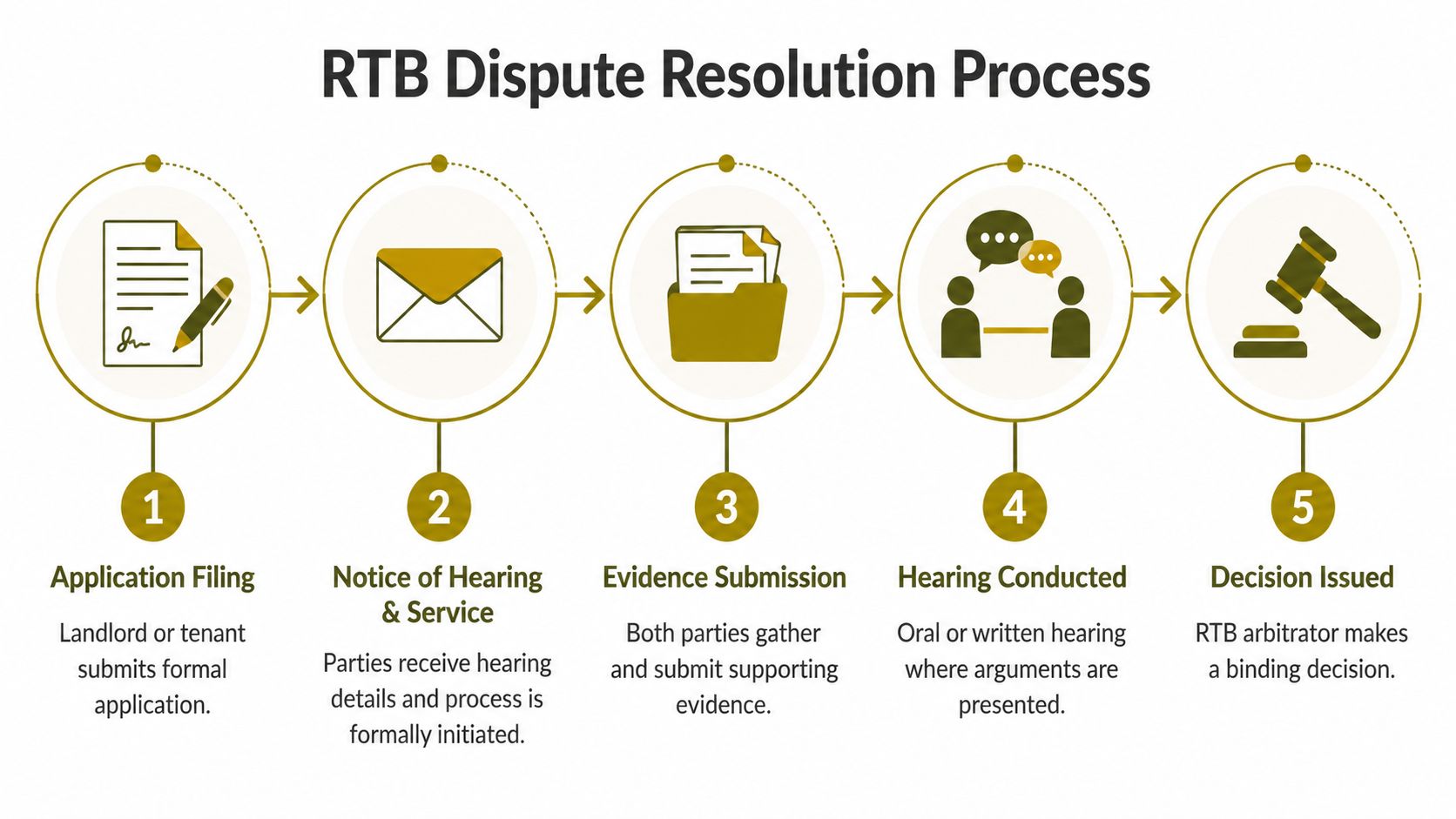
Step one through step three
The process starts with the Application for Dispute Resolution, usually on Form RTB-12. Once the application is accepted, the RTB issues a Proceeding Package with the hearing details and service instructions.
From there, deadlines start running fast.
A practical way to handle it is to treat the file like a sale that is subject-free and closing soon. Every date matters. Every document has to go to the right person, in the right way, within the right window. Landlords in Albion, Silver Valley, and Pitt Meadows often get into trouble here, not because their claim is weak, but because they assume filing the application was the hard part.
The usual sequence looks like this:
- File the application. Set out the remedy you want clearly, whether that is unpaid rent, an order of possession, or compensation.
- Receive the Proceeding Package. Review the hearing date and service requirements the same day you get it.
- Serve the respondent properly. If service is late or defective, the hearing can be delayed or the claim can be weakened before the arbitrator even reaches the facts.
If your dispute involves a hearing-related form beyond the initial application, this complete guide to the RTB-34 form for BC tenancy disputes gives a useful breakdown of what to check before you submit it.
Step four through decision
Once service is done, the file turns into a hearing file. That means dates, proof of service, evidence delivery, and a clean timeline. In practice, that is where organised landlords separate themselves from owners who are trying to reconstruct events the night before the hearing.
The timeline below covers the parts that usually matter most:
| Stage | What to know |
|---|---|
| After filing | The RTB provides the Proceeding Package and hearing information. Review it immediately and calendar every deadline. |
| Service window | The applicant must serve the package promptly after it becomes available. Missing this step can create delay or dismissal problems. |
| Evidence deadline | Evidence has to be prepared and delivered early enough for the RTB rules and the hearing date. Late evidence is a common avoidable problem. |
| Urgent matters | Some files can be heard faster, but only if they meet the RTB test for urgency. Do not assume a serious inconvenience qualifies as urgent. |
| Decision | The arbitrator issues a written decision after the hearing. Orders can then be enforced through the next legal step if needed. |
This walkthrough gives a useful visual overview before a hearing:
What works in real files
The landlords who do well in RTB hearings usually do three things early.
- Build the chronology first. Put every rent issue, notice, repair complaint, inspection, text, and email in date order.
- Tie each claim to proof. If you want compensation, connect the amount to photos, inspection reports, invoices, and the tenancy terms.
- Deal with digital evidence properly. If you are filing videos, audio, or other electronic material, make sure access instructions and the required RTB form are handled correctly.
Damage disputes need extra care. A landlord in Maple Ridge may know the difference between tenant damage and ordinary use, but the RTB still expects that difference to be shown clearly. For a practical outside reference on that distinction, the passref guide for agents is a helpful reminder of how wear and tear should be separated from compensable damage before numbers are added to the claim.
Good preparation protects more than one month of rent. In neighbourhoods where rental presentation affects resale and long-term value, a poorly handled dispute can drag out possession, delay repairs, and leave a property in worse shape than it should have been. That is why local landlords need a process, not just a position.
Gathering Strong Evidence for Your RTB Hearing
Evidence wins RTB hearings. Not emotion, not a long verbal explanation, and not “everyone knows what happened.” If an arbitrator can't follow your documents quickly, your case gets weaker even when your underlying complaint is legitimate.
In practice, the strongest landlord files are boring. They're chronological, complete, and easy to reference over the phone.
What belongs in the package
The Clicklaw summary of dispute resolution in residential tenancies) notes that evidence supporting a claim, including monetary calculations or Notices to End Tenancy, must be submitted with the initial application or within three days for online applications. It also says applicants must serve copies on the other party not less than 14 clear days before the hearing to avoid adjournment.
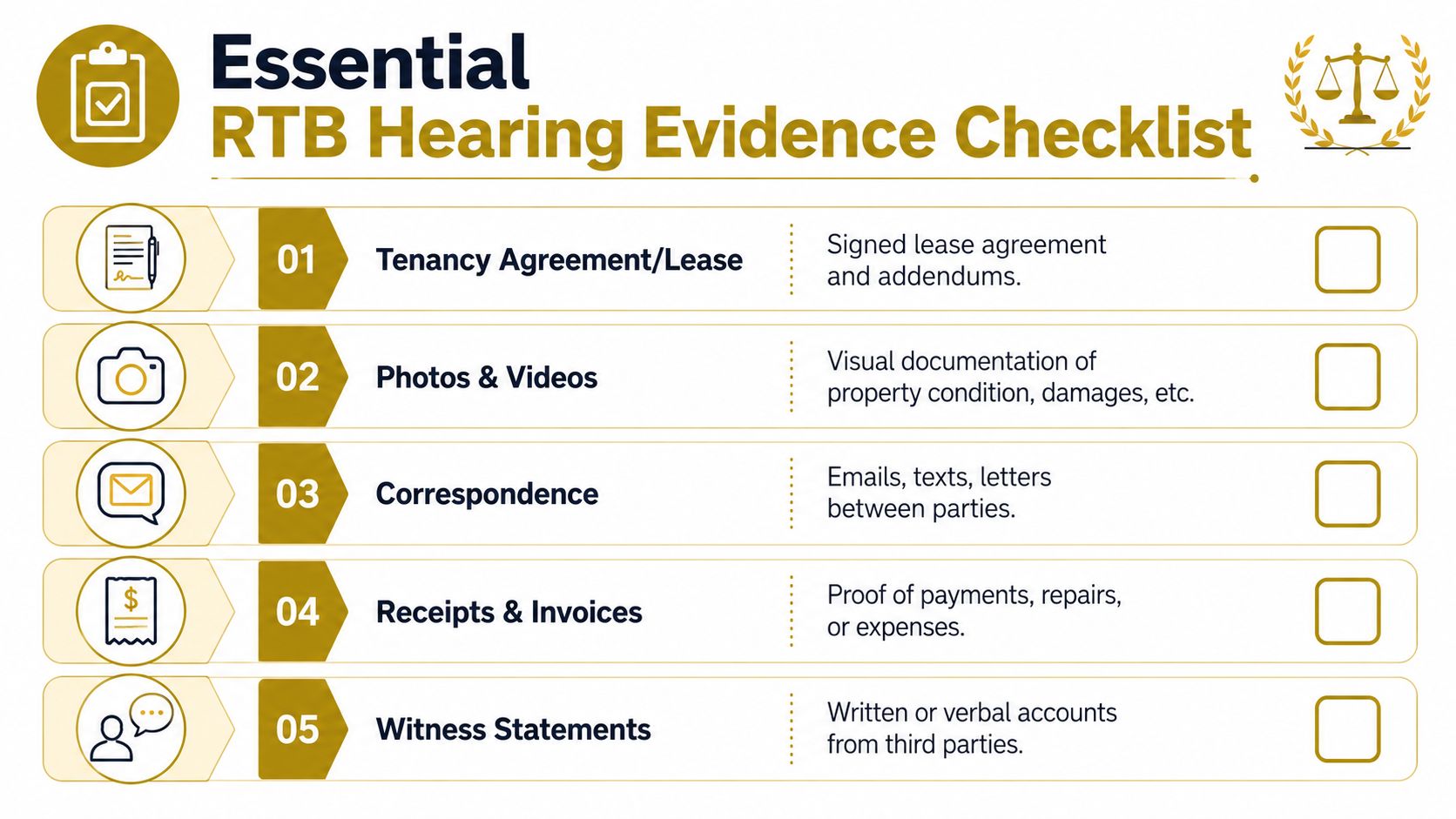
For most Maple Ridge landlord files, the essential package includes:
- Signed tenancy documents: Lease, addenda, pet terms, strata rules if they were incorporated.
- Condition reports: Move-in and move-out inspection records are often the backbone of damage claims.
- Dated visuals: Photos and video should show condition clearly, with context and sequence.
- Communication records: Emails, letters, and texts can support notice, warnings, repair coordination, or admissions.
- Financial proof: Rent ledger, receipts, contractor invoices, and a clean monetary summary.
If you're sorting out whether damage crosses the line from age and use into tenant liability, this passref guide for agents is a helpful reference point for framing that difference before you submit your claim.
The technical mistakes that derail good cases
The same Clicklaw source states the standard application fee is $100, most hearings are conducted over phone with an arbitrator, and service by email or text is not allowed without prior written authorization from the tenant. That last point catches a lot of self-managing landlords.
A few practical mistakes show up again and again:
- Improper electronic service: If you emailed or texted documents without written consent, you may have a service problem.
- No playback access for digital evidence: Clicklaw notes that if digital evidence is submitted in person, you need a physical device capable of playback.
- Messy oral presentation: Because many hearings are by phone, you need a short, orderly explanation tied to page references.
Evidence standard: Don't submit everything you have. Submit everything you need, in the order the arbitrator can understand.
Damage deposit disputes are a good example. Landlords often know money should be withheld but can't prove the amount or the condition difference cleanly. This guide to damage deposit rules in BC is useful if you want to tighten that part of your record before a hearing starts.
Understanding Common Outcomes and The Appeals Process
A hearing win only matters if the order solves the problem. In Maple Ridge, that often means the difference between getting a unit back quickly in Albion or chasing unpaid rent for months while a property in Pitt Meadows sits in limbo.
The outcomes landlords usually care about
The RTB generally issues orders that fall into a few practical categories:
- Order of possession: You recover possession of the rental unit.
- Monetary order: The tenant is ordered to pay money for rent arrears, damage, or another proven loss.
- Compliance order: One side is ordered to do something or stop doing something under the tenancy rules.
For many landlords, the order of possession is the immediate priority. If a tenancy has broken down badly, the main objective is to regain control of the property before the condition worsens or the conflict spills into neighbour complaints. That concern is very real in close-knit areas like Silver Valley or established pockets of West Maple Ridge, where a poorly managed tenancy can affect how the property shows, rents, or sells later.
A monetary order helps, but it is not the same as cash in hand. As noted in AHBL's overview of challenging an RTB decision in BC, RTB monetary orders may still need to be enforced through court if the losing party does not pay voluntarily. That is the trade-off many first-time landlords miss. Winning at the RTB and collecting on the order are two separate steps.
In practical terms, landlords should read the decision for three things right away: what was granted, what was denied, and what deadline applies. Small wording differences matter. If you rely on fob records, intercom logs, or entry history from systems such as Nimbio building access solutions, make sure the final order reflects the conduct you proved.
If the decision goes against you
An unfavourable result does not automatically mean the arbitrator got it wrong. Review applications are limited, the filing windows are short, and weak review requests usually waste time and money.
The first option is usually an Application for Review Consideration through the RTB. Judicial Review through the Supreme Court of British Columbia is a separate court process and is usually a bigger commitment in cost, paperwork, and delay. For a landlord with one condo in Pitt Meadows, that may not be a practical next step unless the issue is serious or the financial exposure is high.
The review deadlines are especially tight:
| Decision type | Deadline |
|---|---|
| Eviction for non-payment of rent, orders of possession, early tenancy termination | Two days |
| Repairs, services, or non-payment-related evictions | Five days |
| All other decisions | 15 days |
The review grounds are also narrow. You generally need to show one of the accepted reasons, such as:
- New evidence that was not available at the original hearing
- Fraud in obtaining the decision
- An outcome that was procedurally unfair or unreasonable under the review standard
A landlord who feels the arbitrator preferred the tenant's version of events usually does not have a strong review application. A landlord who can show key evidence was unavailable despite real effort, or that the hearing process was unfair, may have a better basis to proceed.
Act fast. Read the decision the day it arrives, calendar the deadline immediately, and decide whether the issue is worth another round. If the property is in a high-demand Maple Ridge area and possession is the main goal, the better business decision is sometimes to enforce the order, secure the unit, document condition, and reduce further loss instead of spending weeks trying to re-argue a weak point.
Local Landlord Tips for Maple Ridge and Pitt Meadows
A landlord in Albion can follow every provincial rule and still run into a very local problem. The tenant parks work vehicles on the lawn, the garbage bins stay out all week, and the neighbour beside them starts calling because the street no longer looks cared for. In Maple Ridge and Pitt Meadows, that kind of issue is not just a tenancy headache. It affects curb appeal, neighbour relationships, and the value of the property you may need to refinance, re-rent, or sell.
Local disputes often track with property type and neighbourhood. In Silver Valley and Albion, detached homes bring more wear on yards, fences, drainage areas, and storage space. In downtown Maple Ridge or Pitt Meadows condos and townhomes, the pressure point is often strata compliance. Noise complaints, parking, smoking rules, balcony use, and move-in or contractor access can turn into owner costs fast if the tenancy terms are loose or poorly enforced.
The practical lesson is simple. Write your tenancy terms for the property you own, not for a generic BC rental.
A few habits make a real difference here:
- Set exterior expectations in writing: For detached homes, spell out lawn care, garbage storage, seasonal yard cleanup, and who handles basic upkeep during heavy growth months.
- Match the tenancy to strata rules: If the unit is in a complex, attach the current bylaws and make the tenant acknowledge the parking, pet, noise, and smoking rules at the start.
- Track access carefully: In buildings with shared entry, contractor visits, and fob handoffs, tools like Nimbio building access solutions can help reduce disputes over keys, entries, and common-area access records.
- Inspect with resale in mind: I tell local owners to look at the property the way a future buyer would. Worn fencing, unauthorized paint, pet odour, and neglected landscaping all cost more to correct when they build up over a full tenancy.
That last point matters in Maple Ridge. Softer pricing puts more pressure on condition, and buyers still notice deferred maintenance right away. A rental in West Maple Ridge that shows clean, documented upkeep will hold attention far better than a similar property with unresolved tenant damage, patchy repairs, or visible bylaw problems.
Good local management is often less about winning a hearing and more about avoiding the kind of file that reaches a hearing in bad shape. Clear move-in standards, tighter inspection notes, proper follow-up on neighbour complaints, and consistent enforcement usually protect the asset better than last-minute scrambling. Landlords who want help setting up those systems can review how Brookside Realty's property management team handles local rental operations.
How Brookside Realty Simplifies Dispute Management
A lot of Maple Ridge landlords do fine until a tenancy issue turns procedural. The rent is late, the neighbours in Albion are complaining, or a move-out in Silver Valley leaves damage behind. The problem is no longer just the tenant. It is the paperwork, the timing, the service record, and whether the file is organized well enough to hold up under scrutiny.
That is usually the point where self-managing owners get into trouble. A landlord may have a fair complaint and still weaken the case with scattered photos, incomplete notices, inconsistent communication, or missed follow-up. I see this more often with owners who live outside the area and with landlords trying to manage one rental around a full-time job.
Brookside Realty helps by treating dispute management as an operating process, not a last-minute reaction. The legal framework still applies. What changes is the quality of the file and the consistency behind it.
Practical support usually includes:
- Notice and document handling: matching the issue to the correct form, checking dates, and keeping service records in order.
- Evidence organization: pulling inspection reports, emails, texts, invoices, ledgers, and photos into one clear package.
- Communication discipline: keeping written records with tenants, contractors, and owners so the timeline stays clear.
- Local judgment: separating a true tenancy breach from a problem caused by loose property rules, unclear expectations, or delayed enforcement.
That local judgment matters in Maple Ridge and Pitt Meadows. A noise complaint in a denser pocket near downtown Maple Ridge may need different handling than a yard maintenance dispute on a larger lot in Hammond or a parking conflict in a newer townhouse complex. The RTB process is provincial, but the way problems develop is often very local. Good management accounts for that before a file starts affecting the property's condition, neighbour relationships, or sale readiness.
Owners who want a clearer sense of the day-to-day work can review Brookside Realty's local property management services.
Royal LePage Brookside Realty Property Management is one example of a local team handling the administrative side of difficult tenancies. That support is useful when an owner wants tighter records, steadier tenant communication, and fewer preventable mistakes during a dispute. It also helps protect the bigger picture. In neighbourhoods where buyers notice maintenance issues quickly, poor dispute handling can leave behind damage, access problems, unpaid balances, and a property that shows worse than it should.
Organized files give landlords more options. That can mean settling earlier, presenting a cleaner case, or preparing the property properly for reletting or sale once the issue is resolved.
If you own a rental, are thinking about buying an investment property, or want to sell a home in Maple Ridge or Pitt Meadows without tenancy issues clouding the process, Royal LePage Brookside Realty Property Management can help you plan the next step with local context and practical guidance.