
You're probably here because the math in Vancouver, Burnaby, or the Tri-Cities stopped making sense. You want more space, maybe a yard, maybe a quieter street, maybe the kind of place where a Saturday can involve a trail, a playground, and a coffee shop instead of another open house that feels out of reach.
That's usually when Maple Ridge enters the conversation.
People don't just move here because it's farther east. They move here because they're trying to buy a different daily life. They want room for kids, dogs, hobbies, a home office, or aging parents. They want access to nature without giving up groceries, schools, sports, and basic convenience. They also want a purchase that feels more grounded than constantly stretching to compete in the urban core.
The part many relocation articles miss is that Maple Ridge is not one thing. It's not only “cheaper than Vancouver.” It's a set of neighbourhoods with different rhythms, different commute realities, and different trade-offs. If you're starting with a broader Fraser Valley search, this Fraser Valley relocation guide with Maple Ridge homes is a useful companion. Once Maple Ridge makes your shortlist, the details matter a lot.
Is Maple Ridge Your Next Home Chapter
A common pattern looks like this. A couple in East Vancouver has outgrown a condo. Or a young family in Coquitlam wants one more bedroom, one more bathroom, and a little breathing room outside. They start by saying they're “moving out to save money.” After a few weekends in Maple Ridge, the conversation changes. They stop talking only about price and start talking about lifestyle.
That shift matters.
Maple Ridge tends to appeal to people who want their home to do more than one job. It needs to be a residence, yes, but also a work-from-home space, a gathering place, a launch point for school runs, mountain bike rides, dog walks, and family dinners. That's different from choosing an address purely for commute efficiency or nightlife.
Maple Ridge works best for buyers who want more space and a more grounded pace, and who are honest about what they're giving up to get it.
The city has a strong pull for families, move-up buyers, and people leaving smaller homes in denser areas. But the decision only works when it's made with clear eyes. If you need a walkable, transit-first, urban routine, some parts of Maple Ridge will feel inconvenient fast. If you want trails, larger homes, newer subdivisions, and a community-oriented feel, it can be a very good fit.
The best moves happen when people stop treating Maple Ridge as a fallback and start treating it as a deliberate choice. That means picking a neighbourhood based on how you'll live, not just what's on the listing sheet.
Decoding the Maple Ridge Housing Market in 2026
A buyer tours three homes on a Saturday. The first is a tired split-entry in West Central with an ambitious list price. The second is a clean townhome near Albion Elementary that gets immediate interest because the layout works for a young family. The third is a condo that looks affordable until strata fees, parking, and a longer commute are added to the monthly math. That is Maple Ridge in 2026. More choice than the frenzy years, but still plenty of room to overpay if you read the market too casually.
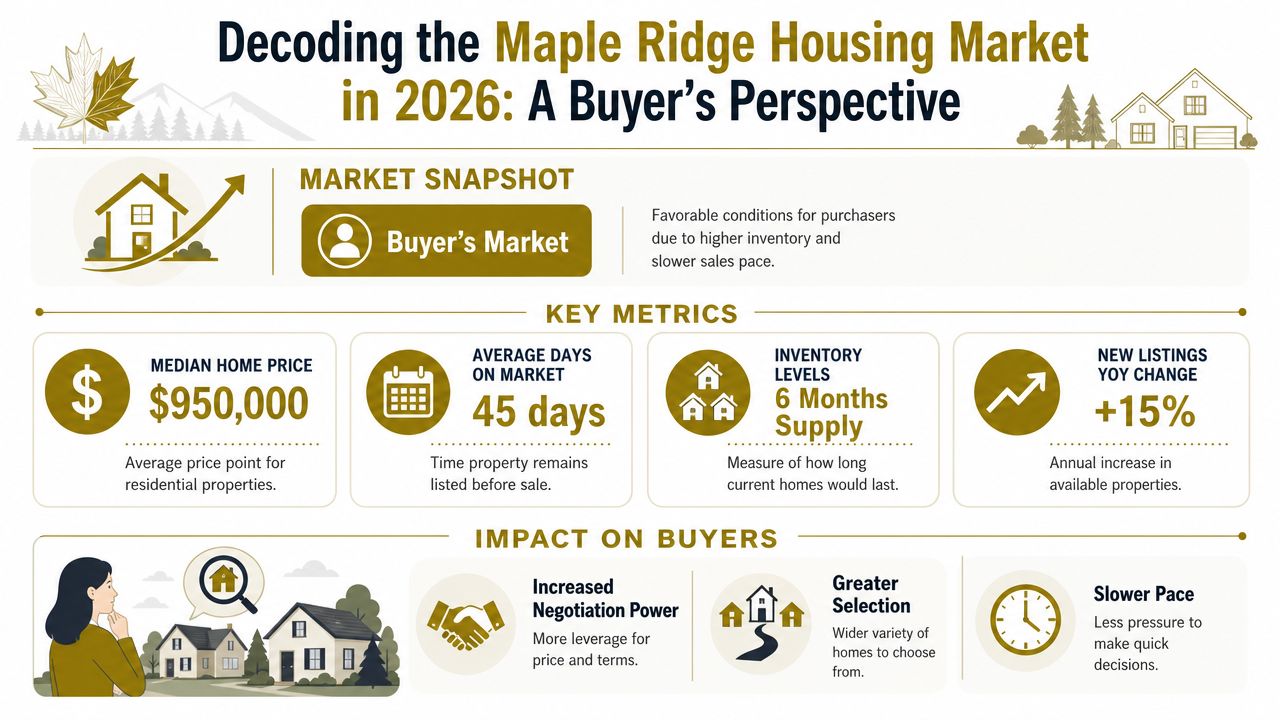
As of June 2026, Maple Ridge is in a buyer's market with 607 homes for sale, 17% of active listings reducing price, a typical $45,000 decrease from list to sale price, and a 96% sell-to-list ratio, according to the June 2026 Maple Ridge market report. Analysts in that report also found the market is most active for homes under $1.15 million.
What buyer's market conditions actually mean
Buyers have more room to inspect, compare, and negotiate than they did a few years ago. That matters, especially for households moving here because Maple Ridge looks cheaper on paper than Coquitlam, Burnaby, or East Vancouver. The sticker price can be lower. The total monthly cost is not always lower once you factor in commuting, gas, a second vehicle, or higher utility costs in a larger detached home.
The 96% sell-to-list ratio is one of the clearest signals. Sellers, on average, are not getting full asking price. The typical $45,000 gap from list to sale means list price often functions as an opening position, especially on homes that were priced off 2021 or 2022 expectations instead of current competition.
That said, buyers should not treat every listing like a distress sale.
Well-located homes still move with purpose. A well-kept family house near Samuel Robertson Technical Secondary, or a practical townhome close to Albion Sports Complex, can draw strong offers because it solves a daily-life problem for the next buyer. In Maple Ridge, negotiation power comes from reading the reason behind the listing, not from submitting low offers across the board.
How to read the market by property type
Detached homes give buyers the biggest spread between asking prices and actual value. Some sellers are still anchored to older peak pricing, particularly if the home has a suite, a larger lot, or mountain views. Buyers in this segment should compare recent solds, track price reductions, and look hard at deferred maintenance. Roof age, drainage, windows, and suite compliance can change the financial picture quickly.
Townhomes are a different story. They sit in the most practical lane for many Maple Ridge buyers because they offer more bedrooms and storage without the full carrying cost of detached ownership. The good ones tend to sell faster than weak listings elsewhere in the market. Family-friendly complexes near schools, parks, and straightforward commuter routes usually do not sit around for long just because headlines say "buyer's market."
Condo buyers have the clearest entry point on price. The average sold price for a condominium in Maple Ridge in March 2026 was $480,212, with sales spanning $265,000 to $590,000, according to the March 2026 Maple Ridge condo market report. For first-time buyers, that can open the door to ownership. It can also create a false sense of affordability if the building has higher strata fees, limited rental flexibility, or an upcoming depreciation report issue.
Where the pressure points are
The busiest price band is still under $1.15 million, which lines up with what many move-up families can finance in Maple Ridge. You can see that pattern in recent Maple Ridge real estate market activity and pricing trends. This is the part of the market where buyers need to stay disciplined. Competition has eased, but the best value homes still get noticed quickly if they check the right boxes on condition, location, and school catchment.
Here is how I usually frame it for clients:
| Property type | What tends to work | What often doesn't |
|---|---|---|
| Detached homes | Patience, strong comparable sales analysis, inspection discipline | Assuming lot size alone justifies the asking price |
| Townhomes | Quick decisions on well-run complexes with useful layouts | Waiting for a perfect deal on the best family-oriented units |
| Condos | Careful review of strata fees, bylaws, and building health | Focusing only on purchase price and ignoring monthly ownership costs |
Maple Ridge in 2026 rewards buyers who do the boring work well. Review sold comparables. Check the commute before writing. Budget for ownership, not just the mortgage. Sellers who price realistically can still get a clean result, but buyers who came here expecting automatic bargains usually need a quick reality check.
Finding Your Fit in Maple Ridge Neighbourhoods
Choosing Maple Ridge without choosing the right neighbourhood is how people end up disappointed. Two homes can have the same square footage and price range, but if one puts you close to the routine you want and the other adds friction to every weekday, they are not the same buy.
Albion for family rhythm
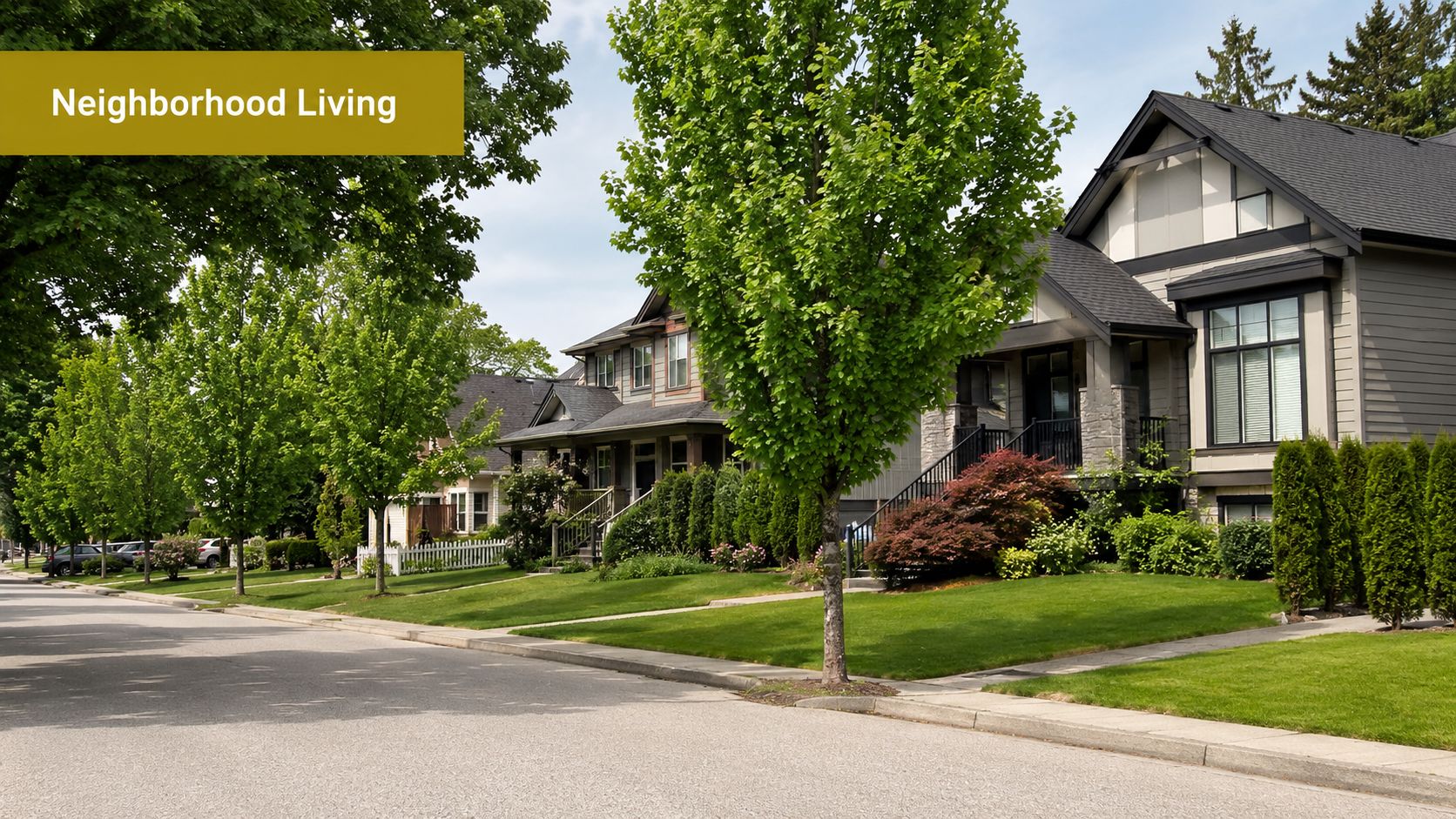
Albion is often where young families land first. It has a newer-subdivision feel in many pockets, with a lot of detached homes and townhomes designed around practical family living. Streets tend to feel active. Kids are outside. Playgrounds and school runs shape the day.
If your ideal weekend includes coffee, a sports field, a birthday party, and an easy walk with the dog, Albion makes sense. It's one of the easier neighbourhoods for buyers who want to plug into a family-oriented routine quickly. If you want a closer look at how this area lives day to day, this Albion Maple Ridge neighbourhood guide is worth reading.
Schools and parks are part of the appeal here. Families often look at the area because daily logistics feel manageable. The trade-off is that some buyers want a little more lot size, more privacy, or less of a newer subdivision feel. Albion isn't trying to be rural. It's trying to be functional for active households.
Silver Valley for trail access and a quieter edge
Silver Valley feels different as soon as you drive into it. There's more of a foothills atmosphere, with homes that often lean into views, green space, and a stronger connection to the natural environment. For many buyers, the draw is obvious. You get closer access to trail networks and an everyday sense that nature is built into the neighbourhood.
This is a strong fit for people who actively use the outdoors, not just people who like the idea of it. If hiking, biking, walking, and getting the kids outside are part of your normal week, Silver Valley can feel like a lifestyle upgrade. If you need quick in-and-out access for errands all the time, it may feel a bit less convenient.
A typical Silver Valley weekend looks quieter. More boots, fewer errands. More time outside, less time bouncing between commercial nodes.
Here's a local video that gives a feel for the area and the broader city context:
Cottonwood for established comfort
Cottonwood tends to attract buyers who want a more established residential feel. You'll find mature landscaping, quieter streets, and a mix of older family homes and newer updates. It often appeals to people who want less of a master-planned look and more of a settled neighbourhood character.
This area works well for buyers who want parks, schools, and practical family living without necessarily being on the edge of the mountain-oriented parts of Maple Ridge. Cottonwood Park is a local anchor, and families often like the balance between residential calm and access to daily essentials.
In Cottonwood, buyers usually aren't chasing novelty. They're looking for stability, familiar family streets, and homes that feel lived in rather than newly minted.
Kanaka Creek for space and a more tucked-away feel
Kanaka Creek sits in a nice middle ground for a lot of buyers. It can offer a more tucked-away residential setting while still keeping family life front and centre. Homes here often appeal to people who want a bit more breathing room and a quieter backdrop without going fully rural.
The green corridor feel is a real part of the experience. Buyers who like walking routes, creekside settings, and neighbourhoods that feel slightly removed from the busiest stretches of town often shortlist Kanaka Creek quickly. It suits households that value calm and don't mind driving for some errands.
West Maple Ridge for convenience and older-lot appeal
West Maple Ridge is often the practical answer for buyers who care about connectivity. It generally offers better access westward, a mix of housing stock, and in many spots, larger older lots than you'll find in newer subdivisions. It also attracts people who want to stay closer to core shopping, services, and commuter routes.
This part of the city can feel less picturesque on paper than Silver Valley and less polished in a master-planned sense than Albion, but for the right buyer it's the strongest value. If your weekdays are busy and your priority is shaving friction off errands, school drop-offs, and regional travel, West Maple Ridge deserves a serious look.
A simple neighbourhood fit test
If clients are torn between areas, I usually ask them to rank these five things:
- School routine: Do you want to walk more often, or are you fine driving most mornings?
- Outdoor lifestyle: Are trails part of your real week, or just an aspiration?
- Commute tolerance: Is westward access a major factor?
- Neighbourhood age: Do you prefer established streets or newer homes?
- Weekend pattern: Do you spend free time at parks and fields, or mostly running errands and meeting friends?
Neighbourhood choice is where a good move becomes a right move. The home matters. The pattern of life around it matters more.
The Real Cost of Living in Maple Ridge
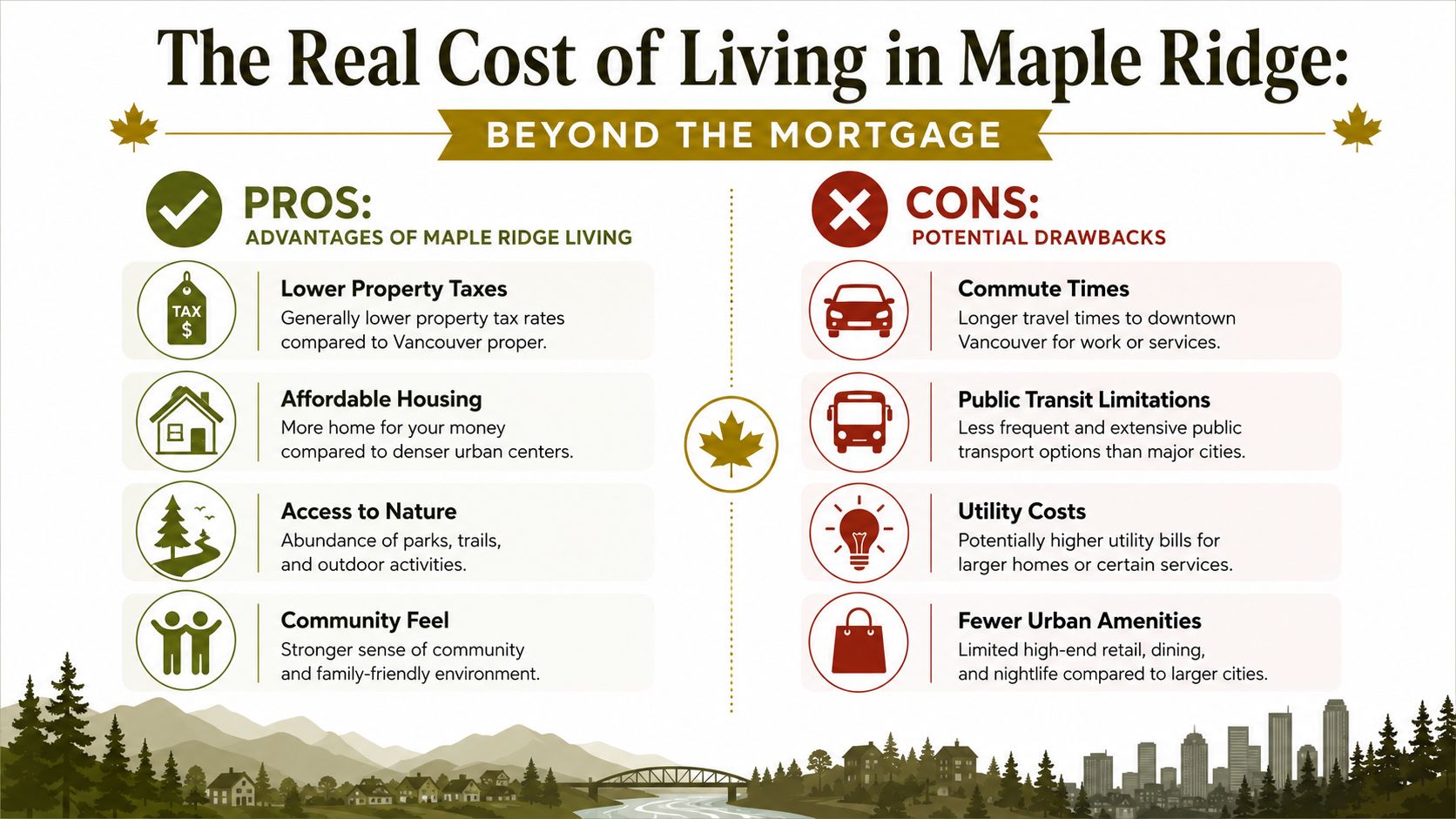
The biggest mistake buyers make is assuming that if the purchase price feels lower than Vancouver, the whole lifestyle will automatically feel cheaper. Sometimes it does. Sometimes it doesn't.
That's where the affordability trap shows up.
Most moving guides ignore the daily carrying reality of suburban life. In Maple Ridge, owning a car is essential for about 95% of residents, and monthly gas expenses average $700 alone, with rising property taxes after the first year identified as part of the local affordability trap in this Maple Ridge cost-of-living video.
The costs people underestimate
Transportation is the obvious one, but not the only one. A larger home often brings larger utility bills. A two-car household can make sense quickly in Maple Ridge, especially if both adults have separate routines or one parent handles school, sports, and errands during the day. Insurance, fuel, maintenance, and parking patterns all matter more here than they do in more transit-oriented areas.
Property tax adjustment also catches people off guard. Buyers tend to focus on the current monthly mortgage payment and the first tax estimate, then realise later that their true annual carrying cost is changing. That doesn't make Maple Ridge a bad move. It means the move needs to be budgeted accurately.
For buyers comparing options, this Maple Ridge home prices overview helps put asking prices into local perspective. But price is only one line of the budget.
A better way to test affordability
Don't ask, “Can we qualify for this house?”
Ask, “Can we comfortably live this life?”
Use a simple monthly stress test:
- Housing payment: Include mortgage, strata if applicable, property taxes, and home insurance.
- Transportation reality: Add fuel, insurance, routine maintenance, and the possibility that one vehicle won't be enough.
- Home operations: Budget for utilities, internet, and the costs that come with larger interior space and outdoor upkeep.
- Family routine: Include childcare, activities, school needs, pet costs, and takeout or convenience spending during busy weeks.
A home can look affordable on paper and still feel tight every month if the transportation and household costs weren't budgeted properly.
Maple Ridge often gives buyers more house and more land for their money than denser parts of Metro Vancouver. That's the upside. The trade-off is that everyday movement usually costs more, and convenience is more car-based than many newcomers expect. The smart approach isn't to avoid Maple Ridge. It's to budget for Maple Ridge as it functions.
Navigating Daily Life Schools Commutes and Amenities
A move works when the weekly routine works. That means understanding where your kids will go, how you'll get around, and what daily convenience looks like once the novelty of a new house wears off.
Schools and family routine
Maple Ridge is a strong draw for families because the city's identity is built around residential living, parks, sports, and neighbourhood schools. In practice, buyers usually narrow their search by school catchment, daycare access, and how much driving they're willing to do before and after work.
Neighbourhoods such as Albion, Cottonwood, and parts of Kanaka Creek are especially popular with families because they tend to line up well with playgrounds, youth sports, and a family-oriented street pattern. When clients are relocating with children, I always tell them to map the school run before they map the kitchen renovation. The school run affects your life a lot more.
A practical short list for families should include:
- Catchment fit: Confirm that the home aligns with the schools you want to pursue.
- After-school logistics: Check how easy it is to get to fields, arenas, dance, or tutoring from that neighbourhood.
- Childcare reality: Look at how your work schedule intersects with pickup and commuting, not just classroom location.
Commuting without wishful thinking
Commute planning is where buyers need to be blunt with themselves. Some people can handle a longer regional commute because they only do it a few days a week. Others say they can, then resent the drive within a month.
West Maple Ridge usually appeals more to buyers who want easier westward access. Port Haney and nearby areas matter for people who want the West Coast Express option. Other households rely heavily on Lougheed Highway, the Golden Ears Bridge, or a combination of driving and transit. If transit infrastructure is part of your long-term decision-making, this look at the SkyTrain and regional transit expansion context can help you think more broadly about how eastern communities connect to the rest of Metro Vancouver.
The key is matching neighbourhood to routine. A beautiful house loses appeal quickly if every weekday starts and ends in frustration.
Amenities that shape real life
Maple Ridge earns its reputation for outdoor access. Golden Ears Provincial Park, Alouette Lake, Kanaka Creek Regional Park, and neighbourhood trail systems aren't occasional attractions. For many residents, they're part of how the city functions. Walks, runs, bike rides, playground stops, and family outings become easier to build into normal life.
Daily convenience is more mixed, and that's important to understand. Maple Ridge covers the essentials well. Groceries, recreation centres, schools, cafés, local services, and casual dining are there. What it doesn't offer in the same way as Vancouver or Burnaby is a dense, highly walkable concentration of higher-end retail, restaurant variety, and urban nightlife.
That trade-off doesn't bother everyone. Many buyers are happy to make it. They just shouldn't discover it after moving.
What a typical week feels like
For most households, Maple Ridge life revolves around a few anchors:
| Part of the week | What it often looks like in Maple Ridge |
|---|---|
| Weekday mornings | School runs, commuter routes, and car-based errands |
| After school and work | Sports, parks, trails, recreation, family dinners at home |
| Weekends | Outdoor time, local shopping, community events, catch-up errands |
Maple Ridge tends to suit people who enjoy spending more of their free time in neighbourhood spaces and outdoor settings than in dense commercial districts.
If that sounds like your household, the city starts to make more sense very quickly.
Your Maple Ridge Moving Checklist and Timeline
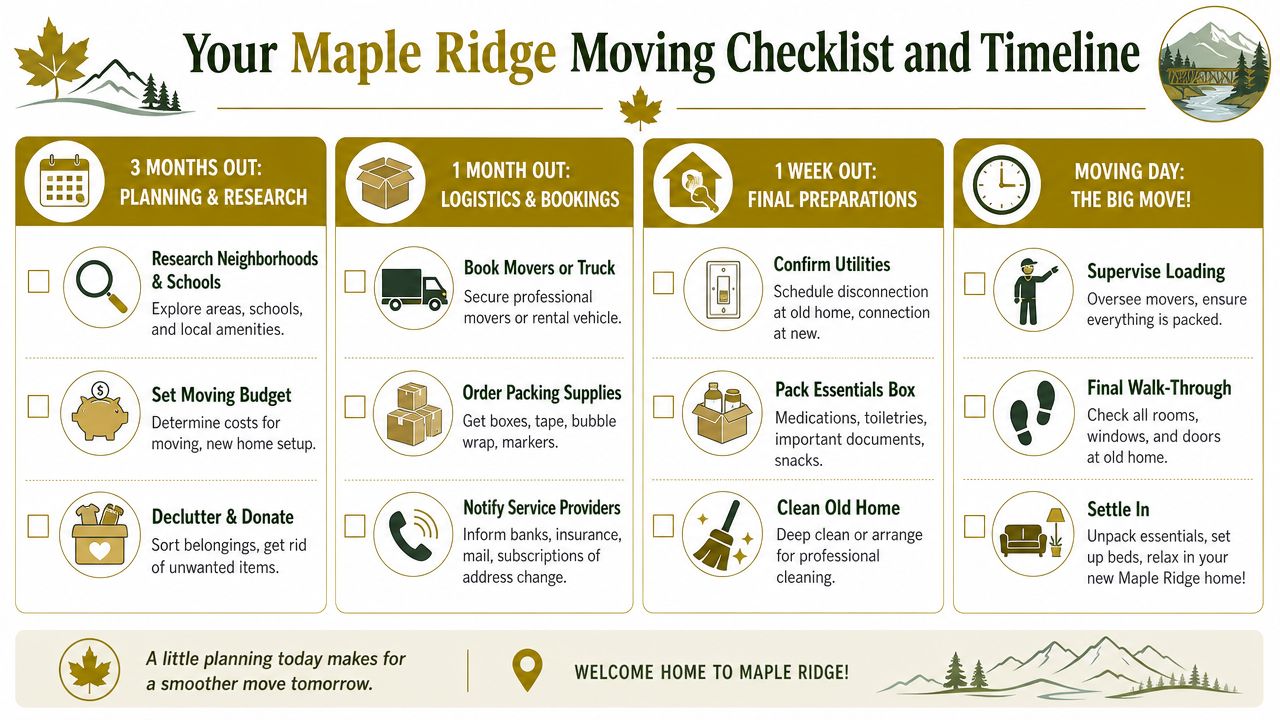
A smooth move often begins sooner than anticipated. The buyers who handle relocation well usually make two smart decisions up front. They sort out the purchase timeline early, and they plan the actual move with local logistics in mind instead of treating it as an afterthought.
Three months out
Start with the decisions that affect everything else.
- Choose your target area: Narrow your search to two or three neighbourhoods based on schools, commute, and lifestyle.
- Set a realistic budget: Build your housing budget around monthly carrying cost, not just approval amount.
- Declutter hard: Maple Ridge buyers often move for more space, but that doesn't mean you should pay to move what you no longer use.
If you want a practical relocation framework, this moving timeline from TLC Moving is helpful because it breaks the process into manageable stages instead of one overwhelming to-do list.
One month out
This is when moving shifts from planning to execution.
Book movers or a truck as soon as your dates are firm. If your possession and move-in dates don't line up perfectly, sort out temporary storage or overlap logistics early. Order boxes, tape, labels, mattress bags, and protective wrapping before you need them, not during the packing crunch.
Also start updating your address details with banks, insurers, subscriptions, and any school or childcare records. These are the tasks people forget until the final week, when they're busiest.
One week out
Now you want friction gone.
Confirm utility changeovers with BC Hydro, FortisBC if applicable, internet provider appointments, and any strata move-in procedures if you're heading into a condo or townhome complex. Pack one essentials box that stays with you. Medications, chargers, documents, toiletries, pet supplies, basic kitchen items, and a few days of clothes should never be buried in the moving truck.
A clean handoff matters too. If you're selling, coordinate cleaning expectations clearly. If you're buying, assume you'll want basic supplies ready at the new place before the first full unpack.
Moving day
Keep the day simple and supervised.
- Walk the old home once more: Check closets, garage, crawl space, storage rooms, and outdoor sheds.
- Direct the flow: Tell movers what goes first, what stays accessible, and what needs extra care.
- Make the new home functional fast: Beds, bathrooms, coffee maker, phone chargers, and kid essentials first.
People often focus on the move as one day. In reality, the easier move is the one where the first three days after possession are already planned.
Succeeding in the Market Tips for Buyers and Sellers
A lot of people move to Maple Ridge assuming the hard part is choosing a home. In practice, the expensive mistakes usually happen in the offer strategy, pricing plan, and neighbourhood fit.
This market rewards preparation. It also exposes weak assumptions fast. Buyers who treat every price reduction as a deal can inherit costly repairs or a punishing commute. Sellers who price from memory instead of current competition often lose momentum in the first two weeks, which is when the listing gets its best attention.
For buyers
Use the extra choice carefully.
A lower entry price than Burnaby, Coquitlam, or Langley does not automatically mean lower ownership stress. In Silver Valley, for example, you may get newer construction and mountain views, but you also need to be realistic about driving for errands, school drop-offs, and commuting west. In older parts of West Maple Ridge, the lot may be stronger and the location more practical, but the house itself can come with older roofs, drainage issues, or renovation work that needs cash soon after closing.
Good buyers stay focused on three things:
- Value relative to the micro-area: A townhouse near Kanaka Creek Elementary and commuter routes competes differently than one deeper into a quieter pocket with fewer daily conveniences.
- Condition behind the cosmetics: Fresh paint and staging do not fix grading problems, poly-b plumbing, or deferred exterior maintenance.
- Terms that affect real cost: Completion date, subject periods, included appliances, and repair credits can change your first-year cash flow as much as the headline price.
I tell buyers to read a listing in reverse. Start with location and resale risk. Then review strata documents or property disclosures. Only after that should the kitchen and finishings get much weight.
For sellers
Sellers need a plan that matches how Maple Ridge buyers shop.
That means pricing against active competition, not the highest sale from a different season or a stronger street. Buyers compare hard in this market. If your Albion detached home is competing with two cleaner, better-presented homes near Samuel Robertson Technical Secondary, the price has to reflect that immediately. Waiting for the market to "see the value" usually leads to price cuts, longer carrying costs, and weaker negotiating power.
Presentation still matters, but not in a generic way. Decluttering helps. Minor repairs help. Professional photos help. What matters most is whether the final package makes sense for the exact buyer pool in that pocket of Maple Ridge.
For example, a family buyer looking near c'usqunela Elementary or Maple Ridge Park will notice storage, yard usability, and bedroom layout before they care about designer light fixtures. A condo buyer closer to the town core is often more focused on strata health, walkability, and whether the unit feels move-in ready without another $15,000 in updates.
Why local execution matters
Maple Ridge is not one market.
Albion, Hammond, East Central, West Maple Ridge, and Silver Valley attract different buyers with different budgets, schedules, and tolerance for trade-offs. A home that sells well because it is close to Laity View Elementary, Golden Ears routes, and daily shopping needs a different marketing angle than a larger house farther out that asks the buyer to accept more driving in exchange for space.
The paperwork side matters too, especially when people are coordinating a sale, purchase, work schedule, and school timeline at once. A secure e-signature platform for sales agreements helps keep documents signed on time and reduces preventable delays during negotiations and subject removal.
The best outcome usually goes to the client who is honest about the full equation. Price matters. So do commute hours, repair budgets, school catchments, insurance, and how long you plan to stay. Maple Ridge can be a smart move, but only if the numbers and the day-to-day reality work together.
If you're buying, selling, or trying to decide whether Maple Ridge is the right fit, Royal LePage Brookside Realty Property Management can help you sort through neighbourhood choices, pricing strategy, and the practical details that make a move work in real life.