

You're scrolling listings after dinner, half-looking, half-daydreaming. Maybe it's a townhouse near Thomas Haney Secondary, a detached place in Cottonwood, or a quieter street backing onto greenbelt near Kanaka Creek Park. Then one listing stops you cold. The price looks lower than the surrounding homes, the photos feel a bit sparse, and somewhere in the remarks you see the phrase court-ordered sale.
That's usually the moment buyers in Maple Ridge call with the same reaction. Interest first. Then caution. They want to know whether they've found a genuine opportunity or walked into a legal process that's far more complicated than a normal purchase.
Both instincts are right.
A court ordered sale in BC can create real buying opportunities, especially in a market where buyers are watching affordability closely and comparing every option in neighbourhoods like Albion, Silver Valley, West Maple Ridge, and Pitt Meadows. But it isn't a shortcut. It's a court-supervised process with different rules, tighter expectations, and a level of uncertainty that catches people off guard if they treat it like a standard MLS transaction.
Is That Deal in Maple Ridge Too Good to Be True
A typical example looks like this. A young family searching around Cottonwood sees a home priced well below similar listings nearby. They know the area. They like being close to schools, sports fields, and the trail systems that make Maple Ridge such an easy place to live. They assume the house needs work, but they're willing to take on some repairs if the price makes sense.
Then they ask why it's cheaper.
The answer is often less about hidden magic and more about a different legal process. The property isn't being sold in the usual way by a homeowner choosing timing, price strategy, and negotiation terms. The sale is being handled under court supervision, and that changes almost everything about how offers work, how quickly decisions happen, and how secure an accepted offer really is.
Why these listings attract so much attention
Buyers are usually drawn in by three things:
- The price point: It may stand out against nearby active listings in areas such as Silver Valley or near Meadowtown.
- The neighbourhood: Many court-ordered homes are still in strong family areas with parks, schools, and established streetscapes.
- The possibility of less competition: Some buyers skip these listings because the process sounds intimidating.
That last point matters. A court-ordered sale often scares away casual shoppers. People who might happily write on a conventional resale in West Maple Ridge don't always want the uncertainty of a hearing date, public disclosure, or a bid challenge.
Practical rule: If a listing looks underpriced and the words “court-ordered sale” appear in the remarks, assume the lower price reflects process risk, property risk, or both.
What buyers often get wrong
The mistake isn't being interested. The mistake is assuming the deal works like any other deal.
A buyer may spend days discussing kitchen updates, paint colours, or whether the backyard works for the dog, while missing the issues that control the outcome. Can you compete with a cleaner offer? Can you accept a property in rough condition? Can you handle the possibility that another bidder appears at the hearing?
In Maple Ridge and Pitt Meadows, where buyers already compare value carefully from Hammond to Albion, that difference matters. A court-ordered listing can be worth chasing. It just has to be chased with a different mindset.
What a Court Ordered Sale in BC Really Means
A court ordered sale in BC is a sale supervised by the court, not only a bank deciding to dispose of a property on its own timeline. The easiest way to think about it is this. The court acts like a referee. It doesn't own the home, and it isn't buying or selling for its own benefit. It steps in to make sure the process is conducted fairly and that the final sale is properly approved.
In British Columbia, court-ordered sales require the lender to petition the BC Supreme Court for permission to sell the property, and the court must approve the final sale price rather than the lender alone. The process also means any buyer's offer is publicly disclosed, and competing bids can be submitted in person by 9:45 a.m. on the hearing date, with the judge typically approving the highest bid while still retaining final authority, as outlined in this explanation of why court-ordered sales and foreclosures often sell for less than market value in BC.
The basic flow
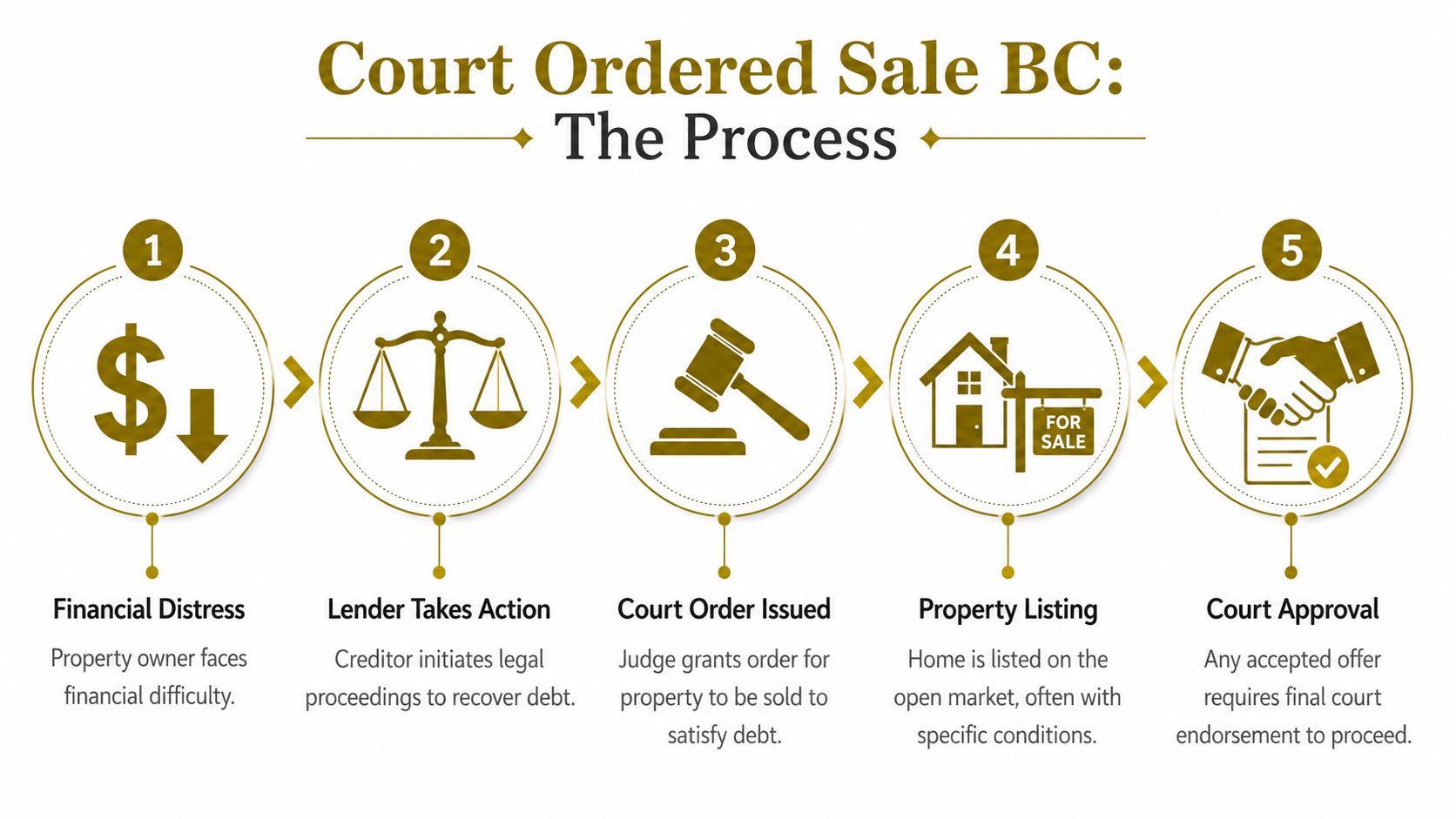
The legal language can feel heavy, but the working sequence is straightforward.
A borrower falls into serious default.
The issue is usually mortgage-related, and the lender starts legal proceedings.The lender goes to court.
The BC Supreme Court is asked for permission to move the property through a court-supervised sale.The property is marketed for sale.
In many cases, it appears on MLS, but the listing terms are not the same as a standard resale.An offer is accepted subject to court approval.
At this stage, many buyers think they're done. They're not.The court hearing determines whether the sale proceeds.
Other buyers may still compete at that stage.
For a more detailed background on the legal steps, this article on the foreclosure process in BC is a useful companion read.
How it differs from a normal sale
In a normal resale, the homeowner and buyer negotiate privately. Price, dates, inclusions, and conditions can all move around through discussion. In a court-ordered sale, there's much less flexibility because the court is supervising the outcome.
That creates practical differences buyers and sellers feel immediately:
- Offers become more exposed: Your accepted price isn't private in the same way.
- Timing can become less predictable: A court date controls the next key step.
- Finality comes later: “Accepted” does not mean “secure.”
- The judge has the last word: Not the lender. Not the listing side. Not the buyer.
The offer that looks done on paper may still be challenged in court.
Why the system exists
The process is designed to protect more than one party. The lender wants recovery. The homeowner's stake still matters. Other interested buyers have a chance to compete openly. That's why this isn't just an administrative sale. It's a supervised one.
For Maple Ridge buyers, that means the legal framework isn't background noise. It directly affects price strategy, conditions, deposit readiness, and how seriously your offer will be taken.
The Buyer's Guide to High Risk High Reward Properties
Court-ordered homes appeal to a certain type of buyer. Usually, it's someone who can stay calm, do quick homework, and make peace with imperfection. If you need the certainty of a polished resale with a long subject period, these properties often feel uncomfortable from the start.
If you can handle uncertainty, there may be opportunity.
Where the upside comes from
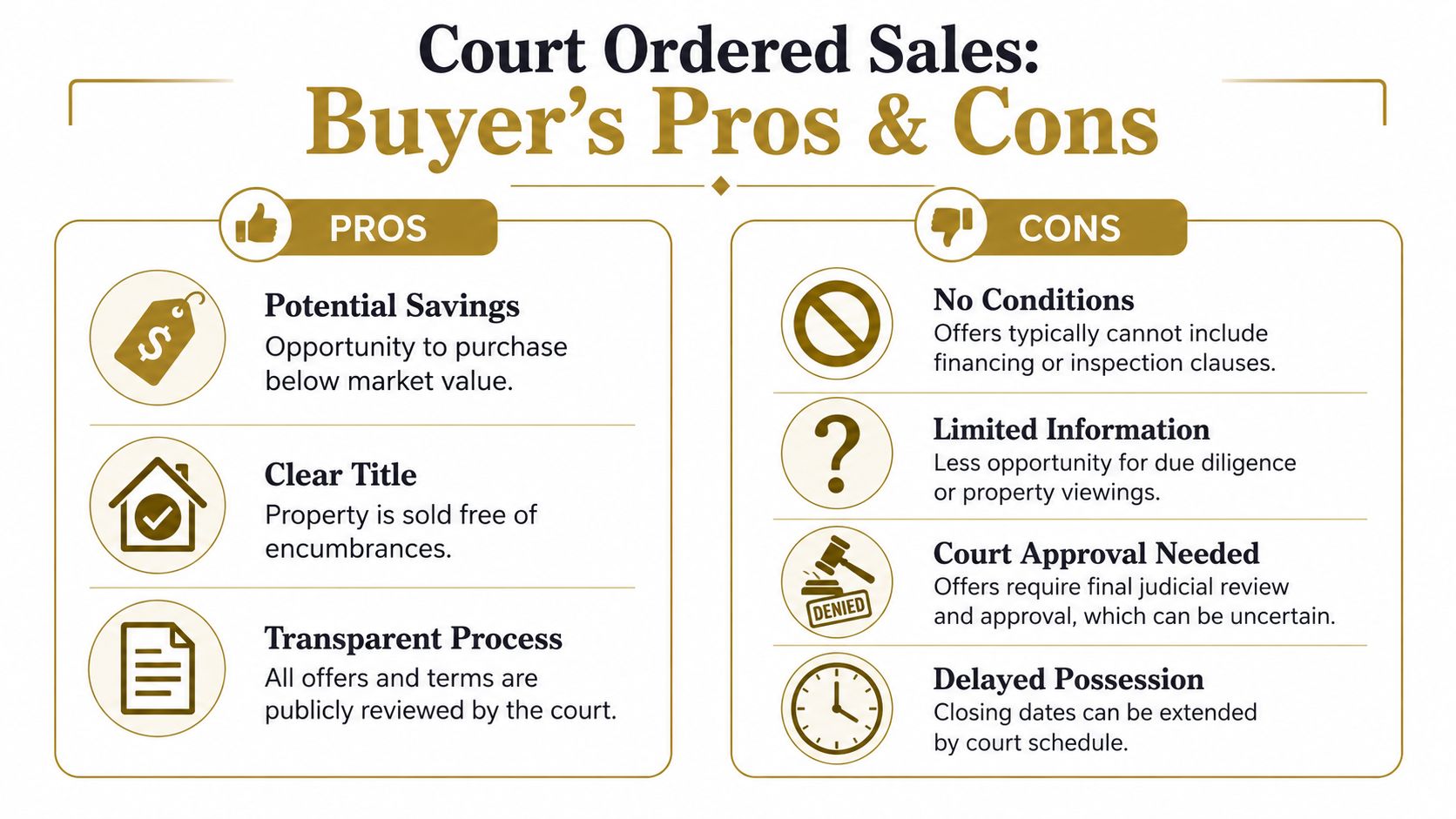
BC-wide foreclosure data shows court-ordered properties typically sell 10 to 20% below market value, and localized Greater Vancouver data cited for Surrey shows bank-ordered foreclosures made up only 0.28% of active listings in the first six months of the year, which reinforces that these are a small but distinct part of the market rather than a mainstream inventory pool. That context comes from this market discussion on foreclosure activity and pricing in the region.
For a buyer in Maple Ridge, that can mean a chance to enter a neighbourhood that might otherwise be out of reach. A detached home near Albion Elementary, a townhome close to commuter routes, or a condo option that keeps you near shopping and recreation may suddenly become financially possible.
But the discount is not free money. It's compensation for risk.
What “as is, where is” looks like in real life
This phrase sounds simple until you're the one buying the property.
It means the home may come with deferred maintenance, missing information, limited access, and no promise that a seller will repair anything before completion. If a conventional seller in Pitt Meadows might fix a leak or negotiate after inspection, that kind of back-and-forth often doesn't exist here.
A buyer considering these listings should think through:
- Condition risk: The property may need work you can't fully measure in advance.
- Financing pressure: If your lender needs time or extra documentation, a cleaner competing offer may beat you.
- Emotional risk: You can spend money preparing, only to lose in court.
- Timeline stress: Possession and certainty may not line up neatly with your plans.
The sealed bid problem most articles miss
One of the least understood parts of the Fraser Valley process is the risk around sealed offers. Current resources often fail to explain that court-ordered sales in the Fraser Valley may require uncontested, sealed bids that a judge awards to the strongest clean offer rather than only the highest price, as described in this overview of foreclosures and court-ordered sales.
That changes buyer behaviour completely.
A strong clean offer usually means very few, if any, buyer-friendly conditions. Quick closing helps. Clear deposit terms help. Proof that the buyer is organised helps. In practice, that's why some buyers lose despite offering more. Their offer is harder to complete.
Clean beats complicated more often than buyers expect.
For readers comparing different forced-sale systems, Buys Houses' complete sheriff sale guide is useful as a contrast piece because it shows how other jurisdictions structure distressed property sales differently from BC's court model.
If you're browsing these opportunities, it also helps to understand how distressed listings differ from lender-controlled inventory more broadly. This overview of a bank-owned home for sale provides that added context.
What tends to work
The buyers who handle this process well usually do a few things right:
- They decide on a hard ceiling early: No courtroom adrenaline, no last-minute stretching.
- They line up professionals first: Realtor, lawyer, lender, inspector, in that order.
- They focus on clean execution: Not just headline price.
- They stay detached: If this one falls apart, they move to the next opportunity.
The buyers who struggle usually approach a court-ordered home like a regular resale and realise too late that the rules are different.
Court Sale Versus Tax Sale Versus Traditional Sale
A lot of confusion comes from lumping very different property sale types into one bucket. In Maple Ridge, a court-ordered sale, a municipal tax sale, and a traditional resale can all involve the same street, the same style of home, even the same MLS search habits. But they are not remotely the same transaction.
The trigger matters
A court-ordered sale begins because a lender has taken legal steps tied to debt and the court supervises the sale. A municipal tax sale starts because property taxes remain unpaid. A traditional resale starts because an owner decides to sell.
That difference affects every practical question a buyer asks. Who sets the terms? Who can negotiate? What happens if new money appears? How much flexibility exists around inspections, financing, and dates?
Maple Ridge's own tax sale process is very specific. Properties with delinquent tax balances unpaid at the auction start can be sold through a municipal auction, and owners must clear all owed taxes by 10:00 AM on the auction day to remove the property from the sale process, according to the City of Maple Ridge's tax sale rules and contact information.
Sale Type Comparison
| Attribute | Court-Ordered Sale | Municipal Tax Sale | Traditional Resale |
|---|---|---|---|
| Primary trigger | Mortgage or debt default leading to court action | Delinquent property taxes | Seller chooses to list |
| Who controls the process | BC Supreme Court supervises final approval | Municipality runs the auction process | Homeowner controls sale decisions |
| Price approval | Judge approves final sale | Auction outcome follows municipal process | Seller accepts or rejects offers |
| Offer experience | Can involve public disclosure and court hearing | Auction-based | Private negotiation |
| Buyer conditions | Often limited, especially if a clean offer is needed | Limited flexibility compared with resale | Usually negotiable |
| Timeline feel | Structured around legal process and court dates | Structured around auction date | More flexible and market-driven |
| Local Maple Ridge note | Often appears like a normal listing until the legal terms matter | Taxes must be paid by 10:00 AM on auction day to stop the sale | Most common format buyers know |
Why buyers mix them up
The language is part of the problem. People hear “foreclosure,” “bank sale,” “tax sale,” and “court sale” as if they all mean bargain property. That's not a safe assumption.
A tax sale follows a municipal mechanism. A court-ordered sale runs through the court. A traditional resale is still just a seller listing a property in the open market. The legal rights, the negotiation room, and the buyer protections are all different.
For anyone trying to understand delinquent tax issues more broadly before auction, this article on understanding tax delinquent property sales gives useful general context, even though the local Maple Ridge rules are the ones that control here.
A related BC example of how courtroom bidding dynamics can affect outcomes is covered in this piece about the Versante Hotel in Richmond selling after a courtroom auction.
Buyers do best when they stop asking, “Is this distressed?” and start asking, “Which process governs this sale?”
What works in each setting
In a traditional resale, negotiation skill and timing often matter most.
In a tax sale, procedural knowledge matters most.
In a court-ordered sale, legal process and offer cleanliness matter most.
That's why buyers who are excellent in one lane sometimes make poor decisions in another. Success isn't just about finding the property. It's about matching your strategy to the sale type.
The Local Market in Maple Ridge and Pitt Meadows
A court-ordered sale in Silver Valley does not behave the same way as one near Meadowtown or on a quiet Cottonwood side street. The court process is provincial. Buyer response is intensely local. In practice, that gap is where people either spot real value or overpay for a problem they did not price correctly.
What the current numbers mean here
The Fraser Valley Real Estate Board publishes monthly benchmark data that gives better local context than broad foreclosure commentary. In its May 2026 statistics package, Maple Ridge benchmark pricing sat at $1,205,200 for detached homes, $727,300 for townhomes, and $504,000 for apartments. Those figures matter because court-ordered sales are judged against the alternatives buyers can purchase in the same week, in the same price band, often within a few blocks.
That comparison gets sharper in Maple Ridge and Pitt Meadows because neighbourhoods are not interchangeable.
A buyer looking at a court sale in Silver Valley is usually comparing it against newer detached stock, steeper lots, and a different commute pattern than a buyer focused on central Maple Ridge. A buyer looking at a condo near Pitt Meadows station is often balancing monthly payment, building condition, and train access more than headline discount. In Cottonwood and Albion, townhome buyers tend to compare strata rules, school catchments, and unit condition very closely. One rough court-sale listing can pull attention fast, but only if the numbers still work after repairs, financing friction, and court timing are added back in.
How this plays out during a live court sale
It is here that local representation earns its fee.
At the BC Supreme Court, sealed bids are not just about writing the highest number. Terms matter. Deposit strength matters. Completion flexibility matters. I have seen buyers get excited by an asking price in Maple Ridge, then lose perspective once they realise they are competing not only on price but on certainty. A clean offer from a prepared buyer can beat a slightly higher offer that creates doubt.
That practical difference shows up more often in areas where values vary street by street. In Hammond, one block can trade very differently from the next depending on lot use, traffic, or proximity to the river. In west Maple Ridge, buyers may be comparing an older house with redevelopment upside against a cleaner conventional listing a few minutes away. In Pitt Meadows, a court-ordered property has to compete with buyers who are already paying close attention to floodplain considerations, access routes, and commuter convenience.
What buyers should watch locally
Three issues come up repeatedly in Maple Ridge and Pitt Meadows court sales:
- Condition gaps: Court-sale homes in family-oriented areas like Cottonwood or east Maple Ridge may look competitive on price, but deferred maintenance can erase the discount quickly.
- Micro-location risk: Two detached homes with similar square footage can perform very differently if one backs onto a busy corridor and the other sits near a desirable school or trail network.
- Competition from regular listings: In a softer market, a motivated conventional seller may offer better overall value than a court sale once legal process, limited warranties, and repair risk are factored in.
For homeowners trying to sort out title problems before listing, resources like resolve tax liens with Omni Tax Help can help frame the broader issue, although the sale itself still has to be assessed under BC court rules and local pricing realities.
Buyers who are also weighing lifestyle fit should read this comparison of Maple Ridge vs Pitt Meadows for families, because the right purchase strategy still depends on whether the neighbourhood works for your day-to-day life.
The short version is simple. Court-ordered sales are governed by one provincial process, but value is set block by block. In Maple Ridge and Pitt Meadows, that local reading matters as much as the legal paperwork.
A Homeowners Guide to Navigating the Process
A lot of Maple Ridge owners first call me after the legal notice arrives, not before. By that point, the stress is high, the paperwork is unfamiliar, and every conversation about the house feels loaded. In Silver Valley, that can mean a newer home with carrying costs that climbed too fast. In Cottonwood, it may be a family property where missed payments have turned into a court file.
The first point to understand is simple. A court-ordered sale does not erase your interest in the property overnight. The court sets the process and limits how the sale is handled, but the home still needs to be exposed to the market properly, shown when possible, and priced in a way the court can approve as fair.
What homeowners should do first
Speed matters, but panic does not help. The owners who put themselves in the best position usually act early, get the right advice, and stay cooperative even if the situation is difficult.
Start with the basics:
- Speak with a lawyer right away: You need a clear read on deadlines, redemption rights, and what authority the lender is asking the court to grant.
- Pull your documents together: Mortgage statements, property tax records, strata documents if applicable, utility information, and any notices tied to title or arrears should be easy to access.
- Prepare the property as well as you can: Even in a pressured sale, cleanliness, access, and basic presentation affect buyer confidence.
- Respond to showing requests and listing logistics: In practice, cooperation improves exposure and helps reduce unnecessary friction.
- Get local sales advice early: A realtor who handles Maple Ridge court sales can explain how the process plays out in real terms, especially if sealed bids and a BC Supreme Court approval hearing are likely. This is one reason many owners look for a local Maple Ridge realtor with neighbourhood-level court sale experience.
That last point matters more than people expect.
A court file may be provincial. Buyer behaviour is local. The way purchasers respond to a stressed sale near Thornhill, Albion, or central Pitt Meadows is not identical, even under the same legal framework.
Why marketing still affects the result
Court involvement does not guarantee a good sale price. The property still has to compete with ordinary listings, and buyers know court sales often come with limited assurances, tighter timelines, and fewer chances to renegotiate after acceptance.
The BC Supreme Court process also puts added weight on how the listing was handled. The court wants to see proper exposure and a fair opportunity for the market to respond. The BC Government guide to foreclosure and judicial sale procedures outlines the formal structure, but on the ground the goal is straightforward. Bring forward the strongest defensible offer available under the circumstances.
In Maple Ridge, that can mean very different strategies depending on the property. A clean townhouse near Kanaka Creek Elementary may attract broad buyer interest quickly. An older detached home on acreage with deferred maintenance may need sharper pricing and more buyer education. If the sale goes to sealed bids for court approval, presentation, timing, and buyer confidence matter because a hesitant buyer often misses the hearing stage entirely.
What usually makes the situation worse
Owners sometimes assume the court order makes property condition irrelevant. It does not. Buyers still notice odours, clutter, water damage, access problems, and missing information. Those issues narrow the buyer pool and weaken offers.
Refusing entry without a valid legal reason also creates problems. So does trying to hide known defects. In my experience, a realistic approach gets better results than a defensive one.
The strongest outcome usually comes from alignment between the homeowner, legal counsel, and listing side. Everyone should be working toward the same practical result. Get the home in front of qualified buyers, reduce avoidable objections, and put the best possible offer before the court.
Why a Local Expert Is Your Most Important Asset
The hardest part of a court-ordered sale isn't finding the listing. It's judging whether the opportunity is real, the risk is manageable, and the process fits your situation. That's where local experience stops being a nice extra and becomes central to the decision.

A local Maple Ridge professional brings value in ways that broad online advice fails to. They know how buyers react to a detached listing near Golden Ears routes versus a townhome in Albion. They know when a “deal” is just a tired property with difficult terms. They know which streets draw strong family demand near schools, trails, and commuter routes, and which ones need more caution.
For buyers, local knowledge changes the bid
Buyers need more than access to MLS remarks. They need pricing judgment rooted in the immediate area, practical advice on offer structure, and honest direction on when to walk away.
That usually includes:
- Street-level pricing context: Not just city averages, but what nearby competing homes are doing.
- Offer strategy: Especially when clean terms matter more than an aggressive headline number.
- Due diligence coordination: Lender, lawyer, title review, and realistic repair thinking.
- Discipline: Someone willing to say, “This one isn't worth the risk.”
For a broader view of why neighbourhood-specific representation matters, this article on the top reasons to hire a local Maple Ridge realtor is worth a read.
For homeowners, expertise protects value
When a homeowner is already under pressure, poor handling can make a difficult process even harder. The right local agent helps with pricing, presentation, access planning, buyer communication, and making sure the property is marketed in a way that supports the strongest possible result before the matter reaches court approval.
That doesn't remove the legal reality. It does improve how the property meets the market.
A quick look at the office and local presence behind that kind of support helps make the point.
What works best in Maple Ridge and Pitt Meadows
The most successful clients don't chase court-ordered sales because the words sound exciting. They pursue them only when the property, neighbourhood, financing, and legal process all line up.
That's true whether you're buying near Kanaka Creek, selling a family property in West Maple Ridge, or weighing options in Pitt Meadows close to schools, parks, and commuter access. The process is manageable when the advice is local, candid, and specific to the property in front of you.
If you're buying or selling in Maple Ridge or Pitt Meadows and need clear advice on a court-ordered sale, foreclosure-related listing, or a standard residential move, Royal LePage Brookside Realty Property Management offers local guidance grounded in real neighbourhood knowledge and practical next steps.