
You're probably here because you've typed something like bank owned home for sale into Google and hoped there might be a shortcut into the Maple Ridge market. That instinct makes sense. Buyers want an edge, especially when they're trying to balance price, condition, commute, and long-term value in places like Albion, Cottonwood, West Maple Ridge, Silver Valley, and nearby Pitt Meadows.
The problem is that a lot of what people think they know about bank-owned homes comes from American websites and renovation TV. In British Columbia, the process works differently, the risks sit in different places, and the bargain isn't automatic. A court-ordered sale can create an opportunity, but only if you understand what you're buying, how the court process works, and where the costly surprises tend to hide.
The Allure and Reality of Bank-Owned Homes in Maple Ridge
The appeal is easy to understand. Buyers see the phrase “bank-owned” and imagine a motivated seller, less competition, and a price that beats the rest of the market. In Maple Ridge, where families are comparing detached homes near school catchments, parks, and commuting routes every day, that idea gets attention fast.
Local reality is more grounded. In Maple Ridge, BC, bank-owned properties are legally classified as court-ordered sales. At the same time, the broader market includes 970 houses for sale with a market price of $1,196,500, down 1.6% over the past year, according to Maple Ridge real estate listings on REALTOR.ca. Separate foreclosure inventory also exists, including a Northwest Maple Ridge court-ordered property listed at $940,000, which shows why these homes draw interest from buyers looking for a different entry point.
Why local buyers chase them
A detached house in Silver Valley feels different from a home in West Maple Ridge near older lots and mature trees. A property in Albion may appeal to a family focused on neighbourhood feel and access to schools, while Pitt Meadows may attract buyers who want a flatter streetscape, easy access to trails, and a more direct commute.
Court-ordered sales enter that conversation because some buyers hope they'll find better value than they can get through the standard market.
But value and discount aren't the same thing.
Practical rule: A court-ordered sale is not a coupon. It's a legal process with a property attached.
What buyers usually get wrong
The biggest misconception is thinking these homes are hidden deals waiting for anyone with fast reflexes. That's not how it plays out in Maple Ridge. These listings often attract experienced investors, builders, and buyers who already understand as-is risk, title review, and court timelines.
What works is treating a court-ordered sale as a specialised purchase category, not as a bargain bin. Buyers who approach it that way usually ask better questions about condition, financing, access, and resale potential. Buyers who don't often get distracted by the list price and overlook what the process can cost them later.
For a broader look at how local housing decisions fit into the area market, this overview of Maple Ridge real estate trends and neighbourhood context is a useful starting point.
Understanding Court-Ordered Sales The BC Process
In British Columbia, the phrase most buyers need to learn is court-ordered sale. That's the legal framework behind what many people casually call a bank-owned home. It matters because BC does not follow the same script you'll see in many US articles about REO properties.
What the term actually means
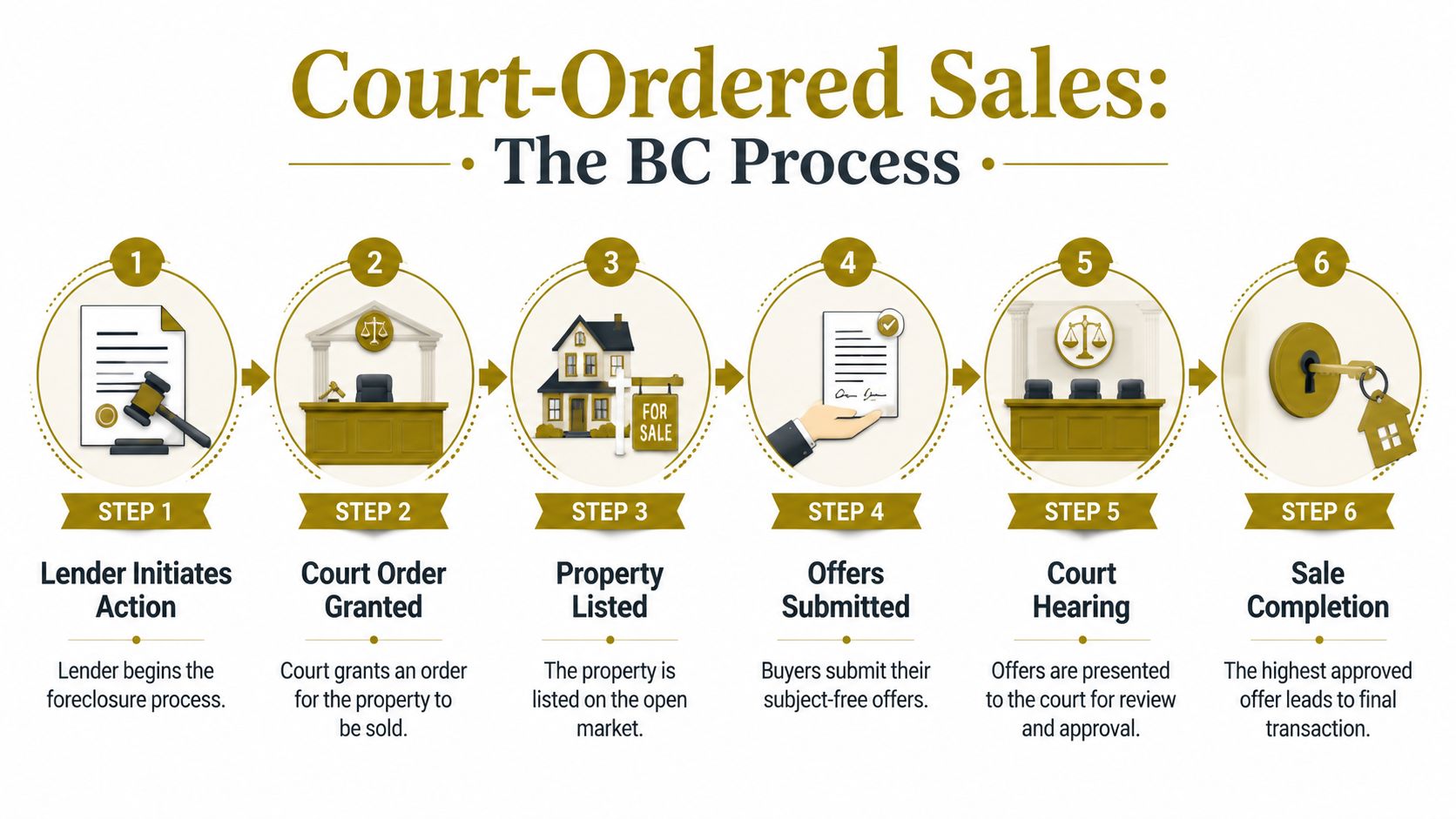
A court-ordered sale happens when a lender starts legal action after mortgage default and the court supervises the sale process. The property is marketed, offers are collected, and the final sale still needs court approval. That judicial oversight changes the rhythm of the deal from day one.
Who is involved
Several parties can affect the outcome:
- The lender starts the action and wants recovery on the debt.
- The homeowner still has an interest in the file during the process.
- Other creditors may have claims connected to the property.
- The court reviews the sale and decides whether the proposed offer is acceptable.
That last point is where many buyers get tripped up. In a standard purchase, seller acceptance usually means you're moving toward closing. In a court-ordered sale, accepted terms are often just one stage in a longer legal path.
Why this process feels different from a normal purchase
A conventional seller may negotiate over dates, repairs, inclusions, or conditions because they're trying to move a transaction forward. A court-ordered sale is more rigid. The process is built to satisfy legal requirements and protect the debt recovery process, not to create a comfortable buying experience.
That's why buyers often see terms that are stricter than what they're used to in a normal detached home purchase near Kanaka Creek, Hammond, or central Maple Ridge.
The court process doesn't reward buyers for being hopeful. It rewards buyers for being prepared.
One legal detail that catches people off guard is how title transfer language can differ from what they expected in a regular resale transaction. If you want a plain-English legal explainer, understanding bargain and sale deeds gives useful context around deed language and why legal review matters.
For buyers who want a better local grounding in how foreclosure matters are handled here, this guide to the foreclosure process in BC helps connect the legal side to the actual purchase process.
Where to Find Maple Ridge and Pitt Meadows Foreclosures
Finding a bank owned home for sale in Maple Ridge or Pitt Meadows usually starts with changing your search language. If you only search “bank-owned,” you'll miss listings that are described in BC terms. You need to watch for references to court-ordered sale, foreclosure, or similar wording in listing remarks and brokerage notes.
Start with the public-facing options
Some court-ordered sales appear where ordinary buyers already search for homes. Others show up more clearly on specialised foreclosure sites. Dedicated platforms such as Realtyvibe.ca and Zealty.ca provide free access to Maple Ridge court-ordered sales, and those properties sit alongside 951 traditional active listings, according to BC foreclosure listings for Maple Ridge.
That matters because these homes aren't always tucked away in some secret database. They're often marketed within the same wider ecosystem buyers are already watching.
What to look for in listing language
When reviewing listings, pay attention to wording that signals a non-standard sale:
- Court references: Phrases that indicate court approval is required.
- As-is wording: Language that limits seller representations.
- Special schedules: Added legal documents or sale-specific terms.
- Restricted access: Fewer showing windows or limited property information.
Some of these listings are easy to miss because the photos look ordinary. A detached house near Cottonwood Park or a property on a larger lot in Pitt Meadows can look like any other listing until you read the remarks carefully.
Why working with the right agent changes the search
This is one category where experience matters more than enthusiasm. A realtor who regularly searches Maple Ridge and Pitt Meadows inventory can spot court-order wording quickly, flag unusual clauses, and tell you when a property looks attractive on price but risky on structure, title, or location.
That local filter is useful because neighbourhood context changes the analysis. A home near schools and family-oriented streets in Albion may have stronger owner-occupier appeal. A property in an older area may need more scrutiny on lot lines, additions, or deferred maintenance. A home closer to Pitt Meadows amenities may look straightforward but still carry court-sale complications behind the scenes.
If you're actively watching inventory, this roundup of MLS listings in Maple Ridge is a practical companion to a foreclosure-focused search.
Weighing the Risks and Rewards of a Court-Ordered Sale
A court-ordered sale can work well for the right buyer. It can also punish a casual one. The reward is the possibility of buying below what comparable conventional listings might command. The risk is that you absorb far more uncertainty, with fewer chances to renegotiate once you're in.
The upside that draws buyers in
Some buyers are comfortable taking on repairs, legal review, and tighter timelines if the property offers a strong location or enough margin to justify the work. That can be attractive in neighbourhoods where detached inventory is always watched closely and buyers want land, house size, or future upside more than polished finishings.
This route tends to suit buyers who can tolerate friction. They're not expecting a tidy seller disclosure package or a smooth back-and-forth over minor fixes.
Where buyers get hurt
The phrase as-is, where-is is the heart of the risk. If the roof is near the end of its life, if the basement has moisture issues, if permits are missing, or if the yard improvements don't line up neatly with the legal lot boundaries, those problems can become yours.
The transaction also tends to be less flexible than a traditional purchase. That doesn't mean every court-ordered sale is a bad idea. It means buyers need to earn the opportunity by doing serious homework before they write.
For investors who like structured decision-making, this article on property investment risk management is a useful framework for thinking about downside exposure before chasing a “deal.”
Traditional Sale vs. Court-Ordered Sale in BC
| Aspect | Traditional Home Purchase | Court-Ordered Sale |
|---|---|---|
| Seller relationship | Direct negotiation with a homeowner or standard seller | Negotiation happens within a legal process supervised by the court |
| Conditions | Buyers often try to include financing, inspection, or document review subjects | Offers are commonly expected to be subject-free or far less flexible |
| Property condition | Sellers may provide fuller disclosure and sometimes negotiate after inspections | Property is commonly sold as-is, where-is, with limited recourse |
| Repair discussions | Buyers can sometimes request credits or repairs | Buyers usually need to price in repairs themselves |
| Timeline certainty | More predictable once terms are agreed | Court dates and approval steps can add uncertainty |
| Competition | Competes with other buyers through normal offer process | A buyer may still face competing bids at court |
| Risk profile | More balanced allocation of risk | Buyer takes on more legal and physical property risk |
| Best fit | Buyers wanting predictability and protection | Buyers who are organised, well-advised, and comfortable with uncertainty |
A lower list price only helps if you understand the cost of everything the seller isn't promising.
Who should think twice
Some buyers should be careful about this path:
- First-time buyers with little repair tolerance: If unexpected expenses would destabilise your budget, a court-ordered sale may be the wrong fit.
- Buyers who need contractual flexibility: If you rely on long subject periods, this process won't feel comfortable.
- Anyone expecting a co-operative seller: That isn't the tone of this type of transaction.
The buyers who do best are usually the ones who can separate excitement from analysis. They know that not every rough home is underpriced, and not every court sale is worth winning.
Your Due Diligence Playbook for As-Is Properties
Due diligence on a court-ordered sale happens before the offer goes in. That's the shift many buyers struggle with. In a standard transaction, subjects create breathing room. Here, your protection comes from what you investigate in advance.
A practical review starts with financing, then moves into property condition, legal review, and neighbourhood-specific issues.
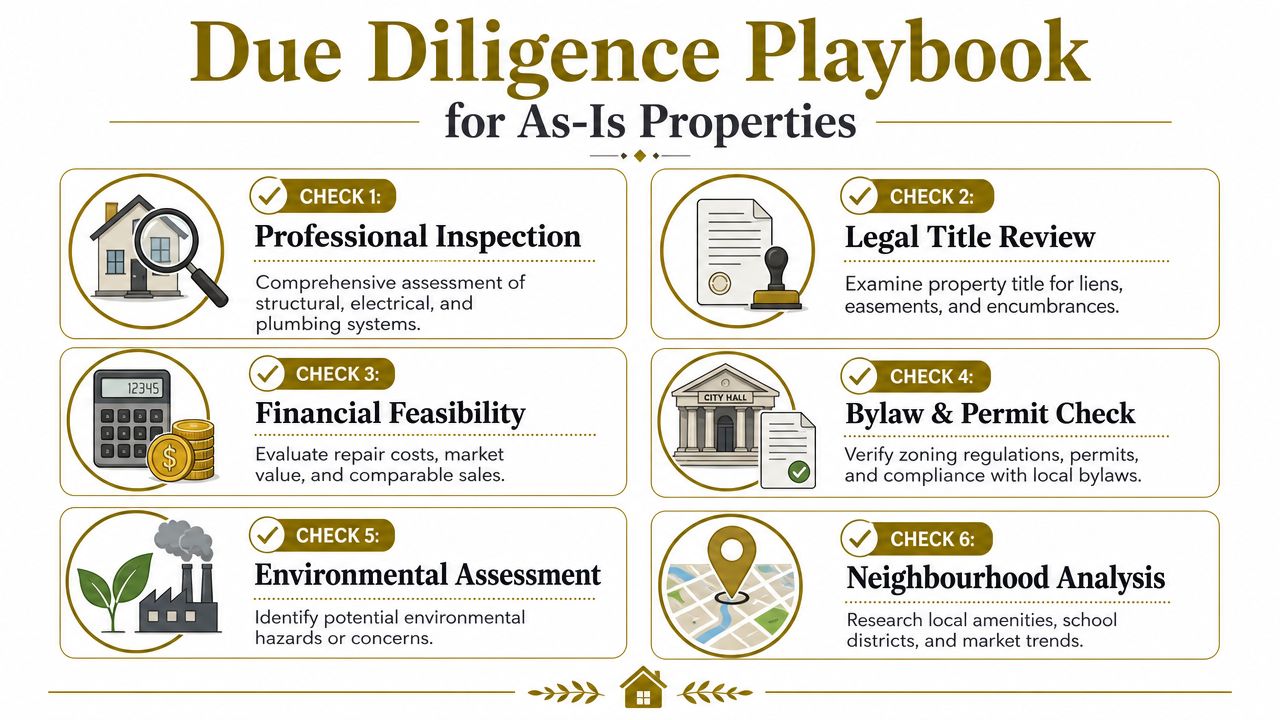
The non-negotiable checks
- Firm financing position: You need more than casual lender interest. If you can't remove financing risk before the offer, you may be taking on more than you realise.
- Home inspection planning: Even if the seller won't fix anything, you still need to understand the structure, systems, and visible defects.
- Title and legal review: Have a lawyer review the paperwork and title issues early, not after you're emotionally committed.
- Municipal and permit review: Look into additions, suites, decks, sheds, and other improvements that may raise compliance questions.
- Neighbourhood fit: A rough house in the right area can make sense. The same house in the wrong micro-location often doesn't.
For buyers who haven't gone through a detailed inspection before, this plain-language guide on what to expect from a home inspection is useful for knowing what inspectors typically focus on and how to read the findings.
A Maple Ridge issue many buyers miss
In Maple Ridge, bank-owned homes frequently lack a current property survey, which means buyers may need a new survey or a reliance letter to verify setbacks, fences, and additions, especially in older neighbourhoods such as Cottonwood and Silver Valley, as noted by Key Homes on bank-owned property considerations.
That matters more than many people think. Older lots can carry long-standing fence placements, retaining walls, sheds, or additions that everyone has lived with for years. In a normal family sale, there may be more disclosure and context. In a court-ordered sale, you may get far less history.
Local caution: If a property line issue would bother you after possession, investigate it before the offer, not after closing.
This is also where valuation discipline matters. If you're trying to decide whether the numbers still work after likely repairs and survey costs, a review of house appraisals and cost considerations can help frame how lenders and buyers think about value versus condition.
A short video can also help clarify the inspection mindset buyers need before taking on an as-is property:
What due diligence looks like in practice
A smart buyer doesn't just ask, “Can I afford the purchase price?” The better question is, “Can I afford the purchase price, immediate repairs, legal review, survey issues, and the possibility that I'm still competing at court?”
If that answer is yes, then a court-ordered sale may be worth pursuing. If that answer depends on everything going perfectly, it usually isn't.
Making an Offer and Navigating the Court Approval Process
The process now becomes less familiar and more strategic. A buyer may feel they've won once the lender accepts their offer terms, but that isn't the finish line. In a court-ordered sale, it's closer to the middle of the road.
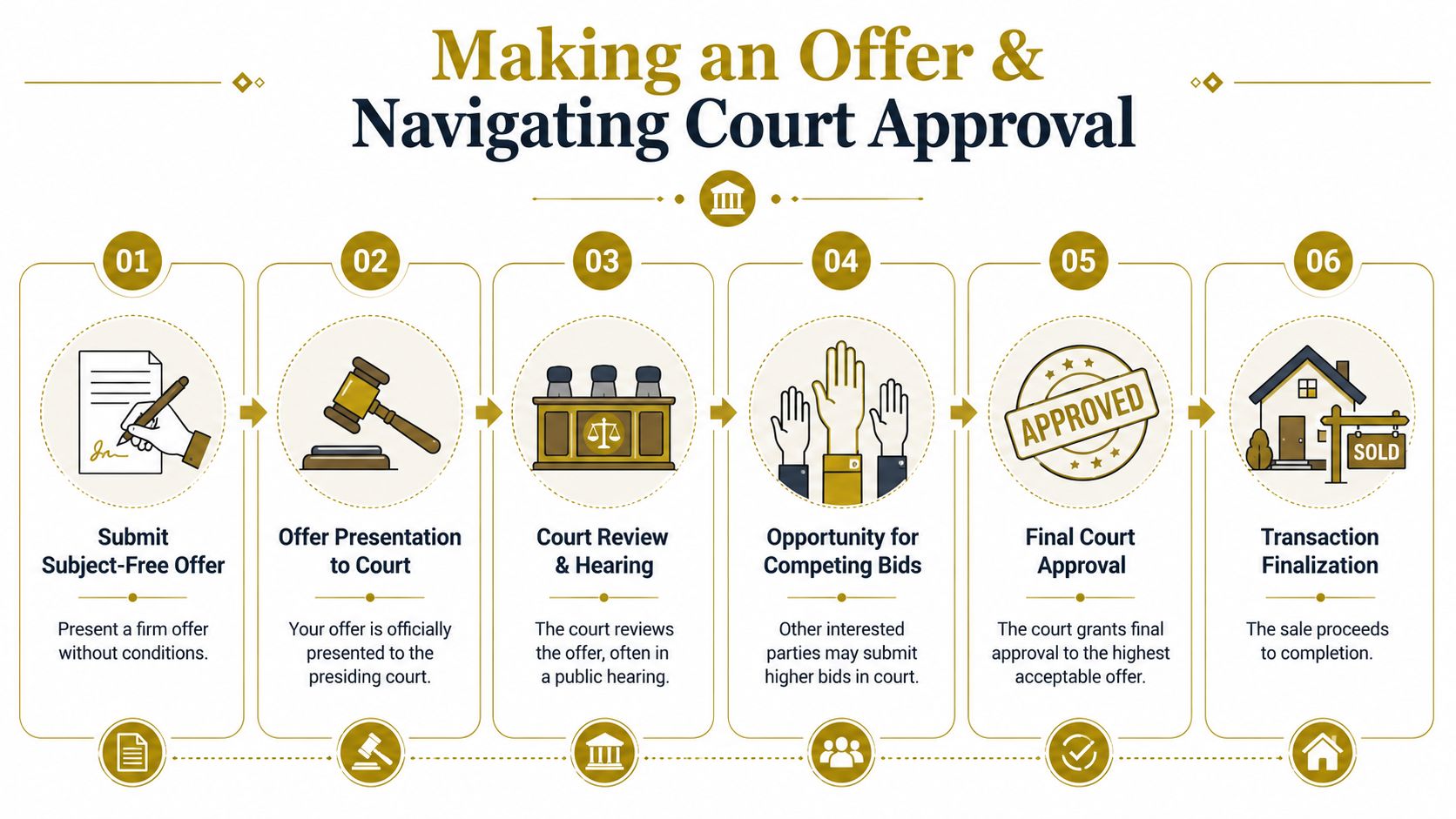
The two-stage reality
First, the buyer prepares an offer that is usually expected to be clean, serious, and difficult to attack. Then, if those terms are accepted for presentation purposes, a court hearing is scheduled so the sale can be reviewed and approved.
At that hearing, another interested party may appear and submit a competing offer. That possibility changes how experienced buyers think. They don't just ask whether their first number is acceptable. They ask how far they're willing to go if the process gets competitive in court.
What improves your position
Several things help:
- Strong paperwork: Clean documents and clear deposit arrangements show you're ready.
- A realistic opening number: Too low and you may not get traction. Too aggressive and you may erase the value you were chasing.
- Emotional discipline: If another bidder pushes the number past your comfort zone, you need a hard ceiling.
- Professional guidance: This process is much easier when your realtor understands local court-sale mechanics and courtroom expectations.
Court-ordered sales favour buyers who can stay calm after they've already spent time and money preparing.
Why going alone is a gamble
A regular resale already has moving parts. A court-approved sale adds legal procedure, stricter terms, and the risk of losing the property after you thought you had it lined up. That's a poor place to learn by trial and error.
An experienced local agent can help you decide whether a property in Maple Ridge or Pitt Meadows is worth the effort, whether the offer strategy is sound, and whether the court process is likely to justify the work. If you're comparing your options, this page on choosing a realtor in Maple Ridge is a helpful place to start.
If you're considering a court-ordered sale, or just trying to figure out whether a conventional purchase would serve you better in Maple Ridge or Pitt Meadows, Royal LePage Brookside Realty Property Management can help you sort through the trade-offs with practical local guidance.