
If you're looking at the suburbs of Vancouver BC from a Maple Ridge or Pitt Meadows point of view, you're probably already feeling the tension that defines this market. You want enough space to live properly. You want a commute you can tolerate. You want neighbourhoods that fit your day-to-day life, not just a spreadsheet. And you don't want to overpay because a postal code sounds closer to downtown.
That's the main challenge across Metro Vancouver. Buyers often start with a map and a budget, then quickly realise that Burnaby, Richmond, Surrey, Coquitlam, Langley, Pitt Meadows, and Maple Ridge are not interchangeable. Sellers face a similar issue. If you own in Maple Ridge, your home isn't competing with every listing across the region. It's competing within a very specific value conversation about space, access, lifestyle, and what buyers are willing to trade for each.
From the east side of the region, the question usually isn't “Which suburb is best?” It's “Which trade-off works for me?” That's a far more useful way to approach the search.
Finding Your Place in the Metro Vancouver Puzzle
A lot of buyers begin the search in the same place. They look at Vancouver first, then Burnaby, then maybe Coquitlam or Surrey, and eventually they start moving further east because the numbers and the lifestyle start to make more sense there.
That progression isn't random. Metro Vancouver had about 2,657,000 residents in 2023, while the City of Vancouver itself had about 662,248 people. The average home price in Greater Vancouver reached $1,318,687 in early 2024, with detached homes averaging $2,207,689 according to this Vancouver demographics overview. When that many people are competing inside a tight regional housing system, suburban communities stop being a backup plan. They become the working part of the market.

Fit matters more than the first search result
A detached house in one suburb and a townhome in another don't answer the same need. One buyer needs room for kids, a dog, and hockey gear. Another wants a lower-maintenance home near transit. Another is selling in Maple Ridge and wondering how to position their property against newer stock in Surrey or Langley.
That's why broad “best suburb” lists usually miss the point. They flatten very different communities into one ranking.
A more useful filter looks like this:
- Commute reality: How often do you need to reach Vancouver, Burnaby, or another job centre?
- Home type: Are you looking for a condo, townhome, detached house, or future redevelopment potential?
- Lifestyle: Do you want walkable urban convenience, or do parks, trails, schools, and yard space matter more?
- Stage of life: First-time buyers, move-up families, downsizers, and investors don't shop the same way.
Practical rule: Don't start with “What's cheapest?” Start with “What problem is this move solving?”
For a current pulse on regional conditions, it also helps to compare your search against more current local commentary such as these Metro Vancouver housing market insights for May 2026. The exact property that fits you often sits in a different municipality than the one you first had in mind.
What Maple Ridge buyers usually see earlier than everyone else
Buyers shopping further east often get clarity faster because the trade-offs are more visible. You know you may be giving up some proximity to the core. In return, you're usually looking for more functional homes, more outdoor access, and neighbourhoods that feel less compressed.
That doesn't mean every eastern option is automatically better value. It means you need a smarter lens. Once you use that lens, the suburbs of Vancouver BC stop looking like a giant blur and start breaking into clear categories.
Why Not All Suburbs Are Created Equal
The biggest mistake buyers make is comparing Metro Vancouver homes by square footage alone. A similar-sized home in Burnaby and Maple Ridge can sit in completely different value systems because the region doesn't price housing by size only. It prices housing by access, land constraints, and future use.
Think in value zones, not municipal borders
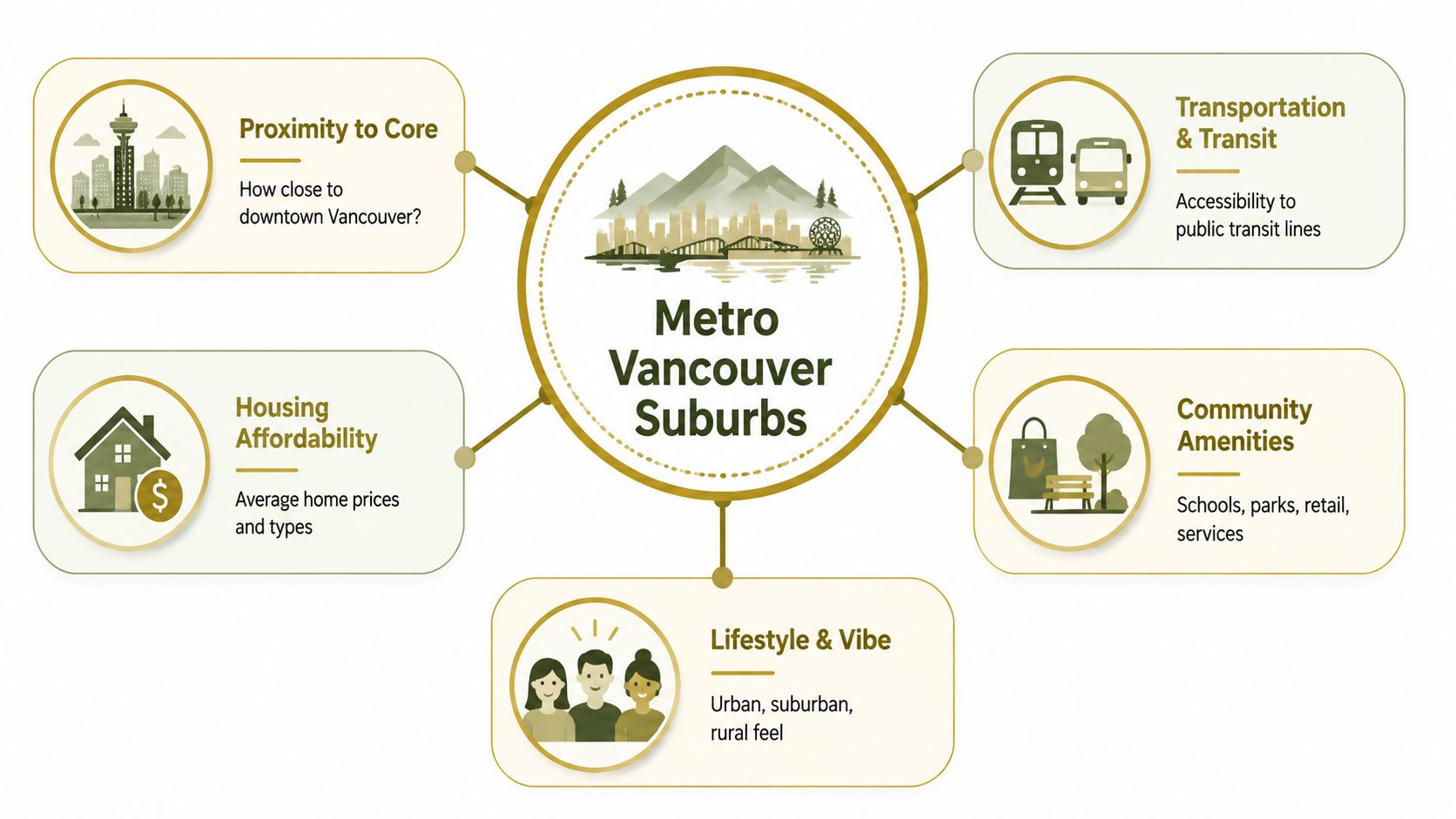
A simple way to understand the suburbs of Vancouver BC is to picture the region as a set of value rings. Closer isn't always better for every buyer, but access changes price behaviour.
As noted in this overview of Vancouver's southern suburbs, Metro Vancouver's suburban housing market is best analyzed as a transit-access and land-scarcity system. Developable land is constrained by river crossings, the Agricultural Land Reserve, and urban boundaries. In practice, that means two homes that look similar on paper can command very different prices if one sits in a stronger transit catchment or a municipality with more redevelopment potential.
Here's how that plays out on the ground:
| Factor | What it changes | Why it matters |
|---|---|---|
| Transit access | Buyer pool size | More people can realistically consider the property |
| Bridge and highway connectivity | Commute tolerance | Driving friction affects what buyers will pay |
| Land scarcity | Future supply | Limited buildable land supports stronger competition |
| Zoning direction | Redevelopment potential | Buyers may price in future upside |
| Neighbourhood form | Daily lifestyle | Walkability, density, and pace shape demand |
What works and what doesn't
What works is comparing homes inside the same access pattern. A condo near rapid transit should be compared with other transit-oriented product. A detached home in a family-oriented Maple Ridge pocket should be measured against similar lifestyle inventory, not only against an inner-ring condo.
What doesn't work is using broad averages to justify a purchase. Averages hide too much.
A shorter map distance doesn't always create better value. A better daily pattern often does.
If you're weighing older homes against new construction while making those comparisons, some of the insights from Stage AI for Realtors are useful because they frame the trade-offs buyers feel in showings. Newer homes often win on layout and maintenance expectations. Older homes can offer lot position, neighbourhood maturity, and renovation upside. In Metro Vancouver, those differences become sharper when transit and land constraints are layered on top.
A second helpful lens is to look at how the region is shifting toward denser, more connected suburban living. This piece on smarter connected suburban communities in BC fits that conversation well, especially if you're trying to judge whether a suburb's current character will hold or evolve quickly.
Life Close to the Core Burnaby Richmond and North Van
Burnaby, Richmond, and North Vancouver often sit high on buyers' wish lists for one reason. They give people a version of suburban living without feeling far from the metropolitan core.
That convenience is real. So is the trade-off.

Burnaby offers connectivity and constant change
Burnaby appeals to buyers who want strong regional access and a wide range of housing forms. You'll find tower districts, established single-family pockets, shopping nodes, and areas that continue to intensify.
The upside is convenience. The compromise is that many buyers pay a premium for that convenience while accepting less private outdoor space, more density, and a faster-moving urban environment. For some households, that's exactly right. For others, it starts to feel busy very quickly.
If Burnaby is on your shortlist, it helps to understand where redevelopment pressure is strongest. This local look at Brentwood Block and Burnaby development direction is useful because it reflects how neighbourhood identity and housing form can shift over time.
Richmond gives access and a very specific lifestyle
Richmond tends to attract buyers who value airport access, established commercial amenities, and a strong everyday convenience factor. It can work very well for households whose routines are tied to certain employment areas or who want a flatter, highly serviced community.
The trade-off is that Richmond doesn't offer the same natural environment or neighbourhood rhythm as places further east. A buyer looking for a larger yard, direct trail access, or a more tucked-away residential feel often keeps moving.
North Vancouver delivers scenery, but not at a casual price point
North Vancouver has a lot of emotional pull. The mountain backdrop, outdoor access, and distinct local identity are hard to ignore. Buyers who choose it usually know why they're paying for it.
What they also accept is a tighter, more competitive environment where inventory type, traffic pattern, and neighbourhood positioning matter a great deal. You may get remarkable surroundings, but you won't usually get “more for less” in the same way buyers often hope to find further east.
Close-to-core suburbs work best when your schedule benefits from that closeness every week, not just in theory.
For Maple Ridge and Pitt Meadows buyers, these inner-ring communities are useful comparison points. They show exactly what the region charges for proximity, and exactly what space many households are willing to give up to stay near the centre.
Exploring the Rapidly Growing Hubs
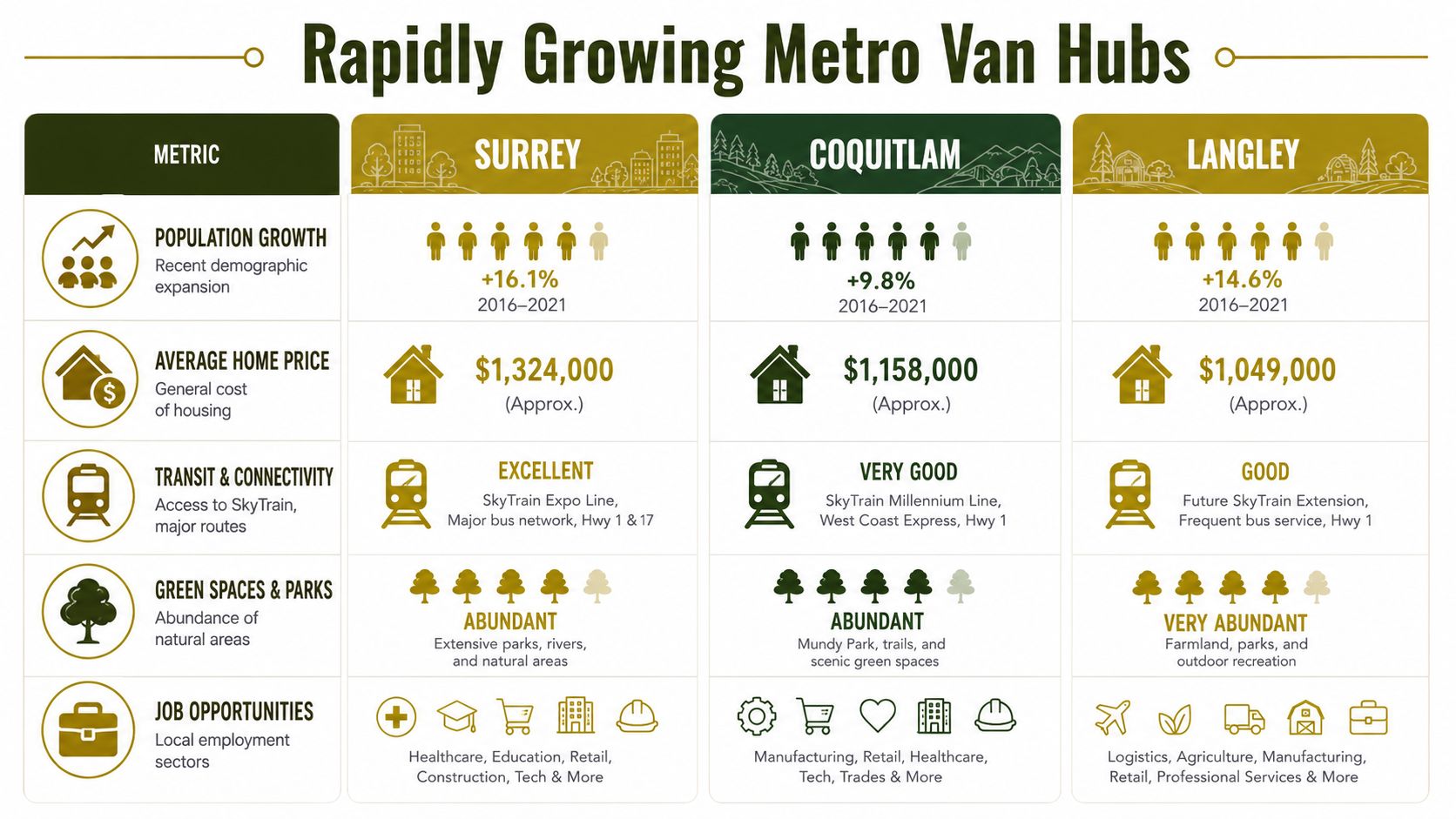
Surrey, Coquitlam, and Langley sit in the middle of a lot of buyers' decision-making. They're not the closest suburbs to Vancouver, but they aren't the eastern edge either. They often attract buyers who want a balance between access, newer housing stock, and somewhat more room than the inner ring typically provides.
Surrey, Coquitlam, and Langley are growing in different ways
Surrey often feels like a region unto itself. Some areas are urbanising quickly, while others still feel more spread out and residential. Buyers need to separate city-centre product from family-oriented neighbourhood product because they serve different goals.
Coquitlam tends to attract buyers who want transit-oriented options and a more structured connection to the regional core. It often suits people who are comfortable with denser housing forms if the commute logic is strong.
Langley draws plenty of attention from buyers who want suburban convenience with newer developments and road-oriented mobility. For many Maple Ridge buyers, Langley is the direct comparison when they're asking where their money works harder.
One recent report highlighted Coquitlam West and Willoughby Heights as areas benefiting from transit and highway improvements, with estimated average prices of about $873,933 and $894,516 respectively in the BIV coverage of undervalued Metro Vancouver neighbourhoods. That's useful, but it doesn't answer the full question. Cheaper than another suburb doesn't automatically mean undervalued.
Here's a practical comparison:
- Surrey: Best for buyers who want scale, variety, and are comfortable sorting through very different submarkets.
- Coquitlam: Strong option if transit access ranks near the top of your list and you're open to denser housing.
- Langley: Often appeals to buyers chasing newer suburban product, but neighbourhood-by-neighbourhood selection matters a lot.
This local discussion of Surrey's ambitious entertainment district plans also helps frame how growth can reshape a suburb's future identity, not just its pricing.
To get a broader visual sense of how these hubs are discussed, this video adds useful context:
The key question isn't “Is it cheaper?”
The key question is whether a suburb's discount is tied to a temporary perception gap or to a permanent limitation. Buyers who miss that distinction often end up choosing based on headline pricing instead of long-term fit.
That's where Maple Ridge and Pitt Meadows start standing apart. Their case isn't just about being east. It's about what that eastern position gives you.
The Maple Ridge and Pitt Meadows Advantage
Maple Ridge and Pitt Meadows work best for buyers who want their home to do more than provide an address. They want livable square footage, practical neighbourhoods, and easier access to nature without leaving the regional economy behind.
That's why the value proposition here tends to be misunderstood by people who only compare distances on a map.

What buyers gain by moving further east
As density increases in the core, eastern municipalities take on a more important housing role. Statistics Canada reporting cited in this Vancouver profile and demographic summary supports that broader pattern, and the same source notes a regional median household income of $82,000. That matters because many households are trying to solve the same problem. They need ownership options that still align with real monthly life.
Maple Ridge and Pitt Meadows often answer that need better than people expect.
Neighbourhoods here solve different problems well
Albion usually appeals to families who want a residential feel, schools nearby, and neighbourhood parks that are actively used. Silver Valley attracts buyers who value a newer-home setting and direct access to trails, trees, and a more outdoors-oriented daily routine. West Maple Ridge is often where commute-conscious buyers start focusing because of its relative convenience within the community. Pitt Meadows appeals to people who want a quieter rhythm, flatter geography, and a location that still feels connected.
Those are not small differences. They shape whether a move feels like a compromise or a genuine improvement.
A few practical examples:
- For growing families: Larger-feeling neighbourhood patterns, local parks, and more room for everyday life often matter more than shaving a bit off the commute.
- For move-up buyers: The appeal is frequently functional space. Extra bedrooms, yard use, storage, and home office flexibility all carry real value.
- For downsizers who still want breathing room: Pitt Meadows in particular can offer a calmer setting than denser suburban centres.
Buyers who succeed in Maple Ridge usually aren't chasing prestige. They're buying usability.
What sellers in Maple Ridge should understand
If you're selling in Maple Ridge or Pitt Meadows, the pitch isn't “we're cheaper than Vancouver.” That's weak positioning, and it misses what local buyers respond to.
The stronger story is about lifestyle fit. Sellers do better when they present the property through the lens buyers already care about:
- Daily function: Show how the layout works for families, remote work, hobbies, or multigenerational living.
- Neighbourhood rhythm: Highlight parks, schools, trail access, and the feel of the immediate area.
- Commuter practicality: Be clear about route options and where the home sits within Maple Ridge or Pitt Meadows.
- Property type honesty: A detached home, townhome, or condo each attracts a different buyer. Marketing should reflect that.
If you're actively comparing local inventory, this page of homes for sale in Pitt Meadows is a helpful reference point for understanding how buyers frame east-of-region options.
For many households, living further east isn't settling. It's choosing space, pace, and long-term livability over a shorter line on Google Maps.
Navigating the 2026 Fraser Valley Market
The Fraser Valley conversation now sits inside a larger regional economic story. People don't buy in Maple Ridge and Pitt Meadows in isolation. They buy here while staying connected to Metro Vancouver's employment engine.
That connection matters because Metro Vancouver generated 57% of British Columbia's total GDP in 2020 and 77% of BC's high-technology-sector GDP, as outlined in Invest Vancouver's data-driven perspective on the region. For housing, that kind of concentration tends to push demand outward into municipalities where ownership, space, and land-use flexibility remain more realistic.
What that means locally
In practical terms, Maple Ridge and Pitt Meadows keep benefiting when buyers decide they don't need to live closest to the core to remain part of the region's economy. Hybrid schedules have also changed how many households judge distance. If you're commuting every day, location pressure feels one way. If you're commuting less often, lifestyle starts carrying more weight.
That doesn't mean every property will perform the same. Buyers still need to watch location within the municipality, housing type, and local supply. Sellers need to understand that presentation matters just as much as price point.
A few patterns tend to hold:
- Well-positioned family homes usually draw attention because they solve several problems at once.
- Townhomes and practical strata options appeal to buyers who want an entry point without giving up the area.
- Homes with clear outdoor or functional lifestyle benefits tend to stand out against denser competing suburbs.
Strategy matters more than volume of listings
For sellers, one of the biggest missed opportunities is weak marketing. Strong visuals, floor plans, and a clear explanation of lifestyle fit help eastern suburban properties connect with the right buyer pool. If you're thinking about listing, this resource on how to sell properties faster with virtual tours is worth reviewing because it speaks directly to how buyers filter homes before booking a showing.
Royal LePage Brookside Realty Property Management is one local option for Maple Ridge and Pitt Meadows owners who need support with real estate services or property management, but the key point is broader than any single company. In this market, strategy wins. Generic listing copy doesn't.
Your Next Move in Maple Ridge Real Estate
The suburbs of Vancouver BC make more sense when you stop treating them like one market. Burnaby, Richmond, North Vancouver, Surrey, Coquitlam, Langley, Pitt Meadows, and Maple Ridge all ask buyers to make different trade-offs. Some give you proximity. Some give you transit convenience. Some give you density and amenities. Further east, you often gain space, nature, and a more usable day-to-day lifestyle.
That's why Maple Ridge and Pitt Meadows continue to stand out for many buyers and sellers. They sit inside the regional economy, but they don't have to mimic the most compressed parts of it.
A simple decision framework for buyers
If you're buying, narrow your search with three filters first:
- How often do you commute and to where
- What kind of home do you need
- What kind of week do you want to live
That sounds basic, but it clears up a lot. Buyers get into trouble when they chase a municipality name instead of a lifestyle fit. The right home in Albion may serve you better than the wrong one closer to downtown. The right property in Pitt Meadows may beat a denser option in a faster-growing hub if calm, convenience, and space matter more to you.
A sharper lens for sellers
If you're selling, don't market your home as a discount version of somewhere else. Position it around the strengths local buyers are already searching for. Show the function of the home. Show the feel of the neighbourhood. Be honest about commute realities, but don't apologise for the eastern location. For the right buyer, that location is the point.
The best suburb isn't the one with the loudest reputation. It's the one that fits your real life after possession day.
Good decisions in this market come from local context, not generic rankings. If you want to buy or sell in Maple Ridge or Pitt Meadows, the most useful next step is a grounded conversation about your timing, your goals, and which neighbourhoods fit the way you live.
If you're planning a move and want practical guidance on buying, selling, or evaluating a property in Maple Ridge or Pitt Meadows, Royal LePage Brookside Realty Property Management offers local real estate support built around market knowledge, pricing strategy, and neighbourhood insight.