You've found a condo or townhome that looks right. The kitchen works, the layout fits, the neighbourhood feels good, and the monthly strata fee seems manageable at first glance. Then the document package lands in your inbox and suddenly the easy part is over.
That's where many first-time buyers in Maple Ridge and Pitt Meadows get stuck. A listing in Albion, Cottonwood, or near the West Coast Express can look straightforward until you start reading bylaws, budgets, meeting minutes, and engineering language about roofs, balconies, plumbing, and reserve funds. Buyers aren't asking for a legal lecture. They want to know one thing: is this a well-run building, and what will it really cost me to own?
Your Guide to Strata Living in Maple Ridge
In Maple Ridge, strata living can mean a condo near the town centre, a family townhome in Albion, or a newer development closer to Silver Valley. The setting changes, but the buyer concern is usually the same. You're not only buying the space behind your front door. You're buying into a system of shared decisions, shared costs, and shared risk.

A lot of buyers assume strata is mostly about rules for pets, parking, and noise. Those things matter, but they're not the whole story. Strata property management affects your day-to-day life, your monthly budget, how major repairs get handled, and how future buyers will view your home when it's time to sell.
What local buyers need to understand early
Before you write off a building because the fee looks high, or get excited because the fee looks low, you need context.
- Monthly fees tell only part of the story. A lower fee can sometimes hide deferred costs.
- Meeting minutes often reveal more than the listing does. You'll usually spot recurring issues, owner frustration, or signs of a council that stays ahead of problems.
- Neighbourhood matters, but governance matters too. A beautiful complex near Kanaka Creek or in Pitt Meadows still needs competent management.
A well-run strata usually feels boring in the best way. Bills are paid, repairs are tracked, owners know the rules, and surprises are reduced.
That's what buyers should be looking for. Not perfection. Good process.
What Exactly is a Strata Corporation
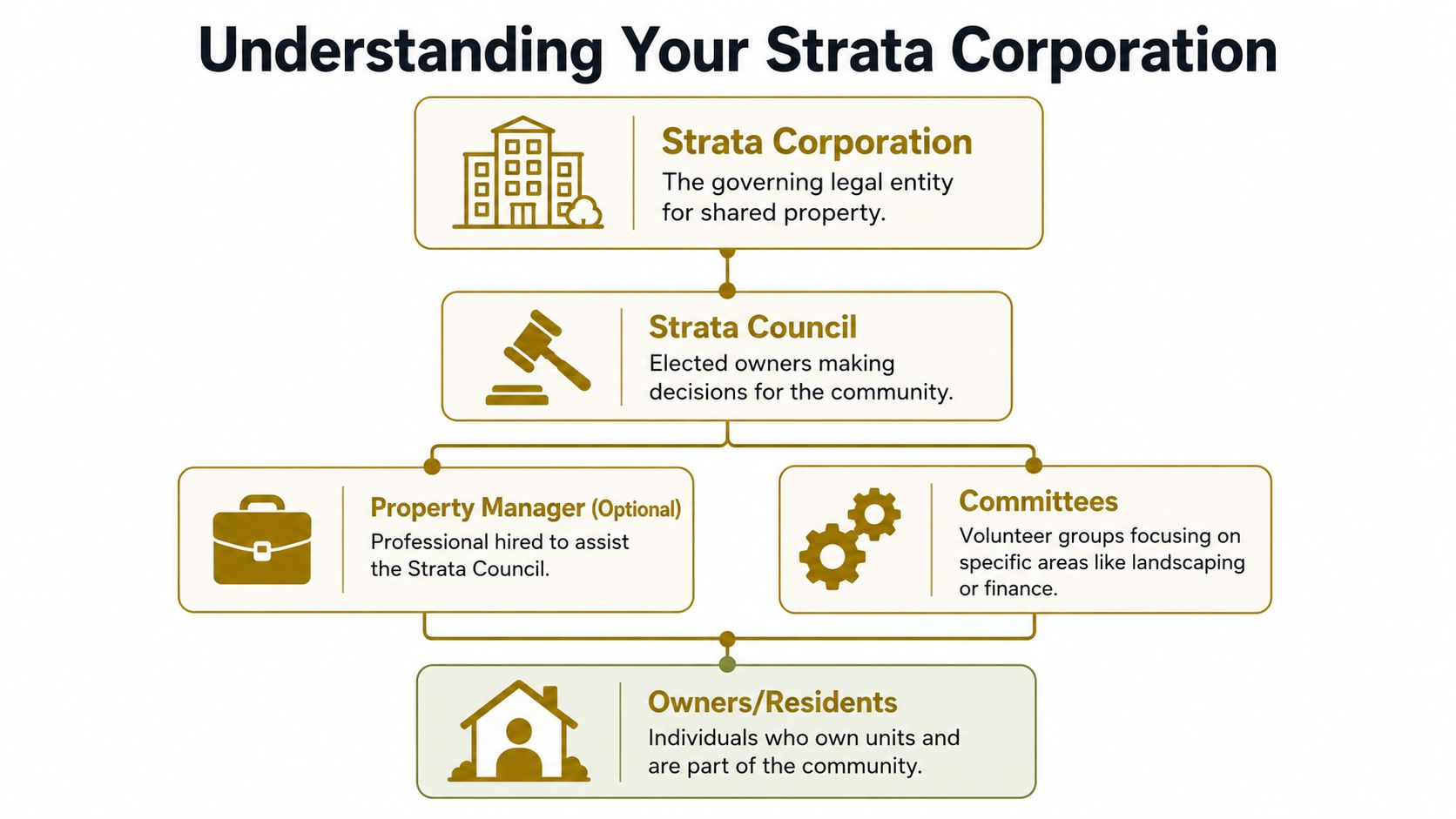
A strata corporation is easiest to understand as a small local government for a building or complex. It isn't a company in the usual business sense. It's the legal body made up of all owners, and it governs the shared property and shared obligations of the community.
If you buy into a strata in Maple Ridge, you own your home, but you also become part of that corporation. That means you get rights, responsibilities, and a vote.
For a more basic overview, this short guide on what a strata property is is a useful starting point before you dig into the operational side.
The parts owners need to know
A few terms come up over and over in document review.
- Strata lot means your unit. That's the home you buy.
- Common property means shared areas used by everyone, such as hallways, roofs, lobbies, driveways, elevators, or grounds.
- Limited common property usually means shared property assigned to the use of one owner or a small group, such as a balcony, patio, or parking stall in some complexes.
If you've never owned in a strata before, this matters because maintenance responsibility often depends on which category applies. Buyers get caught when they assume “my balcony” means “my repair bill” or, just as often, the opposite.
Who makes decisions
Most day-to-day decisions come from the strata council, which is a group of elected owners. They're not separate from the ownership group. They're your neighbours serving in a governance role.
Here's the practical version:
| Part of the strata | What it does |
|---|---|
| Owners | Vote on major matters and fund the corporation through strata fees and levies |
| Strata council | Handles routine governance, approves work, and responds to issues |
| Property manager | Carries out administration and operational tasks if hired |
| Committees | Help with landscaping, finance, social matters, or building-specific projects |
Important distinction: council members decide policy and direction. A manager carries out the process. When that line gets blurry, buildings get messy.
In a healthy community, owners understand that they are not solely residents. They are members of the governing body that owns and maintains the shared property together.
The Role of a Professional Strata Manager
Some stratas are self-managed. That means the volunteer council handles the books, records, notices, repairs, contractor coordination, meeting preparation, and owner communication themselves. In a small, simple complex with highly engaged owners, that can work. In many buildings, it becomes hard to sustain.
Professional strata property management adds structure. It doesn't replace council authority, but it does give the council a system to operate through.
If you want a broader real-world view of the day-to-day scope, this overview of what a property manager does lays out the operational side clearly.
Where managers create real value
Most of the work falls into three buckets.
Financial administration
A professional manager helps collect strata fees, process invoices, support budgeting, coordinate trust accounting, and prepare financial reporting for council and owners. In these demanding areas, inexperienced volunteer management often starts to strain, especially once insurance renewals, vendor contracts, or emergency invoices start piling up.
In larger property management markets, scale and software adoption are already central to operations. California, for example, had an estimated 54,173 property management companies and a residential property management software market size of USD 145.2 million in 2021, projected to reach USD 185.5 million by 2027, with 19,248 active property management software installations in July 2022. Those figures point to a mature operating environment where technology supports shared-governance buildings and complex maintenance coordination, according to Strategic Market Research's property management industry statistics.
Records and communication
Good managers keep minutes, maintain official records, send notices, support annual general meetings, and help councils follow procedure. They also create a buffer between owners and council when tensions rise.
That buffer matters more than people think. In a strained building, every email can feel personal. A manager introduces process.
Maintenance coordination
Managers don't usually swing the hammer. They coordinate insured vendors, schedule work, log complaints, and help the council compare options. Security also falls into this operational bucket. For buildings reviewing access control, lighting, entry systems, or after-hours response planning, this property management security guide is a practical resource because it frames security as part of building operations rather than an afterthought.
What doesn't work
The weak setup is a council that expects the manager to “take over everything” while no one on council reads reports, approves decisions properly, or follows up on long-term planning. The other weak setup is the opposite: a council micromanages every call and every invoice, slowing everything down.
A manager is most useful when council governs and the manager executes.
Navigating the BC Strata Property Act
Most buyers don't need to memorise the Strata Property Act. They do need to know where ultimate authority sits and how to read the documents that affect daily life and future costs.
At the top is the Act itself. Then come the bylaws, which govern behaviour and obligations within that specific strata. Then come the rules, which are often narrower and usually deal with the use of common property and shared facilities.
The documents that matter before you buy
When I'm speaking with first-time condo buyers in Maple Ridge or Pitt Meadows, I tell them not to focus only on the listing sheet. The full story is usually in the document package.
Pay close attention to:
- Meeting minutes from at least the past two years. Look for repeated leaks, ongoing disputes, major project discussions, insurance concerns, or chronic owner complaints.
- The annual budget. This shows what the building expects to spend and where the money is going.
- The Form B Information Certificate. This helps confirm key details about the strata lot and financial obligations.
- Bylaws and rules. These affect pets, rentals, parking, storage, renovations, and use of common areas.
If minutes keep circling back to the same unresolved issue, that's usually not bad luck. It's a management or governance pattern.
This isn't just legal homework. It's how you find out whether a townhome complex in Silver Valley is organised, whether a condo near downtown Maple Ridge has deferred maintenance, or whether a building in Pitt Meadows is constantly arguing over the same operational problems.
Vendor decisions and conflict disclosure
BC also expects a regulated approach to professional conduct. In British Columbia, strata property managers operate under a regulated compliance model. Conflicts of interest must be disclosed in writing under Section 30 of the Rules, and the BCFSA also recommends providing multiple quotes where a manager has any actual or perceived service-provider relationship. That guidance matters because it helps protect owners from opaque vendor decisions and related-party risk, as outlined by the BCFSA conflict of interest guidelines for strata management.
That's one reason governance quality matters so much. If a manager or council can't explain how vendors are chosen, owners should slow down and ask better questions.
For readers tracking broader policy discussion around the province, this article on calls to overhaul the B.C. Strata Property Act gives useful local context.
The Money Talk Fees Funds and Special Levies
This is the part buyers care about most, and for good reason. The question isn't whether strata living has shared costs. It always does. The question is whether those costs are being handled in a way that protects owners, or postponed in a way that creates future pain.
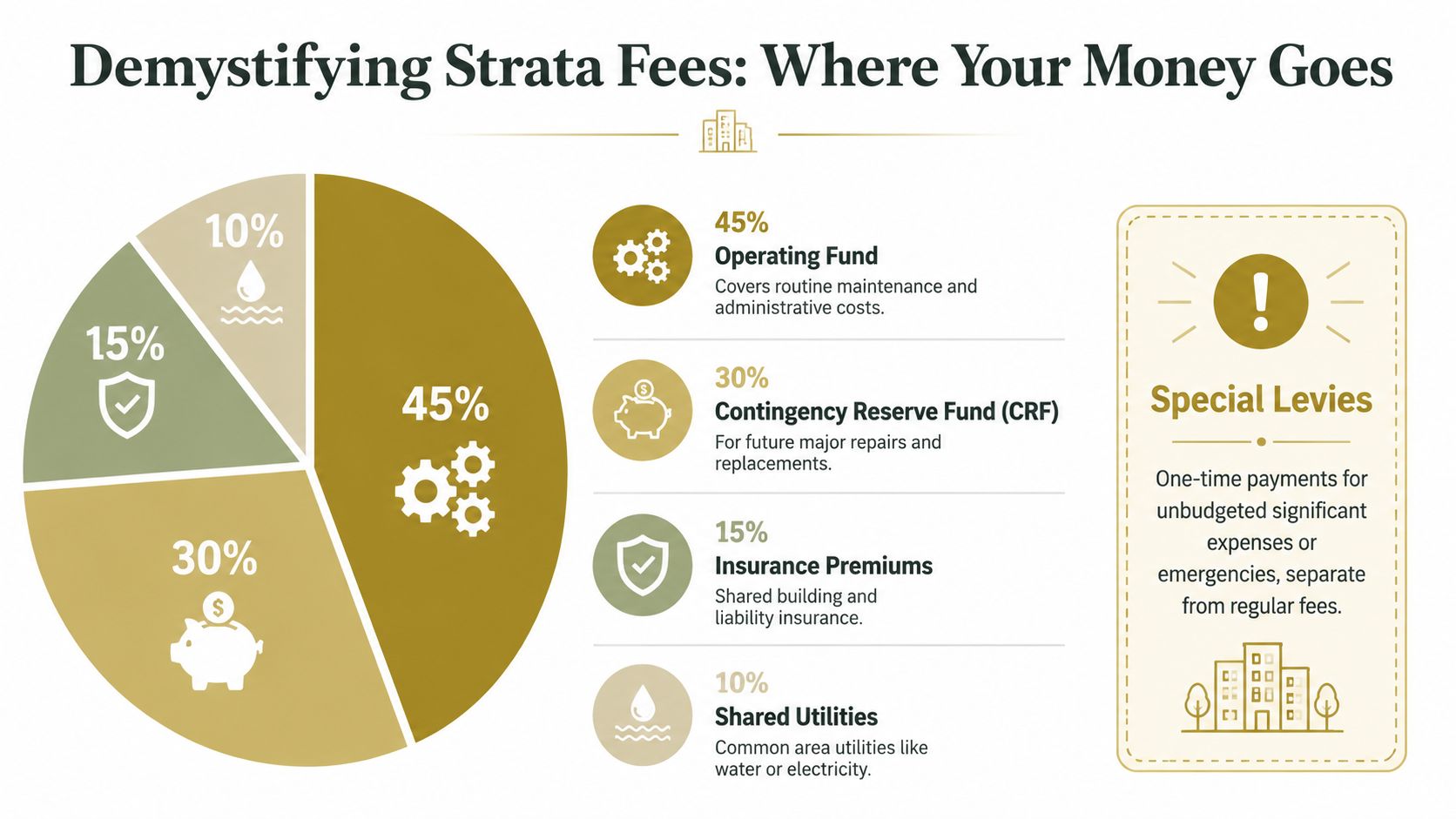
Where your monthly strata fee goes
In practical terms, strata fees usually support two broad financial needs.
First, there's the operating fund. That covers recurring expenses such as cleaning, gardening, management, minor repairs, and routine administration.
Second, there's the contingency reserve fund, often called the CRF. That's the building's savings pool for larger repair and replacement work over time.
The mistake many first-time buyers make is assuming a low monthly fee equals affordability. It might. It might also mean the building isn't saving enough for future work.
In British Columbia, the key financial question is simple: who pays when major repairs are needed? The answer is the owners, either through monthly contributions to a reserve fund or through one-time special levies. An underfunded reserve in an aging building can materially change the actual cost of ownership, as explained in this piece on strata repair costs, reserve funds, and special levies.
Why the depreciation report matters
A depreciation report is one of the most useful planning documents in a strata. It gives owners a long-range view of building components that wear out over time, such as roofing, windows, balconies, plumbing systems, and building envelope elements.
That report doesn't predict the future perfectly. It does something just as valuable. It forces the building to plan.
In Maple Ridge and Pitt Meadows, this matters because buyers often compare two homes based on list price and monthly fee alone. But two similar-looking properties can carry very different financial risk if one building has weak reserve planning and the other has been steadily funding future work.
Here's the issue in plain language:
- Healthy reserve planning usually means owners absorb major costs gradually over time.
- Weak reserve planning often leads to sudden cash calls.
- Deferred maintenance can also affect resale because future buyers read the same minutes and reports you do.
A practical comparison can help:
| Building condition | What buyers often see | What owners may later face |
|---|---|---|
| Proactive strata | Higher but understandable fees, regular projects, clearer records | Fewer surprises and easier budgeting |
| Reactive strata | Lower fees and less visible planning | Pressure for special levies and tougher resale conversations |
Before going further, this video gives a useful visual overview of how strata finances and ownership responsibilities work in practice.
Buyer and seller implications
For buyers, a badly underfunded building can turn an apparently affordable condo into a stressful one.
For sellers, poor governance doesn't stay hidden. Once a buyer's lawyer or agent reviews the package, unresolved maintenance and weak reserve planning often come straight back into price negotiations.
If you're also trying to understand how ownership charges are treated more broadly, especially when people mix up strata fees with tax questions, this explainer on understanding HOA fees and taxes is a helpful comparison piece.
Practical rule: don't ask whether the strata fee is high or low. Ask whether it matches the building's actual obligations.
Common Strata Issues and Practical Solutions
Most strata conflict isn't dramatic. It's repetitive. A resident parks in the wrong stall. A neighbour complains about late-night noise. Someone installs flooring without proper approval. A leak starts as “probably nothing” and turns into three units arguing about responsibility.
In Maple Ridge, I see the same categories come up across very different communities. A family-oriented townhouse complex in Albion may deal with parking pressure and patio use. A condo building closer to central Maple Ridge may see more noise complaints, move-in damage disputes, or questions around rentals and visitor access.
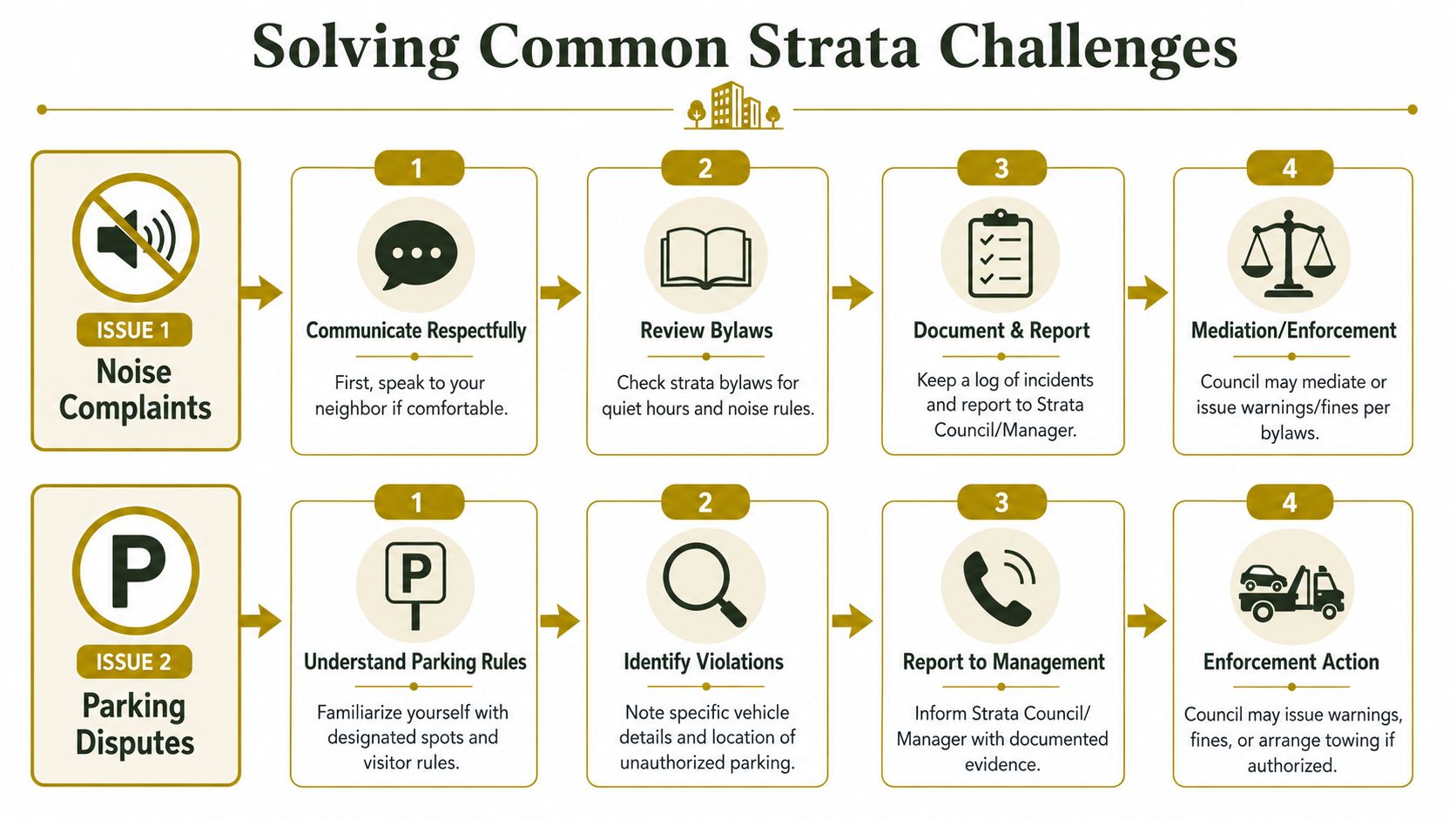
What fair enforcement looks like
The strongest buildings don't avoid conflict. They handle it consistently.
A good process usually looks like this:
- Clear bylaws exist upfront. Residents can't follow standards they can't find.
- Complaints are documented. Dates, photos, correspondence, and incident logs matter.
- Management responds through process, not personality. The same issue gets the same treatment regardless of who reports it.
- Council follows through. Warnings without action train residents to ignore the rules.
Digital systems help here. Digital strata platforms materially improve operating efficiency by automating resident communications, maintenance intake, and financial reporting. The practical result is faster response times and more auditable workflows, which is especially useful in multi-unit properties where delays can worsen risk, according to this article on how strata management software simplifies operations.
A few common Maple Ridge examples
Consider three familiar scenarios.
Parking in a denser complex
A newer development with limited visitor parking gets friction fast. If signage is weak and towing authority is unclear, the dispute becomes personal. If the bylaws are clear and management tracks violations properly, the problem usually cools down.
Pet approval in a family building
A buyer assumes a dog is fine because “everyone seems to have one.” Then they learn the building has size restrictions or approval requirements. The issue wasn't the dog. It was skipping the paperwork.
Plumbing and emergency response
When a stack leak or drain backup affects multiple units, owners often realise how important response systems are. Even though this example comes from another market, these Los Angeles commercial plumbing services for HOA properties show the kind of organised vendor coordination multi-unit communities need when shared systems fail.
Good strata property management removes ambiguity. Residents know how to report issues, managers know how to document them, and council knows when to enforce.
For anyone following governance failures and compliance risk in BC, this report on a B.C. property manager fined during a short-term rental fraud investigation is a reminder that oversight and procedure aren't optional.
Checklist for Hiring the Right Strata Manager
When a strata council starts looking for a new manager, the worst approach is choosing based on fee alone. Cheap management often gets expensive later through missed follow-up, poor records, delayed maintenance coordination, and owner frustration.
The better approach is to interview for fit, process, and local knowledge.
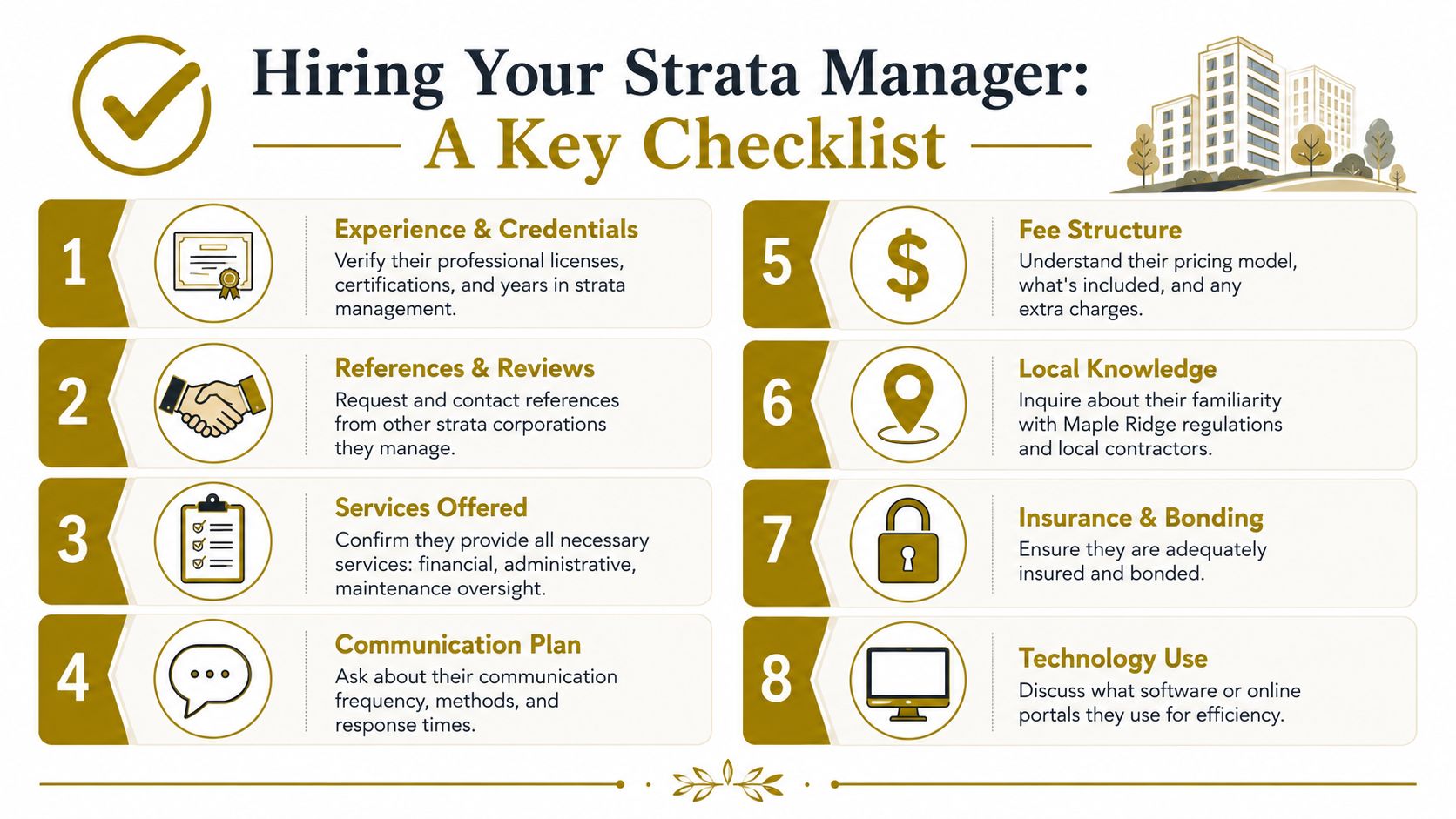
Questions a council should ask
- Are you properly licensed in BC? Start with credentials and brokerage compliance.
- What services are included in your fee? Some contracts look competitive until extra charges appear for meetings, notices, document handling, or after-hours calls.
- Who manages our building? Councils should know whether they'll deal with one named manager or a rotating team.
- What kind of properties do you already handle? A wood-frame townhome complex in Maple Ridge has different needs than a concrete building or a small bare land strata.
- How do you handle emergencies? Ask what happens after hours and who coordinates vendors.
- What technology do you use? Portals, maintenance tracking, and document access matter.
- Can you provide references from similar buildings? Similar size and building type is more useful than a general testimonial.
- Do you know the local contractor environment? Relationships with reliable trades in Maple Ridge and Pitt Meadows make a practical difference.
What local fit looks like
Councils should look for a manager who understands local ownership patterns, family-oriented complexes, commuter-oriented condos, and the practical issues that come with each. A building near schools in Albion may have different concerns than one closer to Pitt Meadows Station.
If your council is comparing local service options, this page on a property management company in Maple Ridge is a useful benchmark for the types of services and questions to evaluate. Royal LePage Brookside Realty Property Management is one local option that provides property management services under its brokerage licence.
Maple Ridge and Pitt Meadows Strata FAQs
Are rental rules still something buyers should check carefully
Yes. Always read the bylaws and any current rules before writing an offer, especially if you may rent the unit later. Buyers looking near commuter routes or close to the West Coast Express often assume flexibility they may not have. Even where the law changes, building-level procedures, move-in rules, parking allocation, and use restrictions can still affect how practical a rental unit really is.
Is a newer building automatically a safer buy
Not necessarily. Newer buildings may have fewer immediate repair concerns, but they can still have governance issues, warranty-related disputes, or unrealistic early budgets. Older buildings aren't automatically risky either. Some are better managed because they've already faced major decisions and built stronger systems.
What's the difference between buying into a condo building and a townhome strata here
In local terms, condo buyers often focus on elevators, lobbies, shared mechanical systems, balconies, and security access. Townhome buyers often deal more with roofing, siding, fencing, roads, drainage, garages, and parking enforcement. The lifestyle is different, but the bigger distinction is how the shared property is maintained and funded.
What should sellers do before listing a strata property
Sellers should review their own documents before the home hits the market. That means reading recent minutes, checking whether any major projects are being discussed, and understanding whether buyers are likely to ask hard questions about fees, repairs, or bylaw issues. A clean listing presentation matters, but so does being ready for document review.
How can I tell if a building is well run without living there first
Look for signs of consistency. Read the minutes. Review the budget. Check whether maintenance issues are identified and followed through. Notice whether rules are understandable and whether the building appears cared for when you visit. If owners are constantly dealing with unresolved basics, that usually shows up in the paperwork.
Do schools, parks, and neighbourhood feel still matter if the strata is strong
Absolutely. A well-run building in the wrong location for your lifestyle is still the wrong home. Buyers in Maple Ridge often weigh walkability, access to parks, school catchments, commute patterns, and whether a neighbourhood feels more family-focused or more compact and urban. The right purchase sits at the intersection of location, building quality, and governance.
If you're buying or selling a condo or townhome and want help understanding the full context behind the strata documents, Royal LePage Brookside Realty Property Management can guide you through Maple Ridge and Pitt Meadows real estate with practical local insight.