
You've just closed on a townhouse in Cottonwood. The keys are in your hand, the tenancy agreement is signed, and the first rent e-transfer lands in your account. It feels like the hard part is over.
It isn't.
Owning a rental in Maple Ridge or Pitt Meadows means you're running a small business tied to a very real asset. The bookkeeping side often gets ignored until tax time, or until a landlord tries to answer a basic question and realises they can't. Is this place producing healthy cash flow? Did that plumbing bill belong under repairs, or should it be treated differently? Where did the tenant's security deposit end up?
Good rental property accounting answers those questions early, when the decisions are still easy to fix.
Beyond the Rent Cheque Why Smart Accounting Matters
A new landlord in Albion collects the first month's rent, pays a roofer after a windstorm, covers a small plumbing invoice from the same personal chequing account, and figures the paperwork can wait until March. By tax time, the problem is not missing effort. It is missing clarity. The landlord cannot tell what the property earned, which costs were deductible, or whether cash flow stayed positive after all bills were paid.

Your books are your operating dashboard
Good accounting gives a Maple Ridge landlord usable answers, not just a folder for tax season. It shows whether a condo near Kanaka Creek is carrying its full weight after strata fees, insurance, mortgage interest, repairs, and vacancy are accounted for. It also shows whether a rent increase, a refinance, or a planned upgrade still makes sense once the numbers are laid out cleanly.
The practical value shows up fast. If a basement suite in West Maple Ridge keeps generating drain callouts, accurate records let you compare the cost of repeated service visits against one larger fix. If a Pitt Meadows townhouse starts consuming more cash than expected, the books force a decision. Keep it, improve it, raise rent where the rules and market support it, or accept that the property is underperforming.
Clear records protect judgment.
CRA compliance starts long before filing season
CRA rules do not begin when you open tax software. They apply when money is received and when money is spent. Rental income and expenses are generally reported on Form T776, and landlords need records that show what was paid, why it was paid, and whether the cost was a current expense or a capital item.
That distinction matters in real properties around here. A leaky roof on a home in Albion may be a deductible repair if you are restoring the roof to its prior condition. If the work upgrades the roof well beyond what was there before, the treatment can change. The invoice alone will not sort that out later if your notes are poor and the scope of work is vague.
For a broader plain-English primer, some owners like to understand rental property tax in another common-law system first, then compare the concepts against CRA treatment. For Maple Ridge and Pitt Meadows landlords, local execution matters more than theory. Clean records, complete invoices, and a clear reason for each expense are what hold up if CRA ever asks questions.
If you are still sorting out which costs may be claimable at all, this guide on rental property tax deductions is a useful next read.
Building Your Bookkeeping Foundation
The landlords who stay organised usually make the same decision early. They stop treating the rental like an extension of their household chequing account.
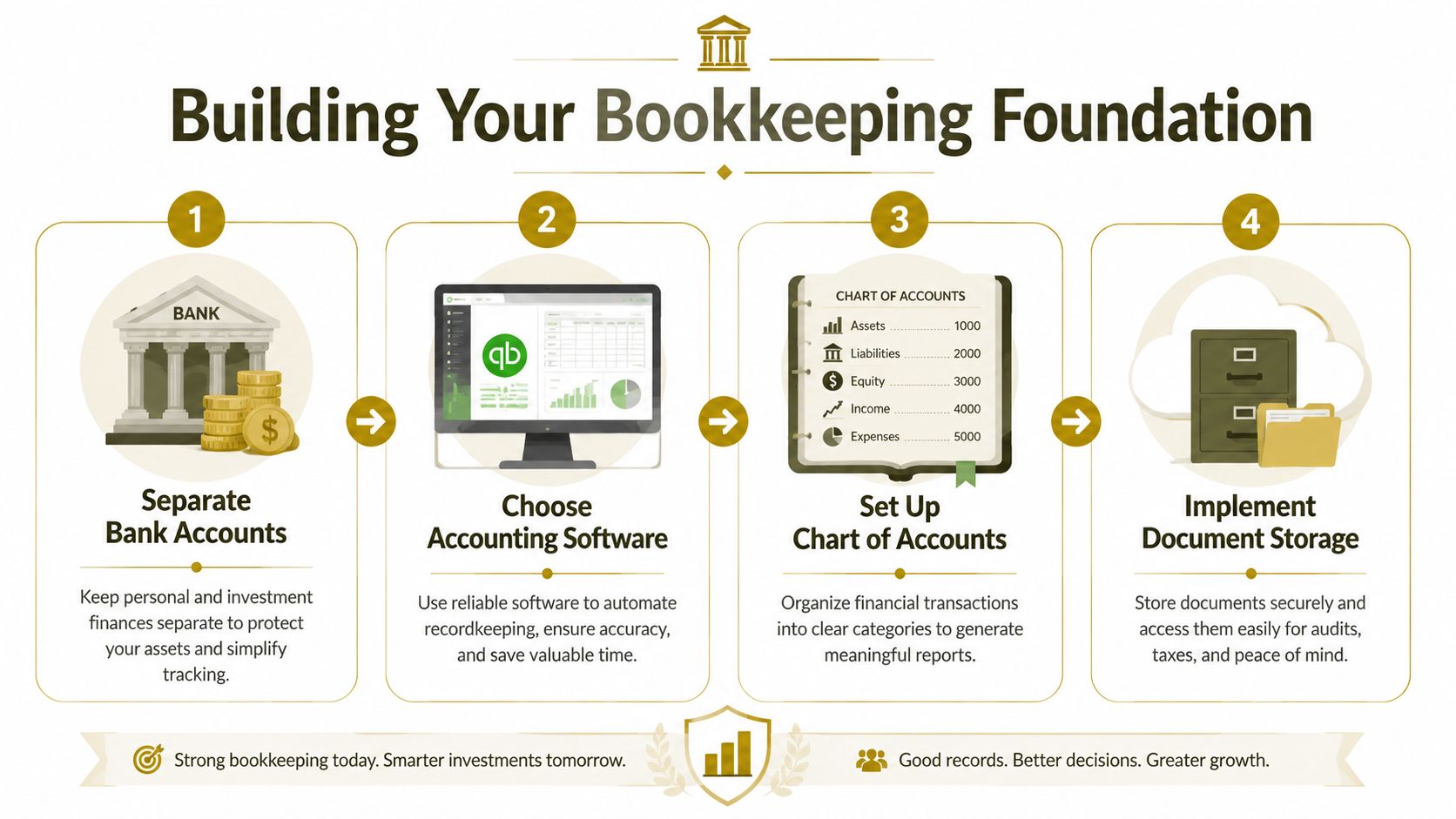
Canadian landlord guidance is clear that a practical workflow starts with a separate bank account and chart of accounts, then records every rent and expense line by property and tenant, followed by monthly bank reconciliation. That same guidance also recommends keeping security deposits in a distinct account so they aren't mixed with operating cash, as noted in this landlord bookkeeping workflow guide.
Start with account separation
Open one dedicated account for rent and operating expenses. Don't run tenant payments through the same place you buy groceries or pay your own FortisBC bill. Commingling turns basic reconciliation into detective work.
For a single Maple Ridge rental, a simple setup often works well:
- Operating account for rent received and routine expenses paid
- Deposit account for security deposits
- Credit card or dedicated payment method for property-related purchases, if you want cleaner digital records
This doesn't need to be elaborate. It needs to be clean.
Build a chart of accounts you'll actually use
A chart of accounts is just your category list. If the categories are too broad, you lose insight. If they're too detailed, you won't keep them updated. Most local landlords do best with a practical middle ground.
Here's a simple structure for a Maple Ridge or Pitt Meadows rental:
| Account type | Example category |
|---|---|
| Income | Rent |
| Income | Parking or storage income |
| Liability | Security deposit held |
| Expense | Mortgage interest |
| Expense | Property insurance |
| Expense | City of Maple Ridge property tax |
| Expense | Strata fees |
| Expense | Repairs and maintenance |
| Expense | Advertising |
| Expense | Landscaping or snow removal |
| Expense | Professional fees |
| Asset | Capital improvements |
A condo owner near the West Coast Express may need strata-related detail. A detached home in Albion may need landscaping and seasonal exterior upkeep categories instead.
Keep your categories stable across the year. Renaming expense buckets every few months makes year-end reporting much harder than it needs to be.
Choose tools that reduce friction
You can start with a spreadsheet if you're disciplined. However, sustaining that discipline proves challenging, especially once maintenance picks up or a second property enters the picture. Accounting software gives you bank feeds, searchable records, receipt attachment, and cleaner reports.
Useful options include QuickBooks and Xero. Some landlords prefer property-specific platforms if they want rent collection and accounting under one login. If you want local support as part of management, Royal LePage Brookside Realty Property Management is one option that provides financial reporting alongside property management services.
For owners who like comparing bookkeeping habits across industries, this piece offers practical advice for Florida small business owners that still translates well to rental operations, especially around process discipline and record consistency.
Store documents from day one
Every invoice, receipt, lease addendum, and contractor bill should be stored in a system that's easy to search. A cloud folder by property and year works well. So does attaching documents inside your accounting software.
Good file names beat vague ones. “2026-04-12 plumber kitchen sink Albion” is useful. “receipt123” is not.
If you're testing whether a rental still makes sense on paper, a rental property cash flow calculator can help you connect bookkeeping to real investment decisions.
Tracking Your Daily Income and Expenses
Once the structure is in place, the ongoing habit matters more than the setup. Strong rental property accounting usually comes down to boring consistency. Record it when it happens. Save the document while it's still in your inbox. Match the transaction before memory fades.
That's how landlords avoid the year-end scramble where every charge at Home Depot starts looking vaguely property-related.

Record income by source and tenant
Not all rent arrives the same way. Some Maple Ridge tenants pay by e-transfer, some still use post-dated cheques, and some landlords rely on a property management portal. However it comes in, record the payment against the right tenant and the right property.
That matters most when something goes sideways. If a tenant in a Pitt Meadows suite pays late, partially pays, or applies a payment to the wrong month, your ledger should show exactly what happened without guesswork.
A clean income entry should answer:
- Who paid the rent
- Which property or unit the payment belongs to
- What period the payment covers
- Whether anything unusual happened, such as a short payment or a reimbursement
Track expenses while the details are fresh
The expense side is where landlords lose deductions and clarity. The invoice from the plumber who cleared a drain in a West Maple Ridge duplex feels easy to remember in the moment. It's much harder to classify properly eight months later.
Keep expenses organised under the categories you established earlier. Common examples for local landlords include:
- Advertising costs such as listing a suite or paying for local rental promotion
- Insurance premiums for landlord coverage
- Property taxes charged by the municipality
- Mortgage interest on the rental financing
- Strata fees for townhomes and condos
- Routine repairs like a faucet replacement, appliance service call, or drywall patch
- Vendor services such as cleaning, gardening, or pest control
- Professional fees for bookkeeping, accounting, or legal help
A condo owner near Kanaka Creek might have fewer exterior maintenance costs but more strata-related entries. An older detached house in Hammond or West Maple Ridge usually generates a wider variety of repair invoices.
The best time to code an expense is when you still remember why you paid it.
Receipt discipline saves you later
Receipts are not optional. Keep the digital invoice from the electrician. Save the paper slip from Haney Builders' Supplies. Upload the PDF from your insurance renewal. If a charge supports a deduction or helps explain a repair history, keep it.
A simple weekly routine works better than a heroic annual cleanup:
- Download invoices from email.
- Photograph or scan paper receipts.
- Attach each document to the corresponding transaction.
- Add a short note if the purpose might not be obvious later.
Mobile scanning apps make this easy. Even a basic phone scanner app is better than stuffing receipts in the glove box and hoping they survive.
What good habits look like in practice
A landlord with one condo in Pitt Meadows doesn't need a complicated finance department. They need a repeatable rhythm.
| Frequency | Habit |
|---|---|
| When rent arrives | Match it to the tenant ledger |
| When an expense is paid | Categorise it and save the receipt |
| Weekly | Review uncategorised transactions |
| Monthly | Confirm the bank record matches the books |
When owners skip these small actions, they usually end up making larger mistakes. They miss patterns in maintenance, misjudge cash flow, and struggle to defend deductions if questions come up later.
Repairs Versus Improvements The Crucial CRA Distinction
A landlord in Albion fixes a roof leak after a week of Fraser Valley rain. The invoice is manageable, the tenant is relieved, and the work had to be done. Then tax season comes around and the key question shows up. Was that a repair you deduct this year, or a capital cost you add to the property instead?
That distinction matters on every Maple Ridge rental, especially older houses in Hammond, West Maple Ridge, and Albion where one small issue can uncover a much larger job.
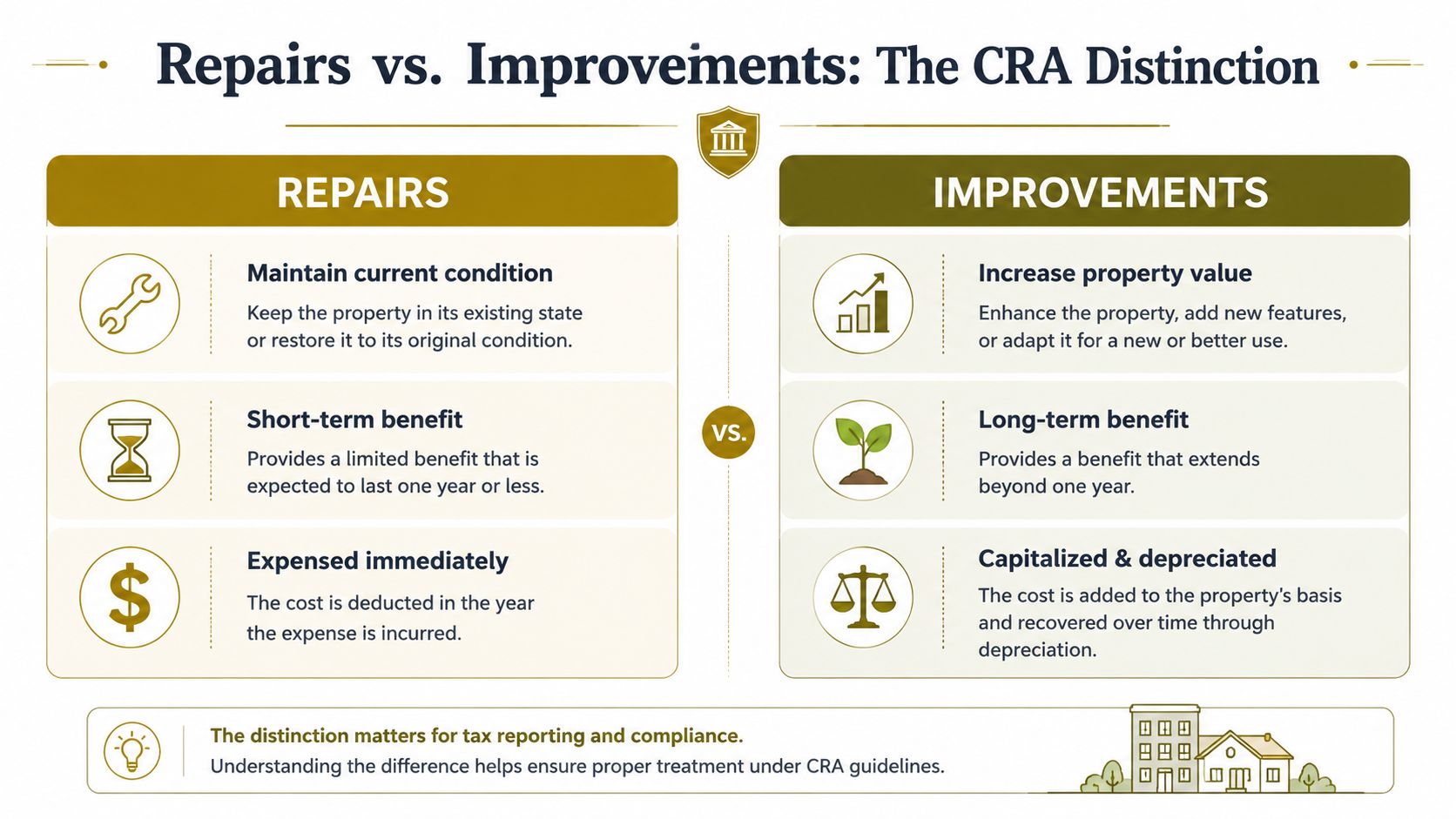
Under CRA rules, landlords need to separate current expenses from capital expenditures. You report rental activity on Form T776, and the tax treatment depends on the nature of the work, not the contractor's wording on the invoice.
The practical difference
A repair brings something back to the condition it was in before it failed. An improvement makes the property better, extends the useful life of a major component, or forms part of a larger upgrade.
On paper, that sounds straightforward. In practice, many new investors become sloppy.
Here is the usual treatment:
| Situation | Usual treatment |
|---|---|
| Replacing a broken window in an Albion house | Repair |
| Fixing a leak under the kitchen sink in Cottonwood | Repair |
| Repainting a damaged wall between tenancies | Repair |
| Replacing all old windows with higher-performance units | Improvement |
| Full kitchen renovation in a condo near Kanaka Creek | Improvement |
| Major roof replacement that extends the building's life | Often improvement |
The invoice title does not decide anything. I have seen contractors label a full replacement as “repair work” and a simple service call as “renovation.” CRA looks at what the work did.
A small bill can still be capital. A large bill can still be a repair.
Maple Ridge examples that cause confusion
Local housing stock creates a lot of grey area. If a home in Albion has a leaky roof and the roofer patches one failing section, replaces a few shingles, and stops the water entry, that usually points to a repair. If the same visit turns into removing and replacing the full roof assembly because the structure is at the end of its life, you are likely looking at a capital item.
Condos near Kanaka Creek create another common mistake. Replacing a damaged laminate plank after a tenant overflowed the bathtub is usually repair work. Tearing out all flooring, upgrading the material, and refreshing baseboards as part of a broader unit update before raising rent is a different story. That is improvement territory.
Context matters. So does timing. If several invoices are really one coordinated project, CRA may look at the whole job rather than each bill in isolation.
Notes make the tax treatment easier to defend
Plain bookkeeping notes save you.
“Roofing work” tells you almost nothing six months later. “Emergency patch to stop active leak over upstairs bedroom” gives the missing context. If the job was part of a bigger plan, say that too. “Full roof replacement after inspection found system at end of life” is much clearer than a generic upload with no explanation.
For Maple Ridge landlords, that habit matters most on older detached homes where repairs and upgrades often blend together over a few weeks.
Where CCA fits
If a cost is capital, you do not deduct the full amount as a current expense in the year you paid it. You add it to the property's capital cost, and you may claim Capital Cost Allowance, or CCA, over time if it makes sense for your situation.
That choice has trade-offs. Claiming CCA can reduce taxable rental income now, but it also affects your records long term and may matter later if you dispose of the property. If you expect to sell, keep clean capital records from day one. The same file that supports annual bookkeeping often supports your position later on selling a home and capital gains.
This video gives a helpful visual explanation of the distinction and why the line matters in practice.
How to stay out of trouble
Before you post any larger maintenance invoice, ask four direct questions:
- Was the job restoring what was there, or upgrading it?
- Did the work extend the life of a major component?
- Was it a stand-alone fix, or part of a broader renovation plan?
- Would your notes make sense to an accountant or CRA reviewer a year from now?
If the answer is unclear, pause and classify it properly before year end. That extra five minutes is cheaper than cleaning up misposted capital work after the fact.
Your Monthly and Year End Accounting Checklists
Landlords who stay calm at tax time usually don't work harder in March or April. They work on a schedule the rest of the year.
For Canadian reporting, your rental bookkeeping should be organised to support cash-basis or accrual-basis reporting, distinguish repairs from capital improvements, and produce monthly profit-and-loss, balance-sheet, and cash-flow reports. Keeping receipts and invoices organised also helps protect deductions and reduce audit risk, as described in this Canadian landlord bookkeeping guide.
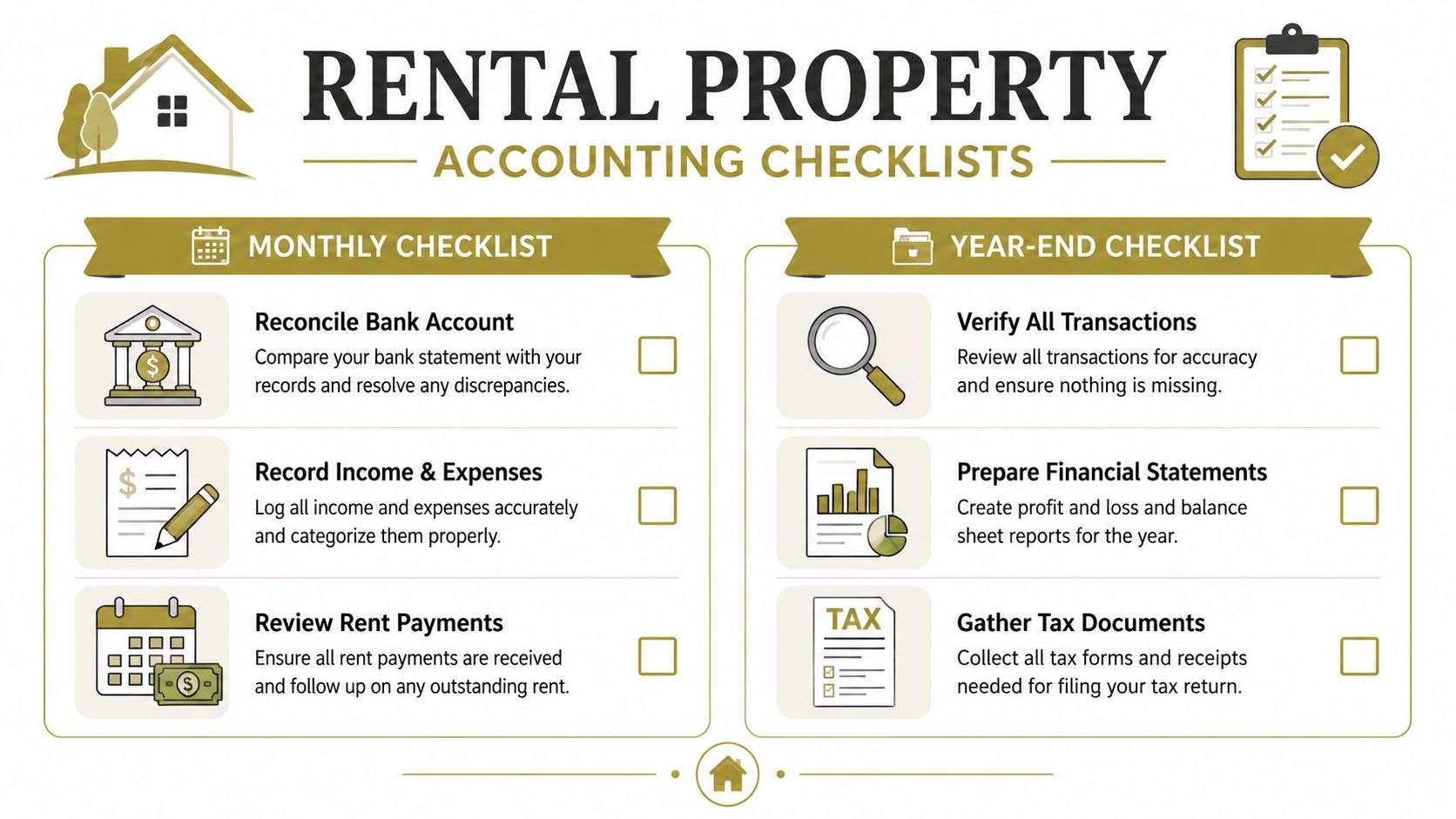
Monthly routine that keeps books healthy
Most individual landlords don't need a long monthly close process. They need a disciplined one.
A solid monthly checklist looks like this:
- Reconcile the bank account so your bookkeeping matches what cleared
- Enter any missing rent or expense items before memory gets fuzzy
- Review unpaid or unusual rent entries and correct coding errors
- Run a profit and loss report to see how the property performed
- Check the balance sheet if you're tracking deposits and capital items there
- Look at cash flow so you can spot pressure before the next repair bill lands
If you own more than one property, do this by property, not only at portfolio level. A profitable Pitt Meadows condo can hide a weaker-performing detached rental in Maple Ridge if you lump everything together.
Review the books when the month is still recent enough that you remember the story behind each line.
Cash basis or accrual basis
This decision affects how you organise your books. Cash basis generally records income when you receive it and expenses when you pay them. Accrual basis tracks income when it is earned and expenses when they are incurred.
Many individual landlords prefer cash basis because it's simpler to maintain. What matters most is consistency and making sure your records support the approach you use.
A basic comparison helps:
| Method | How it works | Practical fit |
|---|---|---|
| Cash basis | Records money when it moves | Often simpler for individual landlords |
| Accrual basis | Records income and costs when they arise | Useful when owners want a fuller operating picture |
If you're unsure which approach fits your setup, get advice before the year closes. Changing habits midstream creates messy records.
Year-end preparation without panic
Year-end gets easier when your monthly work is already done. At that point, you're mostly verifying, not rebuilding.
Use this checklist before handing records to your accountant or preparing your own return:
- Confirm all rent received is recorded correctly.
- Verify every expense has a category and support document.
- Pull out major property work separately so repair and capital treatment can be reviewed properly.
- Generate your annual reports, including profit and loss and any summaries relevant to your balance sheet and cash flow.
- Make sure your records support Form T776 reporting.
- Store digital copies of receipts, invoices, and statements in one organised place.
This is also the right moment to review whether your property still meets your goals. If the books show recurring stress, don't ignore it. Strong records help you decide whether to hold, improve, refinance, or sell.
For landlords who want a broader operational system alongside bookkeeping, this essential property management checklist ties the financial side back to day-to-day management.
Building Your Maple Ridge Portfolio on Solid Numbers
The landlords who build durable portfolios in Maple Ridge and Pitt Meadows usually don't have perfect properties. They have clear numbers.
That clarity changes how you act. You stop relying on rough estimates. You can see whether a condo near Meadowtown is carrying itself, whether an older Albion house is turning into a maintenance trap, and whether an upgrade is likely to support the hold strategy you want.
Good rental property accounting also makes growth less risky. Before buying another unit, you can compare real operating patterns, not hopeful assumptions. If you like reading outside the Canadian market, this guide on how investors grow your UK property empire is a useful reminder that portfolio growth always rests on disciplined numbers, no matter the country.
When you're evaluating your next step, a rental property ROI calculator can help connect clean bookkeeping to acquisition and disposition decisions.
The point is simple. Compliance matters, but bookkeeping's bigger value is decision-making. It tells you what's working, what's draining returns, and what to do next with confidence.
If you're buying, selling, or reviewing an investment property in Maple Ridge or Pitt Meadows, Royal LePage Brookside Realty Property Management can help you connect the property's numbers to the local market reality. Clean books make better decisions possible, whether you're preparing a rental for sale, assessing your next purchase, or trying to strengthen the performance of the property you already own.