You've got a rental property in Maple Ridge, the mortgage is set, the insurance is in place, and now the management proposals are sitting in your inbox. One quote shows a percentage. Another mentions a flat monthly amount. A third looks cheaper until you notice a long list of extras in the fine print.
That confusion is normal. Landlords in Albion, Silver Valley, Cottonwood, Kanaka Creek, and West Maple Ridge often compare fees first, then realise they're not comparing the same service at all.
A good property manager isn't just collecting rent. In a market like Maple Ridge, they're protecting the condition of the home, screening for the right fit, handling tenant issues properly, and keeping the tenancy on the right side of BC rules. If you're still sorting out what questions to ask before signing anything, this guide on how to communicate clearly with property managers in Maple Ridge is a useful companion.
Decoding Property Management Quotes in Maple Ridge
Most quotes look simple at first. They usually aren't.
One company may quote a lower monthly fee but charge separately for tenant placement, inspections, paperwork, and coordination when something goes wrong. Another may charge more each month but include the daily work that takes landlords off the phone. The key question isn't “What's the cheapest quote?” It's “What am I paying for, and what risk am I still carrying myself?”
What trips landlords up
The problem usually starts with language. Terms like full service, leasing fee, administration, maintenance coordination, and compliance support can mean different things from one company to the next.
A landlord with a townhome near Samuel Robertson Technical Secondary may need very little hands-on oversight if the home is newer and easy to maintain. A landlord renting out an older family home near Kanaka Creek Regional Park may need stronger systems for repairs, tenant communication, and ongoing oversight. Those two homes can't be managed the same way, even if the rent is similar.
Practical rule: Never compare property management fees BC by price alone. Compare the service scope, the exclusions, and how the manager handles risk.
How to read a quote properly
Use this short checklist when you review any proposal:
- Monthly fee structure: Is it a percentage of collected rent or a flat amount?
- Leasing costs: Is tenant placement included, or charged separately?
- Maintenance handling: Do they coordinate work transparently, or add markups?
- Communication standards: Who answers calls, emails, and emergencies?
- Local knowledge: Do they understand Maple Ridge neighbourhood differences, school catchments, and renter expectations?
That last point matters more than many landlords expect. A rental near Meadowridge School, Albion Elementary, or the commuter routes into Pitt Meadows often attracts a different tenant profile than a more rural-feeling property on a larger lot.
The Two Main Fee Structures in British Columbia
A Maple Ridge landlord with a newer condo near the town centre usually asks a different question than an owner with an older detached home in Cottonwood or Silver Valley. The condo owner wants predictable costs. The detached-home owner usually cares more about how fast problems get handled, how tenants are managed, and whether small issues are caught before they turn into bigger repair bills.
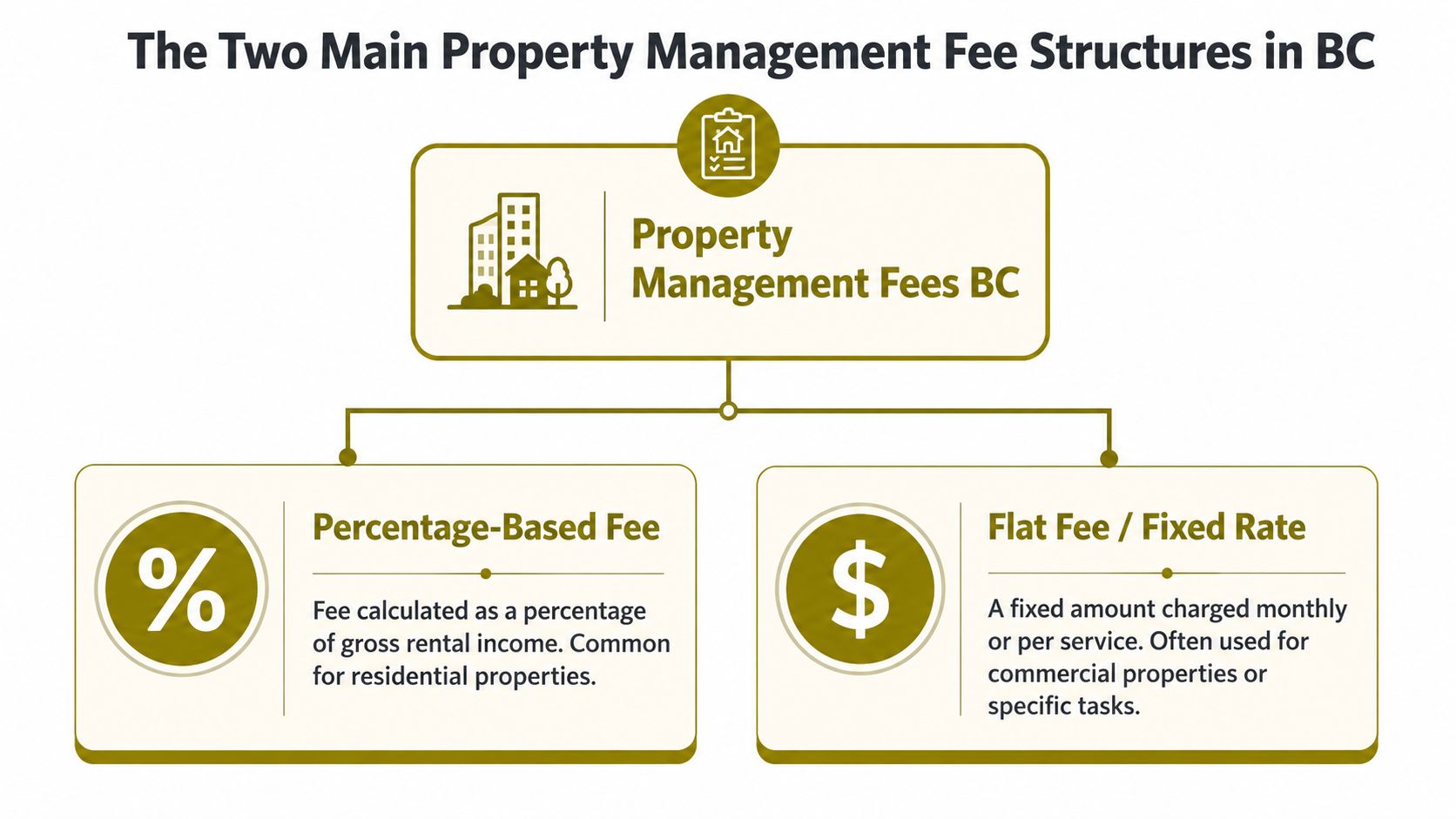
That is why most BC management quotes fall into two basic models. Percentage-based management and flat-fee management. Both are used in Maple Ridge. The right one depends on the kind of property you own, the amount of day-to-day involvement you want, and how much operational risk sits behind the monthly rent.
Percentage-based fees
Percentage pricing is the common model for residential rentals across this region. In British Columbia, residential management fees are often quoted at 8% to 12% of monthly rent collected, which puts a $2,500 per month Maple Ridge rental at roughly $200 to $300 per month under that structure, according to this BC property management fee overview.
Owners usually understand this model quickly. Higher rent means a higher management fee. Lower rent means a lower fee.
In practice, percentage pricing often fits Maple Ridge well because the workload is rarely identical from one property to the next. A condo near transit and shopping can be straightforward. A family rental in Albion, a house with a suite in Kanaka, or an older property with yard upkeep and more maintenance exposure usually needs more coordination. The fee structure leaves room for that difference.
It also lines up the manager's compensation with rent collection and occupancy. That does not guarantee good service, but it does mean the manager has a direct financial reason to keep the property rented, respond quickly when issues threaten a tenancy, and protect the income stream.
A weak manager at a low rate still costs plenty.
For owners comparing how local companies package these services, this guide to top property management services in Maple Ridge gives a useful side-by-side view.
Flat fees
The second model is the flat monthly fee. In BC, some firms charge $100 to $300 per month depending on the property type and service package.
The appeal is simple. The monthly cost is predictable, which some landlords prefer for budgeting.
The trade-off is scope. A flat fee can work well for a low-maintenance property and an owner who wants limited support, but it often comes with tighter service boundaries. If the agreement is priced aggressively, there is a good chance some of the harder work sits outside the monthly fee. That can include extra tenant issues, coordination with trades, notice service, inspection follow-up, or after-hours calls.
That is where landlords get tripped up. The flat number looks lower on paper, but the total cost rises once add-ons start appearing or the owner ends up taking back part of the workload.
Which model works better
Here is the practical way to look at it:
| Fee model | Usually works best for | Watch for |
|---|---|---|
| Percentage-based | Full-service management, especially for detached homes, older properties, or rentals with more moving parts | Whether the company also charges separate admin, inspection, or maintenance fees |
| Flat-fee | Simple properties and owners who want lighter support | Narrow service limits and extra charges for tasks that come up in normal management |
For a straightforward condo in a predictable building, flat pricing may be perfectly reasonable if the contract is clear and the service level matches what you need.
For many Maple Ridge houses, percentage pricing is the more honest model because it reflects the actual work required to protect the rental income and the asset itself. That matters more than shaving a small amount off the monthly invoice.
What Your Management Fee Actually Covers and What It Does Not
A Maple Ridge landlord usually gets frustrated for one reason. The monthly fee sounded clear at the start, but the actual scope of work was not.
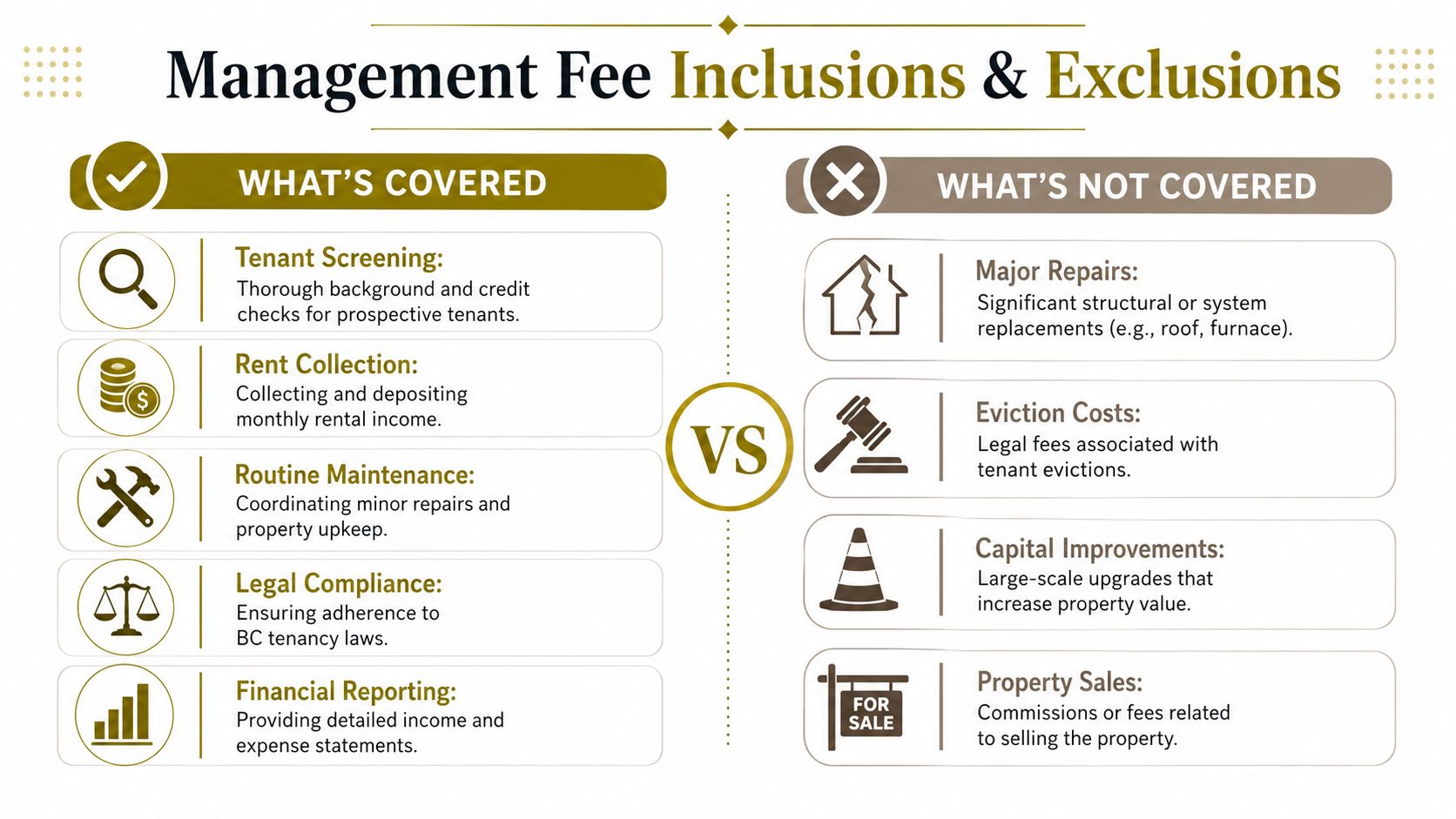
The question is not just, "What do I pay?" The better question is, "What work does that fee keep off my desk, and what still becomes my cost?" In Maple Ridge, that distinction matters because a rental in Silver Valley or Cottonwood can stay quiet for months, then suddenly need fast decisions on repairs, tenant communication, or access for trades. Good management earns its fee by protecting rent flow and keeping small problems from turning into expensive ones.
What full management usually includes
A solid full-service agreement covers the recurring work that keeps the tenancy stable and the owner informed. In practice, that usually includes:
- Rent collection and owner disbursements: collecting rent, following up on arrears, paying approved invoices, and sending regular owner statements
- Tenant communication: handling routine questions, complaints, service requests, and the day-to-day issues that otherwise land on the owner's phone
- Maintenance coordination: arranging standard repairs with qualified trades, getting approvals where needed, and tracking the job to completion
- Tenancy administration: serving routine notices, documenting issues, and managing communication in line with the Residential Tenancy Act and the tenancy agreement
- Reporting and file management: maintaining records so the owner can see what happened, what was spent, and what still needs attention
That work has real value. It saves owner time, but it creates consistency. Consistency is what protects the asset.
If you want a plain-language breakdown of the actual job, this guide on what a property manager does day to day gives a useful overview.
What often sits outside the monthly fee
Monthly management fees usually do not include every event tied to the property.
Leasing is the most common separate charge. As outlined on Brookside Property Management's local fee page, some Maple Ridge managers charge a one-time tenant placement fee equal to 50% to 100% of one month's rent, and that same page states there are no hidden markups on maintenance or vendor invoices. That matters because leasing is front-loaded work. Advertising, showings, screening, reference checks, paperwork, move-in coordination, and setting expectations with a new tenant all happen before the first month settles into routine management.
Owners should also expect some items to remain separate because they are property expenses, not management fees. A plumber's invoice, appliance replacement, strata fines, locksmith service, and remediation work are costs of owning the rental. The manager coordinates them. The owner still pays for them.
Included work versus separate events
Here is the practical split:
| Usually included in monthly management | Often billed separately |
|---|---|
| Routine tenant contact | Tenant placement or leasing |
| Rent collection | RTB hearing attendance or dispute-related work |
| Minor maintenance coordination | Major repairs and capital projects |
| Regular owner statements | Special projects, extensive renovation oversight |
Where landlords get surprised
The biggest misunderstanding is assuming "full service" means unlimited service.
It rarely does. If a furnace fails during a cold snap, a leak shows up after heavy rain, or a tenancy heads toward a dispute, the manager may still handle the coordination, but extra labour or hearing-related work can fall outside the monthly fee. In a place like Maple Ridge, where many rentals are detached homes with more maintenance exposure than a simple condo, those edge cases matter. A clear agreement should spell out who does what, what gets billed separately, and whether contractor invoices pass through at cost.
That is why the cheapest quote is not always the best value. A slightly higher monthly fee can be the better deal if it includes stronger communication, tighter documentation, better contractor oversight, and fewer grey areas when something goes wrong.
How Maple Ridge Market Factors Influence Your Rate
Not every Maple Ridge rental takes the same amount of work to manage. That's why fee quotes differ, even when two properties look similar on paper.

Property type changes the workload
A newer condo near the town centre usually has fewer moving parts. Landscaping may be handled through strata. Exterior maintenance is often less of an issue. Access for showings, inspections, and trades can be straightforward.
A detached home in Albion, Cottonwood, or East Maple Ridge can be different. Yards need attention. Appliances and home systems may be older. Family tenants often stay longer, which is good, but when issues arise they can involve more coordination because the property itself is more complex.
Condition matters more than owners think
Turnkey homes are cheaper to manage in practical terms because they produce fewer emergency calls, fewer contractor visits, and fewer tenant complaints. Homes with deferred maintenance tend to generate more work, more decision-making, and more tenant friction.
That doesn't mean an older house is a poor rental. Many renters specifically want a family home near schools, sports fields, and parks. It does mean the management approach has to reflect reality. A property near Albion Sports Complex or close to school catchments popular with families may need a manager who understands longer-term tenancy expectations, preventative maintenance, and communication that keeps good tenants in place.
Location affects strategy
Silver Valley attracts renters who value trail access, mountain views, and newer residential pockets. Cottonwood often appeals to families who want convenience and neighbourhood feel. West Maple Ridge can draw renters who care about access to amenities, shopping, and established streets. Pitt Meadows rentals may appeal to commuters who want a different pace and layout altogether.
Those differences influence marketing, tenant screening priorities, showing schedules, and maintenance planning. They also affect how quickly a manager needs to respond to vacancy, because renter expectations aren't identical across every micro-market.
A management fee reflects time, complexity, and risk. In Maple Ridge, those three things change block by block.
The practical takeaway
When a quote comes in higher than expected, ask why. Sometimes the reason is weak pricing. Sometimes it's because the property needs more hands-on oversight, more careful leasing, or more owner guidance to keep the investment performing properly.
The right question isn't “Why isn't this as cheap as the condo quote I saw online?” It's “Does this quote match what my property will demand?”
The Real Cost of Self-Management vs Professional Help
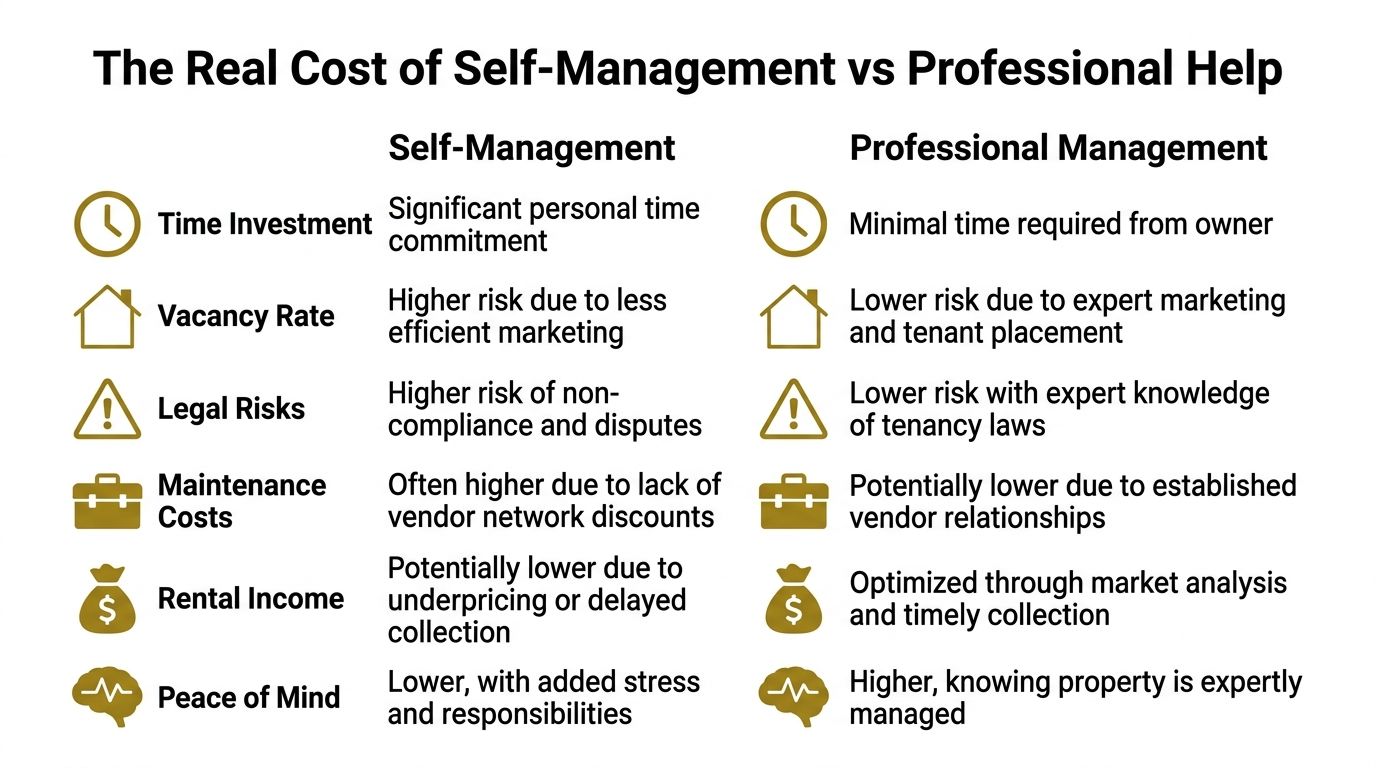
Some landlords can self-manage well. If they live close by, know the Residential Tenancy Act, answer messages quickly, keep records organised, and have reliable trades on call, it can work.
But many owners underestimate what self-management really asks of them. The monthly fee they're trying to save often gets replaced by personal time, avoidable stress, and expensive mistakes.
What self-management actually involves
The obvious jobs are easy to list. Advertising the property, answering inquiries, doing showings, checking applications, collecting rent, and scheduling repairs.
The harder part is consistency. You have to respond when you're at work, with family, or away for the weekend. You need to stay calm when a tenant relationship goes sideways. You also need to document properly, serve notices correctly, and know when an issue is ordinary maintenance versus something that could become a dispute.
Landlords who are weighing both routes should read this local comparison of self-managing versus hiring a Maple Ridge property manager.
Where professional help earns its keep
Professional management buys systems. That matters.
A good manager has a screening process, a repeatable leasing workflow, established communication habits, and contractors they can call without starting from scratch. They also bring distance. That separation can protect the landlord-tenant relationship because the owner isn't reacting personally to every complaint, late payment issue, or maintenance request.
The trade-off in simple terms
- Self-management gives you control: You make every decision directly and you don't pay a monthly management fee.
- Professional management gives you structure: The work is handled through process, documentation, and local market knowledge.
- Self-management can work well for straightforward properties: Especially if the owner is organised and available.
- Professional help often suits busy owners or more complex homes: It reduces the number of issues landing on the owner's desk.
If you don't have time to manage consistently, you don't really have a low-cost system. You have a delayed-cost system.
Risk is part of the cost
A new perspective emerges for many investors. The fee isn't just for convenience. It's for reducing the chance of preventable problems.
A poor tenant placement can create months of difficulty. Slow response to maintenance can turn a small issue into a bigger repair. A procedural mistake during a dispute can put the landlord in a weak position. In a regulated environment like BC, landlords need more than good intentions. They need follow-through.
Time has value too
Maple Ridge attracts many accidental landlords. Some move but keep their old home. Some inherit a property. Some buy a townhome as an investment while still working full time and raising a family. For those owners, the actual cost of DIY management isn't only operational. It's personal.
If your evenings are spent coordinating trades, chasing rent, or drafting responses to tenant complaints, the “savings” can disappear fast. Professional management turns a hands-on obligation into a managed asset. For many landlords, that's the difference between owning an investment and owning another job.
How to Choose the Right Maple Ridge Property Manager
Price matters, but it shouldn't be your first filter. The right manager is the one who can explain their process clearly, understands the local rental market, and gives you direct answers without hiding behind vague package language.

Questions worth asking in the first meeting
Start with the practical items:
- What exactly is included in the monthly fee? Ask for specifics, not broad labels.
- How do you handle leasing and tenant placement? You want to know who does the screening and how decisions are made.
- What happens when a repair request comes in after hours? Their answer will tell you a lot about systems and responsiveness.
- How do you communicate with owners? Some landlords want regular updates. Others only want contact when action is needed.
- How well do you know neighbourhood differences? A manager should understand the difference between renting a family home in Albion and a condo closer to central amenities.
For a deeper shortlist of decision points, review these key considerations when finding the right Maple Ridge property manager.
What a strong local manager should know
They should be able to talk comfortably about renter expectations in Silver Valley, Cottonwood, and West Maple Ridge. They should understand why proximity to parks, schools, commuter routes, and everyday shopping changes the tenant pool. They should also be candid about a property's weaknesses.
If a home backs onto a busy road, needs repair work before listing, or sits in a pocket where renters expect more updated finishes, a good manager will say so plainly. That honesty is worth more than a polished sales pitch.
Watch how they answer hard questions
A manager doesn't need to promise perfection. They do need to explain how they deal with problems.
Ask them how they handle conflict, maintenance approvals, difficult tenants, and owner expectations. If the answers are evasive, overly scripted, or light on detail, keep looking. You want a partner who understands real estate as a business and understands Maple Ridge as a place where people live.
A short video can also help you spot whether a company's approach feels clear and grounded in day-to-day management reality.
Choose fit, not just price
The best working relationship is built on transparency. You should know what the fee covers, how communication works, and what happens when the tenancy gets complicated.
That matters whether you're renting out a former family home near Memorial Peace Park, holding an investment close to schools and trails, or deciding whether to keep or sell a property as your plans change.
If you're weighing your options as a landlord, or you're also thinking about buying or selling in Maple Ridge, Royal LePage Brookside Realty Property Management can help you look at the full picture with local insight and practical advice.