

You're probably asking this for one of a few reasons. Maybe you're considering a move, maybe you're curious after seeing a neighbour's sign go up, or maybe you opened an online estimator, got a number, and immediately wondered whether it's even close.
That question, How much is my Maple Ridge home worth?, sounds simple. It rarely is.
A home's value in Maple Ridge isn't just a price tag pulled from a website. It's the result of current buyer demand, your exact neighbourhood, your home's condition, competing listings, recent sold properties, and timing. A house in Albion attracts a different buyer than a home in West Maple Ridge. A townhome near schools and parks can compete very differently from one with a busier setting. Those details change outcomes.
Your Maple Ridge Home's Value Is More Than a Number
A lot of homeowners start in the same place. They stand in the kitchen, look around at the updates they've made, think about the yard, the street, the school catchment, the commute, and then try to boil all of that down to one number.
That's where frustration usually starts.
An online estimate can give you a quick guess, but a real valuation works differently. It asks better questions. Which homes sold nearby? How similar were they? Did they back onto green space? Were they updated, original, or somewhere in between? Were buyers comparing them to newer inventory in Silver Valley, or to more established homes in Cottonwood or West Maple Ridge?
What buyers are really paying for
In Maple Ridge, buyers don't just buy square footage. They buy a mix of practical and emotional value.
Some are paying for walkability to schools. Others want a quiet family street in Albion, trail access near Kanaka Creek, or a home that shortens the morning routine for a family juggling sports, daycare, and commuting. A detached house with an updated kitchen and a usable backyard may compete very differently from another home with the same bedroom count but less functional space.
A home's market value is the price a motivated buyer will agree to pay today, not the number an owner hopes to see or an algorithm happens to produce.
What a serious valuation looks like
A proper Comparative Market Analysis, or CMA, looks at the homes that matter most. A thorough CMA typically compares your home to 3 to 6 recently sold comps within a tight radius, matching on bedroom and bathroom count, square footage, lot size, and age of upgrades, then adjusting the median price per square foot for features such as finished basements, updated kitchens, or views, as outlined in this Maple Ridge home values overview.
That's the difference between curiosity and strategy.
If you're wondering what your place might be worth, a rough range can be useful. If you're making a decision about selling, refinancing, downsizing, or buying your next home, the process has to be tighter. The best valuations tell the story of your property properly. They don't just average numbers and hope for the best.
Understanding the Data That Determines Your Home's Value
If you want a grounded answer, start with three separate data points. Most homeowners mix them together, and that's where confusion creeps in.
BC Assessment, market value, and benchmark price aren't the same
Your BC Assessment value matters, but mostly because it affects taxes. It is not the same thing as what a ready buyer will pay in the current market. If you want a clear breakdown of that distinction, this guide on assessment vs. market value is worth reading.
The MLS HPI benchmark is different again. It gives a useful market snapshot by property type. As of May 2026, the MLS HPI composite benchmark price for all home types in Maple Ridge stood at about $907,600, with detached homes at about $1,205,200 and townhouses around $727,300, according to this Maple Ridge market update.
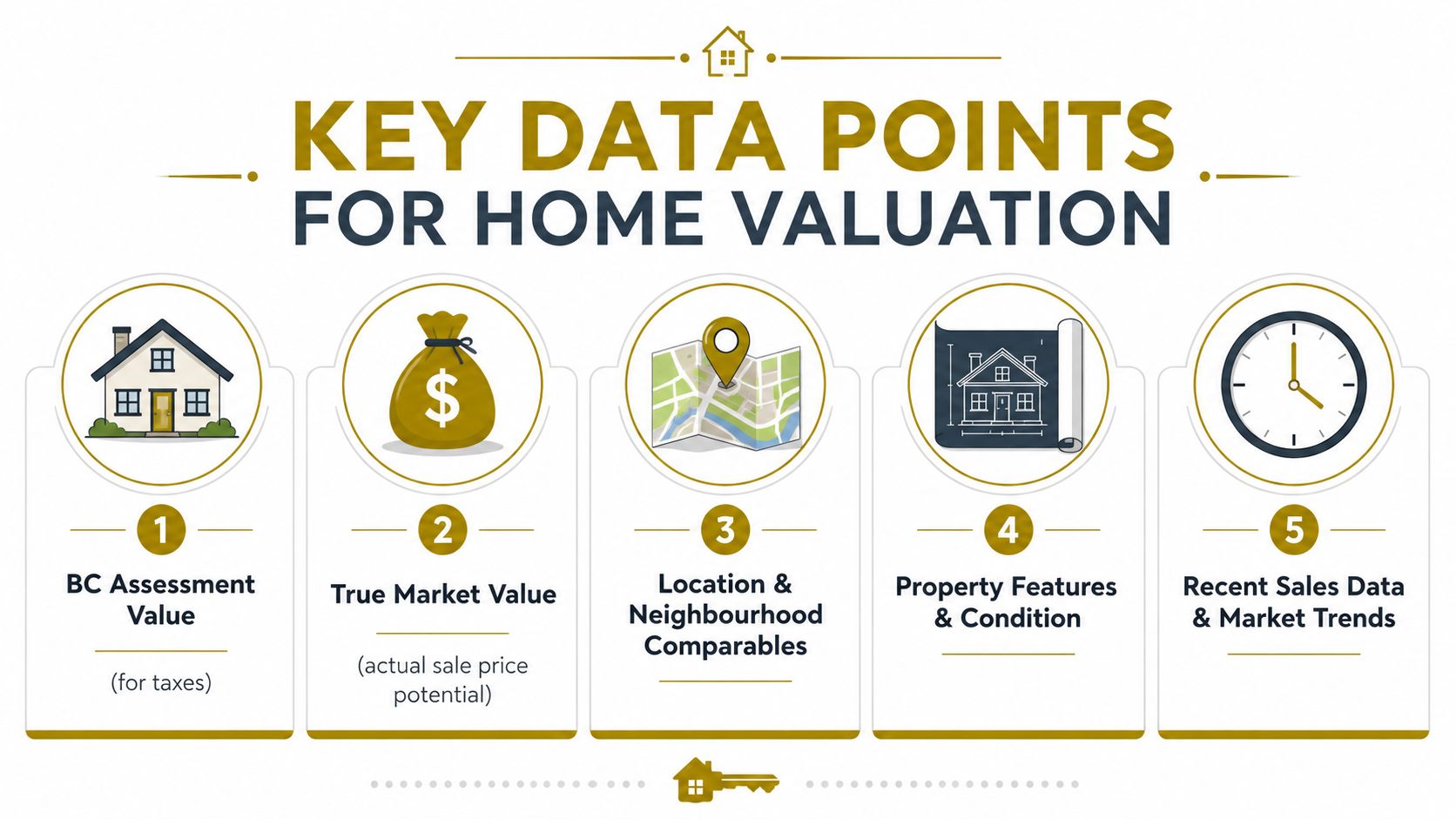
That benchmark is helpful because it anchors expectations. But it still doesn't price your home. It prices a typical home in a category.
The numbers that deserve the most attention
When I'm helping someone answer how much their Maple Ridge home is worth, the most important figures are usually the sold ones.
Here's the order I'd look at them:
- Recent sold comparables: These show what buyers agreed to pay, which matters more than what sellers hoped to get.
- Current competing listings: These show what your home will be judged against if you hit the market now.
- Property type benchmarks: Useful for context, especially if you own a detached home, townhome, or condo.
- Assessment value: Good for tax planning and carrying costs, but not a pricing tool on its own.
- Neighbourhood match: A sale in Albion may not tell you much about a similar-sized home in West Maple Ridge.
Why recency matters
A sale from last year can be interesting. A sale from the last several months is usually far more useful. Buyer sentiment changes. Inventory changes. Presentation standards change. Even two homes with similar floor plans can end up far apart if one was marketed well and one sat too long.
Practical rule: the only number that proves value is a sold price from a genuinely comparable property.
That's why a benchmark, an assessment, and a portal estimate should all be treated as reference points. An accurate determination comes from weighing them against local sold evidence, then adjusting for your home's exact features, condition, and setting.
The Pros and Cons of Online Home Value Estimators
Online estimators are popular because they're fast. You type in an address, wait a few seconds, and get a number that feels reassuringly precise.
The problem is that precision and accuracy aren't the same thing.
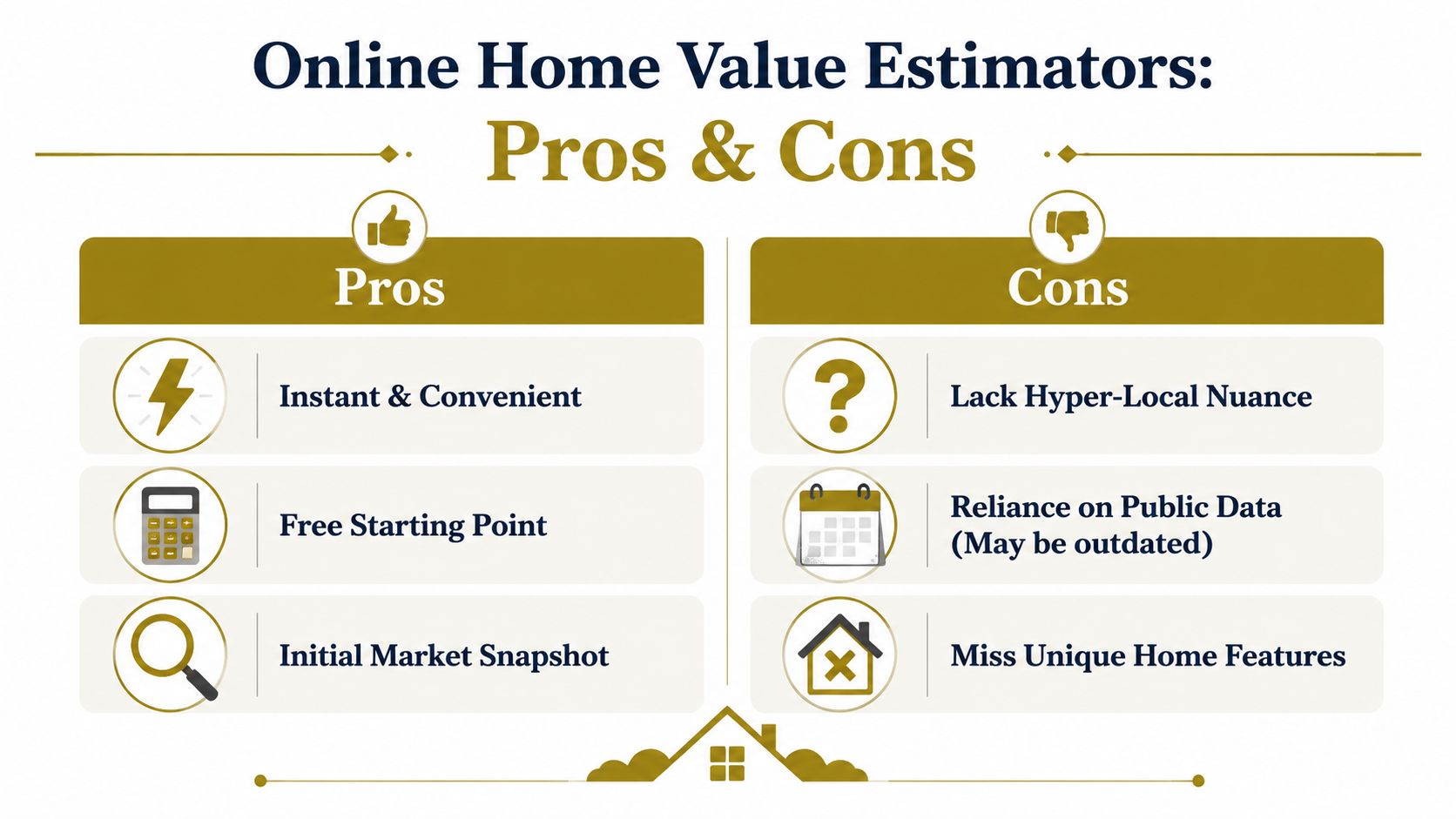
Where AVMs can help
Automated Valuation Models, usually called AVMs, can be a useful first stop. They're convenient, free, and good at satisfying early curiosity. They can also give homeowners a rough sense of where their property may sit within the broader market before they decide whether to dig deeper.
If you're still early in the process, they're fine as a starting point. They just shouldn't be the tool you rely on for a listing decision. This background piece on what the Multiple Listing Service is helps explain why listing data matters so much to valuation tools in the first place.
Where AVMs usually miss in Maple Ridge
Maple Ridge is not a market where every street trades the same way. Online home-value estimators often miss Maple Ridge-specific factors like access to Kanaka Creek Park, proximity to Alouette River trail systems, or the impact of local development plans in areas such as Silver Valley and West Maple Ridge because they rely on limited data fields, as noted in this piece on accurately calculating your home's worth in 2026.
That limitation shows up in very real ways:
- Setting gets flattened: A home near trails, parks, or a quieter pocket may be lumped together with homes on busier routes.
- Renovation quality gets missed: An AVM can't properly judge whether your kitchen refresh was cosmetic or whether the work changed buyer perception.
- Lot nuance disappears: Irregular lots, usable outdoor space, privacy, and exposure are often handled poorly by automated tools.
- Micro-neighbourhood demand gets blurred: Buyers will pay differently for one part of Albion than another. Algorithms usually don't think that way.
The right way to use them
Treat an AVM like a rough weather app. It tells you something useful, but it doesn't tell you whether your exact street is getting sun or rain.
If an online estimate feels high, owners tend to anchor to it. If it feels low, they dismiss it. Both reactions can lead you away from the real market.
The better move is to use the estimate as one loose reference point, then compare it against hyper-local sold properties and a proper CMA. In Maple Ridge, the homes that outperform usually aren't the ones with the best algorithm score. They're the ones priced with a sharper understanding of what matters to local buyers.
How Your Neighbourhood Shapes Your Home's Market Price
Two sellers can list homes with similar square footage, similar finishes, and similar lot sizes, then get very different results because one is on a quieter street in Albion and the other backs onto a busier route in West Maple Ridge. I see that play out regularly. Buyers do not compare every Maple Ridge home as if the town were one uniform market.
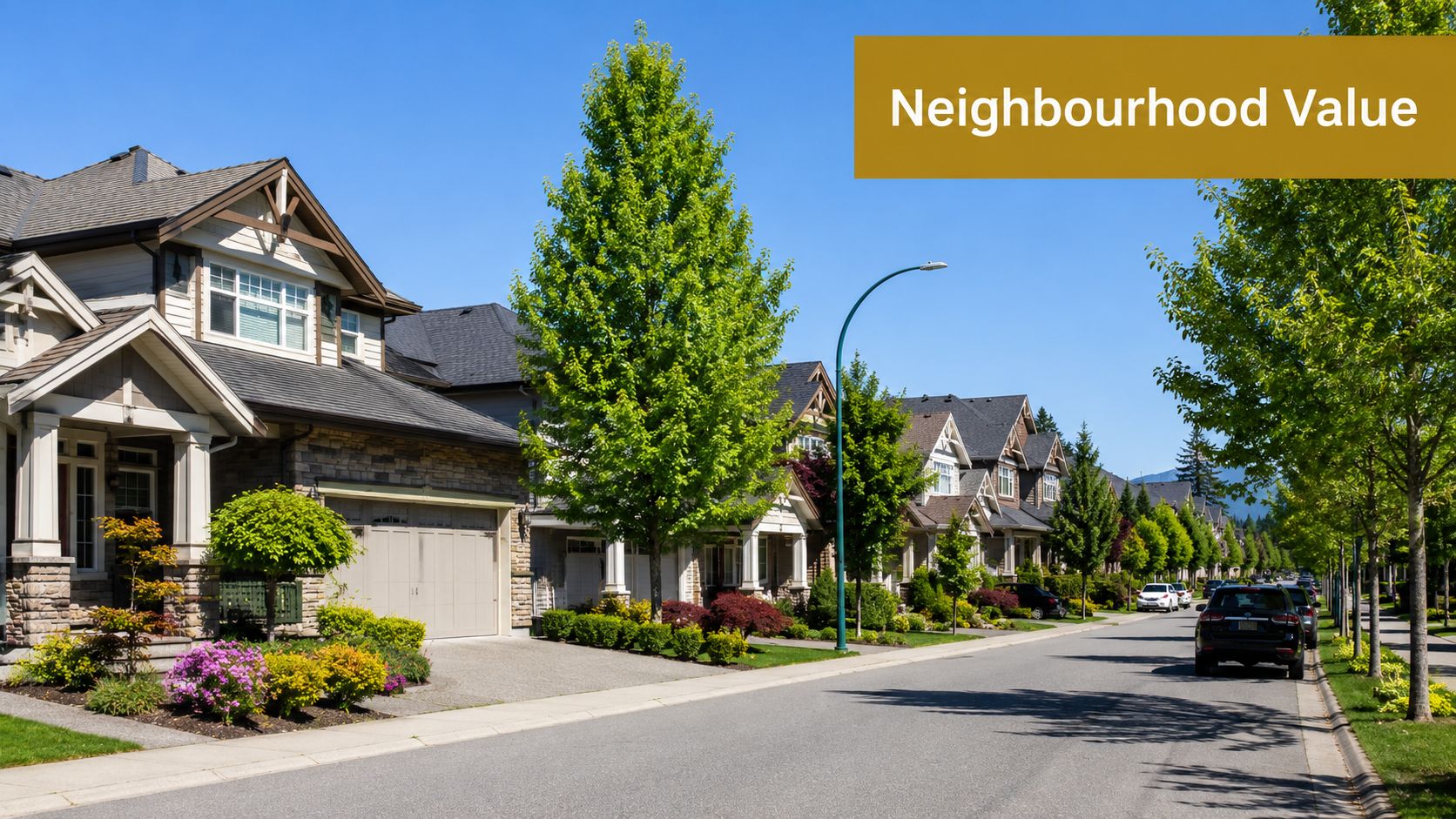
A Maple Ridge address signals a lifestyle before a buyer even books a showing. If you want a broader local overview, this Maple Ridge neighbourhood guide gives helpful context. For pricing, the practical question is narrower. Which buyers are most likely to want your location, and what other homes will they measure it against?
Different areas attract different buyers
Albion usually attracts families who care about schools, daily routines, and usable family space. In that pocket, buyers often notice whether the yard works for kids, whether the floor plan handles busy mornings well, and whether the street feels settled and neighbourly. A polished kitchen helps, but family function often carries more weight.
Silver Valley attracts a different buyer. Newer construction, access to trails, and a stronger connection to nature can all shape value there. I have found that buyers in Silver Valley often pay close attention to privacy, outlook, and how the home fits the setting, not just the interior finish level.
West Maple Ridge often appeals to buyers who put convenience near the top of the list. Commute routes, shopping access, and everyday practicality matter. In some cases, a home with fewer upgrades can still compete well if the location makes life easier.
What buyers are really paying for
Neighbourhood value shows up in small, specific ways that online estimates tend to blur.
A quiet cul-de-sac usually lands differently than a home on a collector road. A property backing onto green space often creates a stronger emotional response than one facing directly into another row of homes. Families may stretch their budget for a preferred school catchment, while another buyer will pay more to be closer to trails and less boxed in by neighbouring houses.
Those decisions are not random. They reflect the trade-offs buyers are willing to make in each part of Maple Ridge.
The local details that shift price
When I price a home, I look past the headline neighbourhood name and into the pocket within it. That is often where value gets won or lost.
- Street traffic and noise: Buyers notice busy frontage, awkward parking, and shortcut traffic right away.
- School access: Catchments and walkability matter most for family buyers.
- Green space and trail access: Homes near parks, Kanaka Creek, and connected trail networks often attract stronger interest.
- Privacy and outlook: Backyard separation, mature trees, and exposure can change buyer perception quickly.
- Surrounding home condition: A well-kept street supports confidence. Deferred maintenance nearby can do the opposite.
Exterior presentation also matters more in some neighbourhoods than sellers expect. In family-oriented areas, buyers often form an opinion before they reach the front door. Simple cost-effective home exterior improvements can help a home fit buyer expectations for the street without overspending.
Buyers rarely say they are paying extra for "location." They talk about the quiet street, the easier school run, the trail access, the privacy in the yard, or the fact that the block feels better cared for.
That is why a proper pricing opinion in Maple Ridge needs more than recent sales pulled from a broad radius. It needs local judgment about how Albion differs from Silver Valley, how one side of a neighbourhood competes with another, and how buyers in each area make decisions.
Strategic Pricing and Quick Upgrades That Add Value
A seller in Albion and a seller in Silver Valley can make the same mistake for different reasons. One prices high because the kitchen was updated two years ago. The other sinks money into finishes the area will not fully pay back. In both cases, the home can sit, buyers start asking what is wrong with it, and the final sale price often ends up lower than if the plan had been tighter from day one.
Price and preparation shape value together.
In Maple Ridge, buyers do not judge a home in isolation. They compare it against the other listings they toured that week, the recent sales their agent showed them, and the amount of work they think they will inherit after possession. That is why strategic pricing matters so much. The right number creates urgency and confidence. The wrong number invites hesitation, low offers, or no offers at all.

Start with buyer competition, not seller optimism
A pricing strategy has to match the homes you are competing with right now.
If three similar homes are available nearby, buyers will line up the photos, compare condition room by room, and use any weakness to justify a lower offer. I see this often with homes that are priced as if every update carries full dollar-for-dollar value. It rarely works that way. A refreshed home can earn stronger interest, but only if the asking price still leaves buyers feeling they are seeing fair market value.
That trade-off is especially clear in Maple Ridge neighbourhoods where buyers shop selectively. In Albion, family buyers usually care about function, yard use, and whether the home feels move-in ready for busy weekdays. In Silver Valley, buyers may pay close attention to finish level, layout, and how the property stacks up against newer competition. The pricing plan should reflect that buyer pool, not a generic average pulled from a broad map search.
The upgrades that usually pay off fastest
The best pre-listing work is usually simple, visible, and tied to buyer objections.
- Fresh paint: Clean, neutral walls photograph better and make the home feel cared for.
- Decluttering and furniture editing: Rooms read larger online and show better in person.
- Lighting updates: A few fixture changes can make an older interior feel current.
- Minor kitchen and bath repairs: New hardware, recaulked edges, and touch-up work often return more than an unfinished renovation.
- Curb appeal: Trimmed landscaping, pressure washing, and a tidy entry change the mood before buyers walk in.
If the outside of the home needs attention, these cost-effective home exterior improvements are a practical reference for sellers deciding where visible curb appeal gains are worth the spend.
A targeted plan usually beats a bigger one. This guide to pre-listing renovations that add value in Maple Ridge is useful if you are trying to sort the projects that help from the ones that eat budget.
Here's a good explainer on the bigger pricing picture:
What sellers often get wrong
Over-improving for the area is one of the most expensive mistakes I see. If a home is surrounded by modest competing properties, a high-end renovation may look great and still fail to return what it cost. The same applies to highly personal choices right before listing. Bold tile, specific paint colours, and custom built-ins can narrow the buyer pool when the goal is broad appeal.
Buyers pay more reliably for homes that feel clean, maintained, and easy to take over.
That usually means fixing the loose handle, replacing the burned-out light fixture, touching up the trim, and dealing with the small deferred maintenance items sellers have learned to live with. Those details do not feel exciting. They do reduce friction, which is what helps a good home earn stronger offers.
When to Request a Professional Market Analysis
A homeowner in Albion may look at three online estimates and get three different numbers. Then a similar home on a nearby street sells fast, while another in Silver Valley sits for weeks after a price reduction. That is usually the point where general research stops being useful and a local pricing opinion starts to matter.
If you are six to twelve months from a move, a rough range may be enough for early planning. If you are sorting out a refinance, downsizing decision, separation, estate sale, or a listing in the near term, you need a tighter number and a clearer strategy.
What a local CMA actually adds
A proper comparative market analysis does more than line up homes with the same bedroom count. It examines which recent sales compete with your property, which ones only look similar on paper, and what adjustments need to be made for lot size, updates, layout, street appeal, and timing.
In Maple Ridge, that distinction matters.
A basement-entry house in one pocket of Cottonwood may attract a different buyer than a newer family home in Silver Valley. Two properties can have similar square footage and still command different prices because one backs onto a busy road, one has a more usable yard, or one is closer to the schools and trails buyers ask about all the time.
A useful CMA answers questions like these:
- Which recent sales would a buyer compare your home to right now?
- Which sold properties need price adjustments because their condition, lot, or location was stronger than yours?
- How much has buyer demand shifted since those homes sold?
- Who is the likely buyer for your home in this market, and what are they paying a premium for?
Request it early enough to use it
The best time to ask for a market analysis is before you are committed to a listing date.
That gives you room to make better decisions. You can sort out whether a repair is worth doing, whether a renovation budget will likely come back to you, whether your target timing lines up with local demand, and whether your next purchase depends on hitting a specific sale range. For a more detailed look at that process, this Maple Ridge home evaluation guide gives useful local context.
I often tell sellers the same thing over coffee. The number matters, but the plan around the number matters just as much. A home that is priced with current competition, neighbourhood expectations, and buyer behaviour in mind usually gives the owner more options than a home priced from a generic estimate.
The real reason sellers ask
The question is rarely just, "What is my home worth?"
The primary question is usually whether the next move is realistic. Can you sell and buy again without stretching too far? Are you carrying expectations from last year's market? Are you leaving money on the table because your home fits a part of Maple Ridge that buyers will pay more for than an algorithm recognizes?
A professional market analysis brings those pieces together. It looks at sold evidence, active competition, property condition, neighbourhood differences between areas like Albion and Silver Valley, and the timing that can affect your final result. That is when a value estimate becomes something you can use.