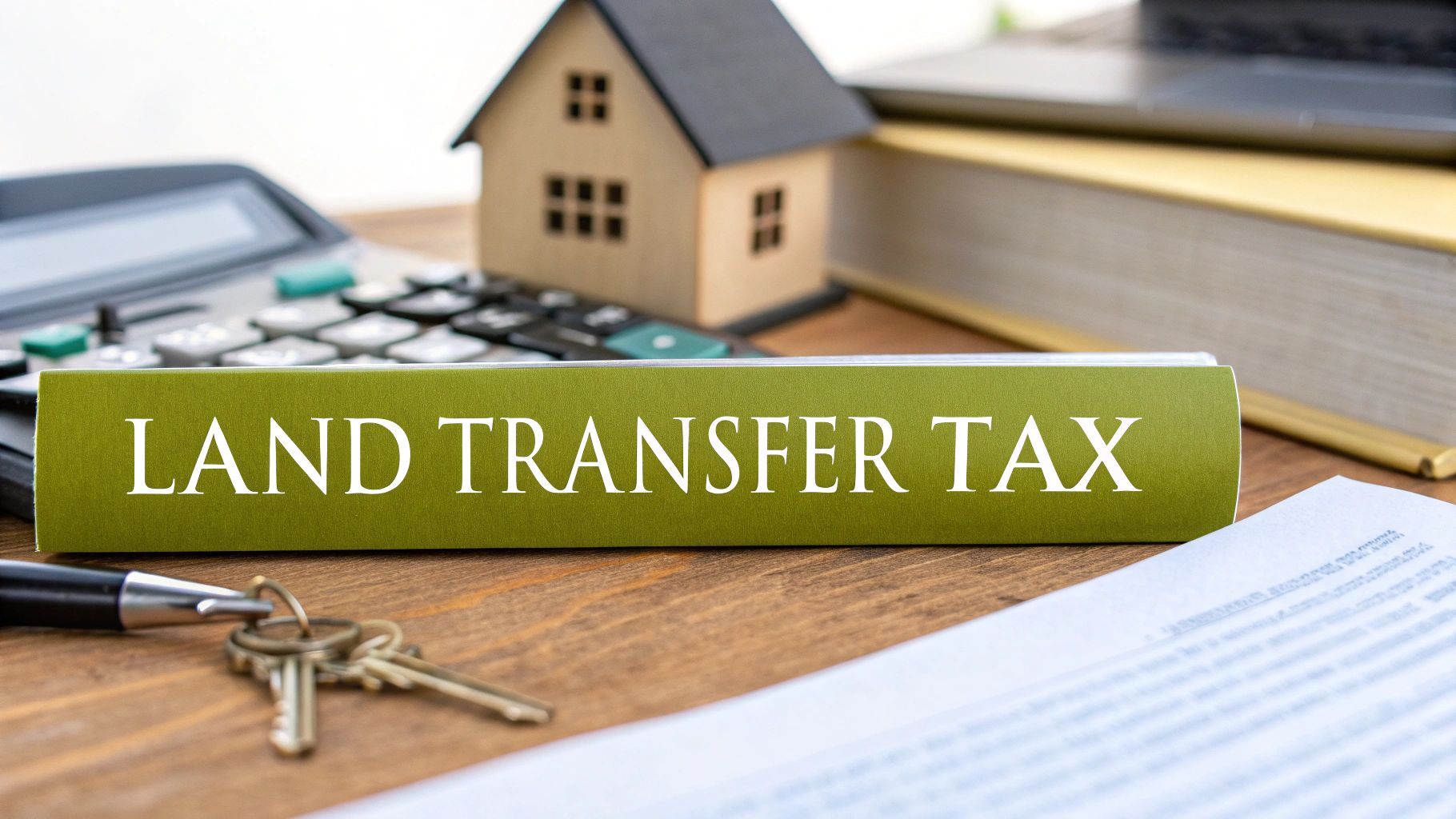
When you're buying a home in British Columbia, one of the biggest closing costs you'll face is the Property Transfer Tax (PTT). You'll often hear it called land transfer tax, and it's a critical expense you need to plan for—completely separate from your down payment.
Think of it as a one-time provincial fee you pay to officially put the property title in your name.
Understanding the Property Transfer Tax in BC
So, what is this tax, really? In short, the PTT is the cost of legally registering your ownership of a property. Whenever a home or piece of land changes hands in BC, this tax is applied, calculated on the property's fair market value on the day the registration goes through.
This tax is a major source of revenue for the province, helping to fund public services we all rely on. But for buyers in competitive markets like Vancouver and the Fraser Valley, it represents a pretty hefty upfront cost that can catch you by surprise if you're not ready for it. For instance, the BC government collected billions in PTT revenue in recent years, highlighting its significant impact on both provincial finances and homebuyer budgets.
Here's a quick rundown of what makes the PTT what it is.
Property Transfer Tax at a Glance
Essentially, it's a fundamental part of the home-buying process in BC that every buyer needs to understand and prepare for.
Why This Tax Matters to You
Getting a handle on the PTT is one of the first steps toward a smooth, financially sound home purchase. If you don't account for it, closing day can become incredibly stressful. As local real estate experts, James and Nicole Isherwood always make a point to talk about this cost early on.
"We see it time and again," says James Isherwood. "Buyers focus so much on the down payment that the PTT becomes an afterthought. Planning for it from day one ensures you can move forward with confidence and without last-minute financial pressure."
Budgeting for the PTT from the get-go allows you to:
- Avoid Financial Surprises: You'll know exactly what you need to have in the bank on your completion date. No scrambling.
- Make Stronger Offers: When you have a clear picture of all your costs, you can make more confident and competitive offers.
- Reduce Closing Stress: A well-planned budget eliminates one of the biggest headaches in any real estate deal.
This guide will walk you through exactly what this tax is, how it’s calculated, and potential ways you might be able to reduce it. To get a complete overview of the purchasing process, you can explore our detailed guide on buying a home in the Fraser Valley.
How Your Property Transfer Tax Is Calculated
Figuring out British Columbia's Property Transfer Tax (PTT) isn't as simple as applying one flat percentage. Instead, the province uses a tiered system, which is a lot like income tax brackets. Think of it this way: you pay one rate on the first chunk of your home's value, a higher rate on the next chunk, and so on.
This marginal approach is actually good news for buyers. It means you aren't paying the highest tax rate on the entire purchase price—only on the portions that fall into the higher value tiers. The first step is to figure out the property's fair market value, which is almost always the price you agreed to pay. If you're curious about where your home might stand, getting a free home evaluation can give you a solid starting point.
BC Property Transfer Tax Rates
The tax is calculated based on these specific tiers. Here’s a clear breakdown of the marginal rates applied to a property's fair market value:
So, how does this work in the real world?
Let's say you're buying a $900,000 home in the Fraser Valley. You would pay:
- 1% on the first $200,000 = $2,000
- 2% on the remaining $700,000 = $14,000
Your total PTT bill would be $16,000. It’s a straightforward calculation once you see how the pieces fit together.
This infographic gives you a simple visual of where paying the PTT fits into the overall home buying journey.
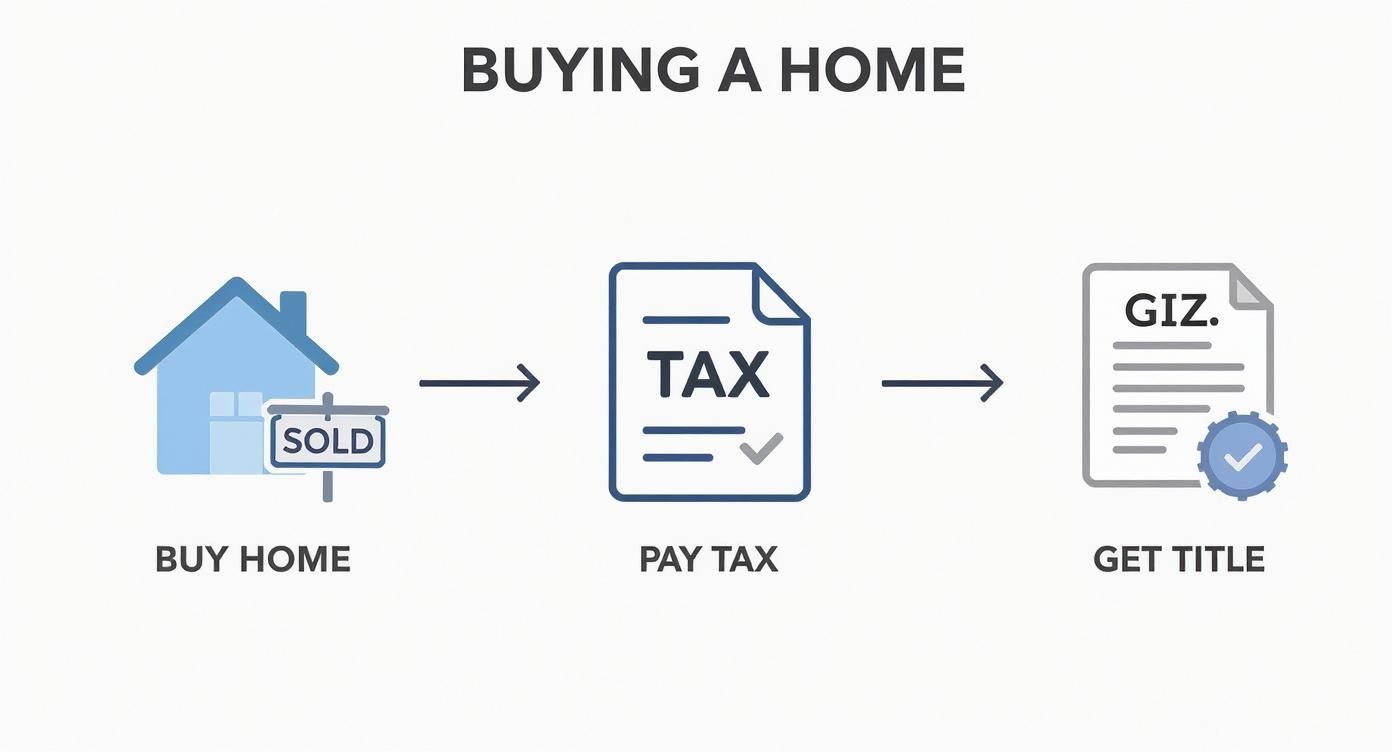
As the diagram shows, paying this tax is the critical step that allows the property title to be legally transferred into your name, making your ownership official.
Let's Run the Numbers: A Real-World PTT Calculation in Vancouver
To really get a feel for how the Property Transfer Tax works in a hot market, let's walk through a real-world example for a home in Vancouver. We'll use a property with a fair market value of $2,450,000 to show exactly how each tax tier adds up to the final bill. Breaking it down this way makes the whole process transparent and really drives home why you need to plan for closing costs well in advance.
Seeing the math laid out line-by-line makes it much easier to follow.
Step-by-Step Tax Breakdown
Here’s how the PTT gets calculated on that $2,450,000 Vancouver property:
- Tier 1: 1% on the first $200,000 = $2,000
- Tier 2: 2% on the portion from $200,001 to $2,000,000 (which is $1,800,000) = $36,000
- Tier 3: 3% on the remaining portion above $2,000,000 (which is $450,000) = $13,500
Add it all up, and you get the total tax you’ll need to pay.
Total PTT Payable: $2,000 + $36,000 + $13,500 = $51,500
That’s a significant chunk of change that has to be paid on your completion date. As real estate experts, James and Nicole Isherwood always advise clients to get a handle on these numbers early in the game to prevent stress down the road. It means you can make an offer with confidence, knowing exactly what you're getting into.
Understanding this figure is crucial for your overall budget. To see how this one-time cost fits in with your potential monthly payments, it's a good idea to play around with a mortgage payment calculator. This gives you a much clearer picture of your total homeownership expenses. Planning ahead is the key to a smooth and stress-free purchase, especially in a competitive market like Vancouver where every dollar counts. This proactive approach ensures there are no nasty surprises when it's time to close the deal on your new home.
Finding Savings with Key PTT Exemptions
Here’s the good news: paying the full Property Transfer Tax (PTT) isn't always a sure thing. The BC government has several exemption programs set up to help homebuyers, which can seriously cut down or even wipe out this closing cost. Knowing your way around these opportunities is the key to keeping more money in your pocket.
These programs are designed for specific situations, from helping first-time buyers break into the market to encouraging the construction of new homes. As local real estate experts, James and Nicole Isherwood always tell their clients to look into every single potential exemption. A few thousand dollars saved on taxes makes a massive difference to your overall financial picture when you're buying a home.
The First-Time Home Buyers Program
This is the big one—the most well-known and valuable exemption for anyone trying to get into the market in Vancouver and the Fraser Valley. If you qualify, you could watch your entire PTT bill vanish.
To get a full PTT exemption, you need to tick all these boxes:
- Be a Canadian citizen or permanent resident.
- Have lived in British Columbia for at least one year before you buy.
- Have never owned a registered interest in a primary home, anywhere in the world.
- The property’s fair market value must be $500,000 or less.
- The land must be 0.5 hectares (1.24 acres) or smaller.
For properties valued between $500,001 and $525,000, there's also a partial exemption available. It's a tight window, but it still offers some handy savings.
Heads up: you must also move into the property within 92 days of the sale registering and live there as your principal residence for at least one full year. The government is very strict about enforcing these rules.
Other Important PTT Exemptions
Beyond the first-timer program, a few other scenarios might get you off the hook for PTT.
- Newly Built Home Exemption: This program gives you a full or partial PTT break on newly constructed homes with a fair market value up to $750,000. It's a great incentive meant to make buying brand-new properties a bit more affordable.
- Transfers Between Related Individuals: In some specific cases, transferring a primary home between close family members (like from a parent to a child) can be exempt from PTT. The rules are pretty strict, so getting professional advice here is a must.
Digging into these exemptions is a non-negotiable step in managing your home-buying costs. If you want to zoom out for a bigger picture of financial planning, you can explore various real estate investment tax strategies that go beyond just the PTT.
Budgeting for All Your Closing Costs
While the Property Transfer Tax is definitely one of the biggest line items, it’s a classic rookie mistake to think it’s the only major expense you’ll face on completion day. A successful home purchase in the Fraser Valley hinges on a realistic budget that accounts for every last fee, saving you from a world of last-minute financial stress.
To make sure you're covered, a good rule of thumb is to set aside an additional 1.5% to 2% of the home's purchase price just for closing costs. Think of it as a financial buffer. It ensures you have enough cash on hand to handle everything without scrambling. As seasoned real estate salespeople, James and Nicole Isherwood make it a point to walk their clients through a detailed budget from day one, so there are no surprises.
Beyond the PTT: A Checklist of Other Costs
When you get your final statement of adjustments from your lawyer or notary, you'll see a list of other important fees. Building a complete budget means planning for these common expenses:
- Legal Fees and Disbursements: Your lawyer or notary public charges for their services, which include handling the title transfer, registering your mortgage, and managing all the essential paperwork.
- Property Appraisal: Before they hand over the mortgage funds, your lender will almost certainly require a professional appraisal to confirm the home's value.
- Home Inspection: This is a non-negotiable step. A thorough inspection from a qualified professional is your best tool for identifying potential issues with the property before you finalize the deal.
- Property Taxes: You’ll need to reimburse the seller for any property taxes they've already paid for the part of the year you'll be the owner.
Factoring in All Professional Fees
Real estate commissions are another key piece of the financial puzzle. In the Fraser Valley, a typical commission structure is 7% on the first $100,000.00 and 3.5% on the balance of the sale price. This is an important number to factor into your financial planning. If you're on the other side of the deal, our guide on selling your home offers some great insights.
Don't forget that other significant costs, like mortgage insurance, can also play a big role in your overall homebuying budget. This is usually required if your down payment is less than 20% of the purchase price, and it's a crucial expense to account for.
Got Questions About the BC Property Transfer Tax? We've Got Answers.
Digging into the details of the Property Transfer Tax can feel a bit overwhelming, and it almost always brings up a few questions for homebuyers. Here are some clear, straightforward answers to the questions we hear most often from our clients across Vancouver and the Fraser Valley.
Think of this as your quick-reference guide. Getting a solid handle on what this tax is and how it works is the best way to walk into your closing day feeling prepared and confident.
When Do I Actually Pay the Property Transfer Tax?
The PTT is due right on your completion day—the day the keys are officially in your hand and the property becomes yours. This isn't a bill that shows up in the mail a month later.
Your lawyer or notary public will take care of the whole process. They’ll collect the tax from you along with your down payment and other closing costs, then send it directly to the provincial government to finalize the title transfer. It's all handled in one smooth transaction.
Is This the Same Thing as My Annual Property Tax?
Nope, and it's a really important difference to understand. The Property Transfer Tax is a one-time tax you pay only when you buy the property. Think of it as the fee for transferring the ownership into your name.
Annual property taxes are completely separate. Those are paid every single year to your local city, like the City of Vancouver or the City of Surrey. That money is what funds essential local services—think schools, parks, road repairs, and fire departments.
Can I Just Add the PTT to My Mortgage?
Generally, the answer is no. Lenders see the Property Transfer Tax as a closing cost, which means it needs to be paid upfront out of your own pocket. You can't just roll it into your mortgage loan.
This is exactly why it's so critical to save for the PTT on top of your down payment. Experienced real estate agents like James and Nicole Isherwood always make sure their clients are budgeting for this expense separately from the very beginning.
Showing up on closing day without these funds ready to go can put the entire purchase at risk.
Does the Seller Ever Pay the Property Transfer Tax?
In British Columbia, the legal responsibility to pay the PTT falls squarely on the buyer. The tax is triggered when the property is "transferred" to a new owner, so it's the new owner who foots the bill.
The seller has their own set of closing costs to worry about. These usually include real estate commissions—which in the Fraser Valley are often structured as 7% on the first $100,000.00 and 3.5% on the balance—plus any legal fees they need to pay to clear their existing mortgage.
Navigating the complexities of the Property Transfer Tax is much easier with an expert on your side. For personalized guidance on buying a home in the Fraser Valley, trust the experience of Royal LePage Brookside Realty Property Management. Contact us today to get started.