
A lot of buyers looking at townhomes in Maple Ridge BC are trying to solve the same problem. They want more room than a condo, they don't want the full upkeep of a detached house, and they need the monthly budget to stay realistic after the keys are in hand.
That last part is where many searches go sideways.
A listing can look affordable at first glance, then ownership costs start stacking up. Strata fees. Property taxes. Insurance. Utility bills. Potential future strata work. In Maple Ridge, where one complex can feel very different from the next, those details matter just as much as the asking price.
Why Choose a Townhome in Maple Ridge
For many buyers, a townhome is the middle ground that finally makes sense. A young family may be priced out of detached homes, but a condo can feel tight once you add kids, pets, storage bins, hockey bags, and the need for actual parking. A downsizer may want to leave yard work behind without giving up a front door, multiple levels, or a garage.
That's why townhomes in Maple Ridge BC keep showing up in serious home searches. They often give buyers a practical mix of space, privacy, and lower maintenance than a detached property.

Maple Ridge also suits the people who choose this housing type. Families often want access to schools, parks, and neighbourhoods where kids can ride bikes and still be close to groceries and commuter routes. Buyers who work in other parts of the Lower Mainland often look here because they still want a home that feels residential, not boxed into a high-rise lifestyle.
What buyers usually like most
- More usable space: Townhomes often offer multiple bedrooms, separate living areas, and better storage than many condos.
- Less exterior maintenance: Owners still need to understand strata responsibilities, but they usually aren't handling the same level of outside upkeep as detached homeowners.
- Parking that works for real life: In Maple Ridge, family-friendly developments often include garage parking, which makes a difference when households have two drivers or need room for bikes and gear.
- Neighbourhood feel: Areas like Albion, Cottonwood, Silver Valley, and West Maple Ridge each give townhome buyers a different version of community life.
Buyers usually aren't choosing between a townhome and their dream house. They're choosing between a workable lifestyle now and waiting indefinitely for a detached home that may not fit the budget.
Maple Ridge has the size and housing base to support that choice. In the 2021 Census, the city had a population of 90,990, 33,103 occupied dwellings, 34,254 total private dwellings, a 10.6% population increase from 2016, a land area of 267.82 km², and a population density of 339.7 people per km², which helps explain why strata housing plays a meaningful role in local ownership options (Maple Ridge census profile summary).
The Maple Ridge Townhome Market Snapshot 2026
The local townhome market isn't frozen, and it isn't reckless either. It's active, but buyers and sellers still have to think.
In April 2026, Maple Ridge saw 28 townhouse units sold, with an average price of $749,471 and an average of 37 days on market (April 2026 Maple Ridge townhouse market report).

What those numbers mean on the ground
An average price in the mid-$700,000s puts Maple Ridge townhomes in a range that attracts several buyer groups at once. First-time buyers moving up from condos, families leaving smaller homes, and downsizers who still want square footage can all end up competing for similar listings.
The 37-day average selling time matters just as much. Homes weren't disappearing overnight, but they also weren't sitting without interest. That usually points to a market where pricing, presentation, and timing still matter a lot.
For buyers, that creates a slightly uncomfortable reality. You may have enough time to review documents properly and think through your offer, but not enough time to drift. If a well-priced unit shows well, has sensible strata fees, and sits in a strong location, hesitation can still cost you.
What works for buyers
A smart buyer strategy in this kind of market is less about chasing headlines and more about being ready for specific units.
- Get clear on your all-in budget: Don't shop by purchase price alone. A townhome with a lower asking price but heavier monthly costs can strain your finances more than a higher-priced unit with leaner ongoing costs.
- Study days on market properly: A property that's been available longer isn't automatically a bargain. It may have pricing, location, layout, or strata issues.
- Treat document review as part of the search: In townhomes, the complex matters almost as much as the unit itself.
What works for sellers
Sellers have room to succeed, but overconfidence can hurt the result.
If the average selling time is over a month, buyers are comparing. They're checking competing units, common-area condition, strata history, and monthly fee differences. A seller who prices too aggressively can lose the early wave of serious attention, which is usually the best attention.
Practical rule: In a moderate-paced market, the first pricing decision is often the most important one. Fixing an ambitious list price later is harder than getting it right at launch.
What this market doesn't reward
It doesn't reward vague positioning.
A listing that says "great family townhome" without backing that up with clear value won't stand out. Buyers want to know whether the home offers real advantages such as layout, garage function, outdoor space, school proximity, or lower carrying costs than nearby alternatives. In Maple Ridge's townhome segment, generic marketing tends to fade into the background.
A Neighbourhood Guide to Maple Ridge Townhomes
Maple Ridge isn't one uniform townhome market. Buyers who search that way usually miss what drives value. The experience of shopping in Albion is different from shopping in West Maple Ridge, and both feel different again from Silver Valley or Cottonwood.
Inventory is fragmented too. City-wide, there are 171 townhomes on the market, while West Maple Ridge has 18 townhome listings, and large projects such as Albion Station with 113 townhomes create a very different buying environment than a smaller boutique complex (Maple Ridge townhome inventory and Albion Station overview).
Maple Ridge Townhome Neighbourhood Comparison
| Neighbourhood | Typical Price Range (2026) | Dominant Vibe | Key Amenities |
|---|---|---|---|
| Albion | Varies by project and strata | Family-oriented, newer suburban feel | Parks, schools, trail access, newer multi-phase communities |
| Silver Valley | Varies by age and setting | Nature-focused, quieter, hillside feel | Trail networks, green space, newer development pockets |
| Cottonwood | Varies by complex and condition | Established, practical, family-friendly | Schools, recreation, daily shopping, commuter convenience |
| West Maple Ridge | Varies by supply and location | Central, convenient, more established | Access to shops, services, older established streets, commuter routes |
Albion
Albion often appeals to buyers who want a neighbourhood that feels built around family routines. You'll find parks, schools, and modern townhouse clusters that suit buyers moving out of condos or older starter homes. The streetscape in many parts of Albion feels planned around community living, which is part of the draw.
The flip side is that buyers in larger multi-phase areas need to compare carefully. In a bigger development, one unit might look similar to the next online, but value can shift based on phase, exposure, finish level, parking setup, and how the strata is run. That's one reason a project-scale market doesn't always behave like a boutique one.
Silver Valley
Silver Valley attracts buyers who care about access to nature and a quieter setting. If trail access, a more tucked-away feel, and newer suburban housing are high on your list, this area often comes up quickly.
What doesn't work here is assuming every Silver Valley listing suits every commute. Buyers need to balance the appeal of the setting with the day-to-day reality of school drop-offs, shopping runs, and travel time. For some households, that trade-off is easy. For others, it gets old fast if they only focused on the unit itself.
A beautiful townhome in the wrong daily routine still becomes the wrong home.
Cottonwood
Cottonwood tends to land well with buyers who want practical convenience without giving up the family-oriented feel many people move to Maple Ridge for in the first place. It often offers a good mix of schools, recreation access, and neighbourhood familiarity.
This area can work well for buyers who want less of a "master-planned project" feel and more of an established residential setting. The key here is to look at complex-specific differences closely. Two townhomes a short drive apart can have very different strata cultures, parking realities, and long-term maintenance outlooks.
West Maple Ridge
West Maple Ridge often appeals to buyers who want to stay closer to services and commuter routes. It can be a strong fit for households that want centrality over a more edge-of-town feel. If you're trying to reduce drive time for errands and everyday logistics, this area deserves attention.
The challenge is choice. The city-wide market may look broad, but when one submarket has only a limited set of active listings, buyers can feel that scarcity quickly. That's one reason it helps to understand West Maple Ridge neighbourhood context before narrowing your shortlist.
How to choose the right area
Some buyers make the mistake of starting with finishes. Quartz counters and fresh paint are easy to notice, but they don't decide whether you'll like living there.
A better filter is this:
- Daily rhythm: How far are school runs, groceries, trails, and major roads from the complex?
- Project type: Are you buying in a larger development with more internal competition, or a smaller site where comparable sales are harder to find?
- Lifestyle fit: Do you want a central setting, a newer suburban pocket, or something closer to nature?
- Resale audience: If you sell later, who is most likely to want this location and layout?
Neighbourhood choice in Maple Ridge isn't just about where you want to live. It's also about how the local pocket shapes competition, future resale, and the kind of compromises you'll be living with every day.
Beyond the List Price The True Cost of Townhome Ownership
This is the part many guides skip.
A lot of listings make townhomes look affordable only by showing the purchase price and a few basic features. That doesn't answer the question most buyers are really asking, which is whether the home will still feel affordable every month after closing.

Existing Maple Ridge townhome content often focuses on inventory, bedroom counts, broad price bands, and the idea that townhomes offer lower cost and less maintenance, but it leaves a major gap around monthly carrying costs such as strata fees, mortgage payments, property taxes, and insurance (Maple Ridge townhome affordability discussion).
What buyers should count before making an offer
The right question isn't "Can I buy this?" It's "Can I comfortably own this?"
Your monthly cost usually includes several moving parts:
- Mortgage payment: This is still the biggest line item for most buyers.
- Strata fees: These can shift the budget more than buyers expect, especially in newer complexes with larger amenity packages or higher ongoing maintenance costs.
- Property taxes: They need to be part of the monthly reality, not treated like an afterthought.
- Insurance and utilities: They may look manageable separately, but together they change affordability.
- Future strata exposure: If a complex has deferred maintenance or weak planning, the monthly fee isn't the whole story.
Why cheaper isn't always cheaper
A lower list price can be misleading.
An older townhome may come with modest monthly fees but need more future work. A newer project may look easier to maintain, but if the strata budget is higher and the amenity package is more expensive to operate, the ownership gap can narrow quickly. Buyers who only compare asking prices often miss this.
The monthly cost is what you live with. The list price is only what gets you in the door.
A better way to compare two townhomes
When comparing properties, line them up on one page and review them like this:
- Purchase price
- Monthly strata fee
- Estimated property tax burden
- Insurance
- Utility pattern
- Strata document health
- How likely the complex is to face expensive future work
That approach changes decisions. It often reveals that one home is the better long-term fit even if the sticker price is higher.
Understanding Townhome Styles and Strata Living
Most Maple Ridge townhomes aren't just about layout. They're also about ownership structure, and buyers need to understand that before they feel confident writing an offer.
Many local developments are built as freehold strata, and family-oriented features are common. For example, Magnolia Grove is described as 52 units, 2-level, and freehold strata, while Willow Townhomes advertises 18 family-friendly townhomes with double garages and unit sizes most over 1,700 sq ft (Magnolia Grove and Willow Townhomes details).

What freehold strata means in practice
In a freehold strata, you own your unit and also share ownership responsibilities for common property. That often includes things like exterior elements, roofing, landscaping, drive aisles, visitor parking, and other shared areas, depending on the strata plan and bylaws.
For buyers, that means you're not only buying a home. You're buying into a system of governance and shared financial decision-making. That's why strata review isn't paperwork for the sake of paperwork. It's part of due diligence.
If you're trying to get familiar with how strata communities are typically managed, a general overview of property management services can help clarify how maintenance, communication, and budgeting are handled at the building or complex level.
What to review before you remove subjects
A clean kitchen and a nice entryway don't tell you whether the strata is healthy.
Look closely at:
- Bylaws and rules: Check pet restrictions, rental rules, parking use, age restrictions if any, and renovation requirements.
- Strata minutes: These often reveal recurring issues such as drainage complaints, building envelope concerns, resident disputes, or upcoming projects.
- Financial statements: You want to see whether the corporation appears organised and financially steady.
- Depreciation report: This helps buyers understand the expected lifespan of major components and whether the strata seems prepared for them.
Red flags buyers shouldn't ignore
Some concerns are more serious than others.
A bylaw you don't like may be workable. A pattern of delayed maintenance, repeated leaks, unclear special levy discussions, or poor record-keeping deserves a much harder look. If the documents feel incomplete or chaotic, don't assume the actual management is better than the paperwork.
Buy the unit, but investigate the strata as if you're joining a small business with your neighbours. In many ways, you are.
Townhome living can be an excellent fit in Maple Ridge, especially when the layout, parking, and neighbourhood all line up. It works best when buyers understand both the physical home and the shared structure wrapped around it.
Financing Your Maple Ridge Townhome Purchase
Financing a townhome isn't exactly the same as financing a detached house, even when the purchase price looks manageable on paper. Lenders look at the property, but they also look closely at your monthly obligations, and strata fees are part of that picture.
That means pre-approval isn't optional if you're serious. It gives you a working price ceiling, but, above all, it helps you search with the right assumptions from the start.
Why strata fees matter to your approval
A buyer can fall in love with a unit, then realise the monthly carrying cost pushes the file in the wrong direction. That's because lenders don't just consider principal and interest. They also look at other recurring housing costs when they assess affordability.
So if one complex carries noticeably higher strata fees than another, that can affect what you can comfortably finance. This is one reason buyers should involve their mortgage broker early and test more than one property scenario before writing offers.
If you want a rough planning tool before speaking with a broker, a mortgage payment calculator can help you compare how purchase price and monthly costs interact.
A simple financing workflow that works
Start with the lender conversation, not the open house.
- Get pre-approved early: This tells you where your payment comfort zone likely sits.
- Build in strata reality: Ask your broker how they want you to account for monthly strata fees when reviewing affordability.
- Keep room in the budget: Don't spend to your absolute ceiling if the complex may have rising costs or future work.
- Match financing to the property type: A clean, well-run strata can feel very different to underwrite than one with messy records or visible issues.
Where buyers get into trouble
They shop emotionally before they shop financially.
The usual pattern is simple. A buyer sees a sharp-looking newer townhome, assumes the payment will work because the list price feels within reach, and only later learns that the total monthly obligation is tighter than expected. The fix is straightforward. Run the ownership numbers first, then go touring.
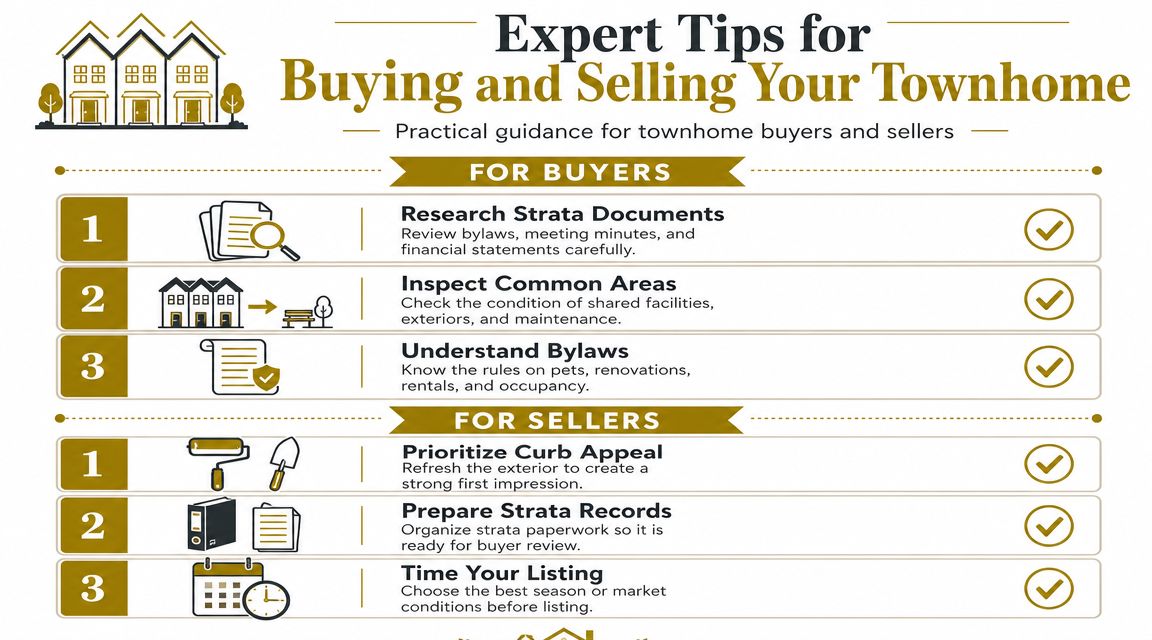
Expert Tips for Buying and Selling Your Townhome
A Maple Ridge townhome can look affordable at first glance, then feel very different once you factor in strata fees, property taxes, parking limits, and the condition of the complex. That is where good decisions get made. Not at the photo stage, but in the details.
For buyers
Buy the complex first, then the unit.
A renovated kitchen is easy to see. Deferred maintenance is not. In Maple Ridge, I tell buyers to pay close attention to the parts of ownership that keep costing money after possession. Review the strata minutes for signs of recurring repairs, check whether the contingency reserve feels thin for the age of the project, and look at how the grounds and parkade areas are maintained. A lower list price can stop being a bargain quickly if the building has larger expenses coming.
Practical checks matter here. Walk the visitor parking area. Open the garage and see if it works for the vehicles you own, not the ones in the brochure. Stand in the unit and listen for road noise, neighbour noise, and play area noise. Those are daily quality-of-life issues, and they affect resale later.
A smart starting point is understanding the full home buying process in Maple Ridge, then applying that process to the specific complex, bylaws, and monthly carrying costs in front of you.
For sellers
Townhome buyers compare hard. Usually against the unit down the street, the last sale in the complex, and one newer project with lower maintenance risk.
That means sellers need more than clean photos. They need a clean story. Prepare the home, but also prepare answers around strata fees, recent building work, parking, storage, pet rules, and what makes the monthly ownership cost feel manageable for the next buyer. If your strata fee covers a meaningful amount of exterior maintenance or insurance-related items, make that clear. If property taxes are reasonable for the area, that helps too.
The physical prep should match how Maple Ridge buyers shop. Clear out the garage so its function is obvious. Make patios and small yards feel usable. Freshen worn flooring if it distracts from the showing experience. Sellers thinking about cost-effective updates should review flooring for maximum home value because flooring condition affects how clean, cared-for, and move-in ready a townhome feels.
Sellers get better results when they market the lifestyle accurately. Family parking, school access, usable outdoor space, and predictable monthly costs often matter more than a generic list of upgrades.
Your Next Step to Finding a Home in Maple Ridge
A Maple Ridge buyer can tour two townhomes on the same Saturday, like the less expensive one more, and still make the better financial decision on the higher-priced unit. The difference often shows up in the monthly numbers. Strata fees, property taxes, insurance gaps, commuting costs, and upcoming building work can change the actual cost of ownership fast.
That is the lens to use for your next step. Choose the home that fits how you live and what you can comfortably carry each month, not just the one that looks best on the listing sheet.
In Maple Ridge, that usually means comparing the complex as carefully as the unit. A townhome near schools and daily shopping may reduce car use and save time every week. A newer project with higher strata fees may still be the cheaper home to own if the contingency reserve is healthier and major exterior work is less likely in the near term. A lower list price in a weaker strata can get expensive after possession.
Sellers should think the same way. Buyers are not only judging finishings. They are asking whether the home feels manageable, well-kept, and predictable to own. For owners planning pre-sale updates, this guide to flooring for maximum home value is a useful place to start because worn flooring can make a townhome feel more expensive to take on than it really is.
If you want help sorting through those trade-offs, from monthly ownership costs to neighbourhood fit and sale preparation, contact a Maple Ridge real estate team that knows the local townhome market.
Royal LePage Brookside Realty Property Management is one local option for buyers and sellers who want practical help with townhomes, houses, and investment property.