
A lot of Maple Ridge investors end up staring at two very different listings at the same time.
One is a newer strata unit in an area like Albion or near the central core. It looks easy. Cleaner finishings, lower yard maintenance, simpler tenant turnover, and a lower entry point. The other is an older detached house in West Maple Ridge or a family pocket near Cottonwood. It needs more attention, but it comes with land, more control, and a different type of tenant demand.
That decision looks simple until you own one.
On paper, many buyers reduce it to purchase price versus rent. In practice, strata vs detached rentals in Maple Ridge for investors is really a choice between two ownership models. One gives you shared expenses, shared rules, and less direct maintenance. The other gives you full autonomy, full repair exposure, and a stronger connection to land value.
I've seen new investors choose strata because it feels safer, then get surprised by bylaws, fee increases, or special levy risk. I've also seen buyers chase detached homes for appreciation, then underestimate the time and cash that older houses can demand when a roof, drainage issue, or furnace stops being theoretical.
The better question isn't which property type is “best.” It's which one fits your capital, your stress tolerance, your tenant strategy, and your exit plan in Maple Ridge.
The Maple Ridge Investor's Dilemma Strata or Detached
A common Maple Ridge scenario goes like this. An investor looks at a tidy condo or townhouse in Albion and likes the clean presentation, newer building systems, and easier leasing story. Then they tour an older detached home in West Central or West Maple Ridge and immediately think about the lot, the yard, the future upside, and the fact that nobody on a strata council gets to vote on how they run it.
Both instincts are valid.
The strata purchase often appeals to buyers who want a more predictable day-to-day ownership experience. The detached purchase usually appeals to buyers who want control and who believe long-term value is tied as much to the site as to the structure sitting on it. In Maple Ridge, where neighbourhood character changes block by block, that distinction matters.
Here's the practical split I give clients early:
| Factor | Strata rental | Detached rental |
|---|---|---|
| Entry point | Usually easier to enter | Usually requires more capital |
| Monthly ownership | More predictable, but includes strata costs | Less predictable, because all repairs are yours |
| Control | Limited by bylaws and collective decisions | High control over use, upgrades, and management |
| Tenant profile | Singles, couples, small families, commuters | Families, multi-generational households, tenants wanting space |
| Resale audience | Broad attached-home buyer pool | Buyers seeking land, space, and autonomy |
| Risk style | Rule risk and building-level risk | Repair risk and property-specific risk |
What new investors often miss
A Maple Ridge rental property doesn't just perform because rent comes in on time. It performs when the ownership structure matches the investor.
If you dislike surprise meetings, document review, and committee-style governance, strata can wear on you even if the suite itself rents well. If you hate unpredictable repairs or don't want to coordinate trades for exterior issues, detached can become exhausting fast.
A good investment property is one you can hold through boring months, annoying months, and expensive months.
That's why this comparison has to go beyond headline affordability. In Maple Ridge, the winning choice often comes down to the type of problem you'd rather solve.
Understanding the Maple Ridge Investment Landscape
Maple Ridge sits in an interesting position for investors. It still gives buyers more variety than many parts of Metro Vancouver, and that variety matters because attached and detached rentals don't behave like the same asset class. They attract different buyers, different tenants, and often different hold strategies.

Attached and detached sit in different investor lanes
One of the clearest ways to frame this is by looking at how investors participate in attached versus detached housing more broadly. JBREC's investor activity analysis shows that about 2.9 million of 14.3 million investor-owned homes are attached homes such as condos and townhomes, while investors overall own and rent about 14.3 million attached and detached homes and account for roughly 25% of all homes sold. The same analysis notes that investor participation rose from about 12% of residential transactions in 2002 to 25% today.
For Maple Ridge investors, that matters because strata rentals usually sit in a higher-liquidity, lower-land-footprint segment, while detached rentals are closer to the scarcer single-family category.
What that means on the ground in Maple Ridge
In practical terms, attached inventory gives buyers more interchangeable options. If you're comparing a condo or townhouse, your competition often includes similar units with similar layouts, similar amenities, and similar buyer logic. Resale can be easier to model, but it's also more sensitive to building reputation, strata governance, and fee structure.
Detached homes are different. A house in West Maple Ridge isn't just a house. Buyers weigh lot shape, street feel, school access, parking, yard usability, suite potential, and how the block feels at different times of day. That makes detached more nuanced. It also makes it less interchangeable.
- For strata investors: you're buying into a building, a council, and a ruleset, not just a floor plan.
- For detached investors: you're buying land exposure, flexibility, and full repair responsibility.
- For both: Maple Ridge location still drives tenant quality and ease of leasing. Near schools, parks, commuter routes, and everyday shopping wins.
Local lens: A strong rental in Maple Ridge isn't just about square footage. It's about how well the property fits the daily life of the tenant most likely to live there.
That's why investors who do well here usually start with segment logic first, then narrow down to property selection.
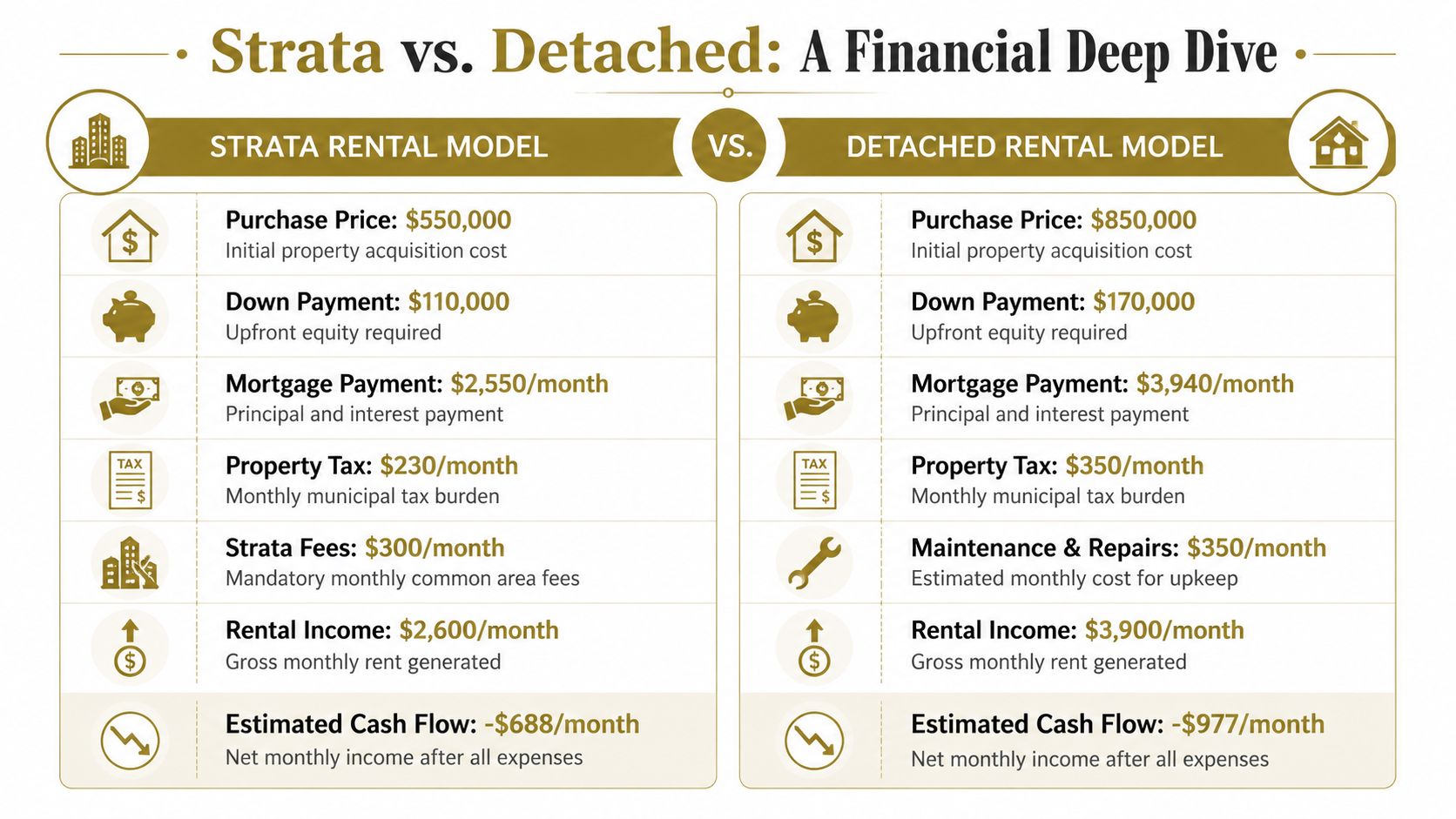
Financial Deep Dive A Tale of Two Cash Flow Models
At this juncture, investors either sharpen their decision or get misled by the wrong numbers.
Too many buyers compare gross rent to mortgage payment and stop there. That shortcut causes trouble fast, especially when comparing strata to detached. The right place to start is NOI and DSCR. Kiavi's investor metrics guide defines NOI as gross rental income minus vacancy losses and operating expenses, and DSCR as NOI divided by annual debt service. Many lenders look for a minimum DSCR of 1.25, and many residential investors use the 50% Rule as a quick screen, meaning roughly half of gross rent gets consumed by operating costs, excluding mortgage principal and interest.
Why gross yield misleads investors
A strata unit can look efficient because the purchase price is lower and maintenance feels outsourced. But that's only half true. Some maintenance is outsourced. The owner still carries strata fees, insurance exposure, and the risk that building-level decisions affect net income.
Detached can fool investors in the opposite direction. A house may look stronger because there's no strata fee and the land component feels safer long term. Then the owner becomes the strata. Every repair, seasonal issue, drainage problem, appliance replacement, and exterior headache lands on one balance sheet.
A practical Maple Ridge underwriting habit
When I review a rental purchase in Maple Ridge, I want buyers to underwrite the property two ways.
First, the disciplined way:
- Gross scheduled rent
- Less likely vacancy allowance
- Less operating expenses
- Equals NOI
- Then compare NOI to annual debt service for DSCR
Second, the quick reality check:
- Use the 50% Rule as a rough screening tool before you get emotionally attached to the property.
- Stress test the weak point. For strata, that's often fees, levies, and bylaw friction. For detached, that's repair volatility.
- Model ownership, not just rent. If the property only works under ideal assumptions, it doesn't work.
This is also why developers and experienced investors spend time unlocking property project potential through feasibility-style thinking. The habit matters even on a single rental purchase. You want to know what the deal looks like after friction, not before it.
Strata costs versus detached costs
Here's the plain-English version of the cash flow difference.
| Cost area | Strata rental reality | Detached rental reality |
|---|---|---|
| Building upkeep | Shared through strata structure | Paid directly by owner |
| Monthly recurring cost | Often more predictable | Often less predictable |
| Surprise cost style | Special levies, fee changes, building decisions | Roof, plumbing, drainage, exterior, mechanical systems |
| Insurance and risk exposure | Building-level complexity can affect owner costs | Simpler ownership structure, but direct repair burden |
| Cash flow pressure | Fees can quietly erode net income | Big-ticket repairs can hit all at once |
The after-fee issue is especially important in Maple Ridge. A local market summary notes that investors should subtract taxes, insurance, and management fees before calculating yield, and the same source references Maple Ridge benchmark pricing around $932,000 with detached sales down about 21.8%, which is why some buyers are weighing lower-entry strata against softer detached pricing without fully underwriting carrying costs in this Maple Ridge market summary.
What works and what doesn't
What works:
- Buying strata when the building documents are clean, the fee structure is sensible, and the rental use fits your tenant profile.
- Buying detached when you have reserve capital and you want operational control.
- Using a real payment model before writing an offer. A simple mortgage payment calculator helps buyers stop guessing.
What doesn't work:
- Treating strata fees as if they replace all maintenance risk.
- Treating detached repairs as occasional inconveniences instead of part of the business model.
- Buying based on monthly rent alone.
Underwriting rule: If a property only looks attractive before fees, repairs, taxes, insurance, and management, it isn't actually attractive.
Ownership and Control Navigating Bylaws vs Total Autonomy
The money matters, but so does the ownership experience. Through this experience, many investors discover what kind of landlord they really are.
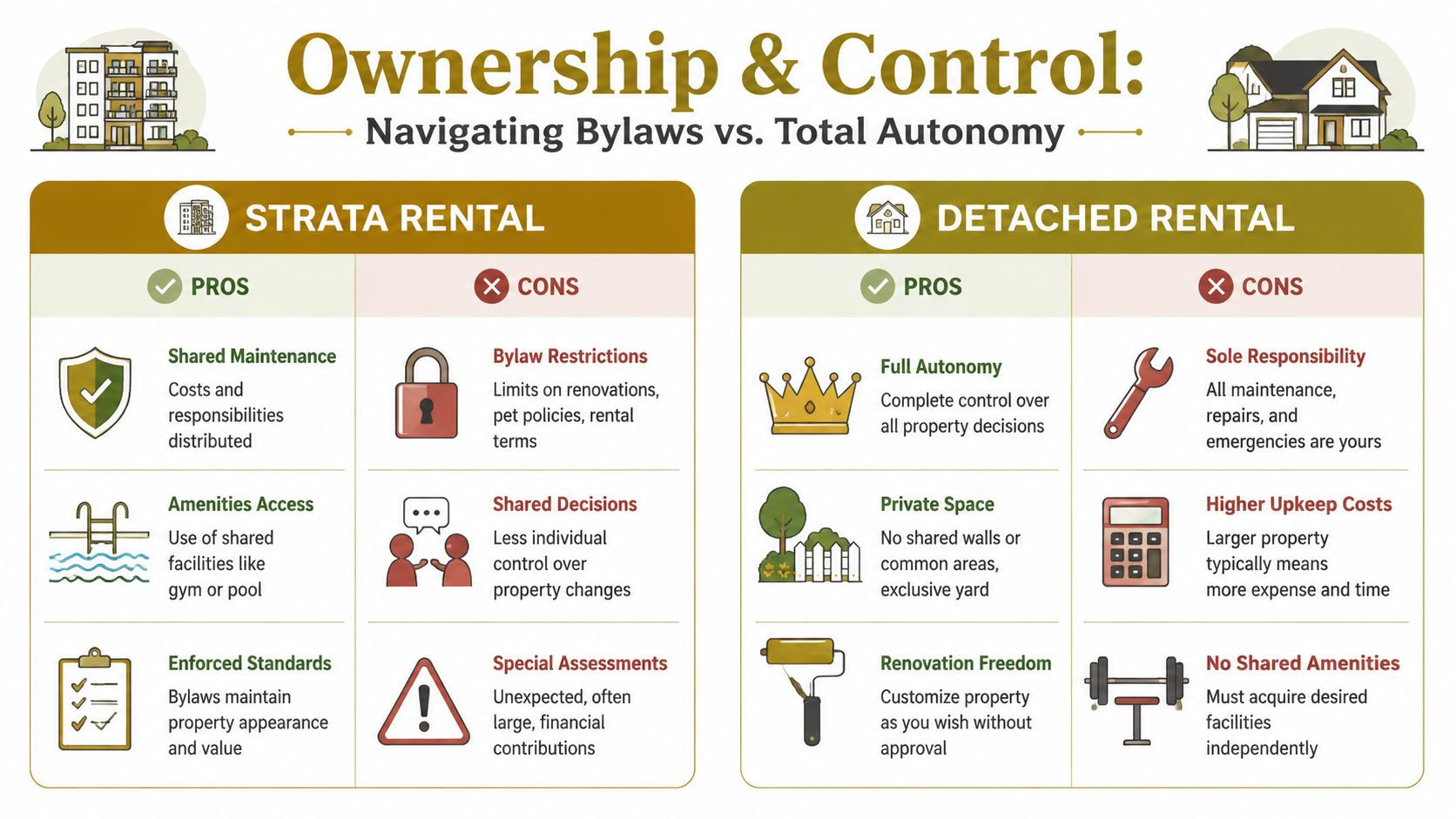
A strata rental means you own your unit, but you don't control the full environment around it. A detached rental means you control the whole property, but nobody shares the burden when something goes wrong. For some investors, that trade is obvious. For others, it only becomes obvious after the first conflict.
The reality of strata ownership
General strata-investment guidance notes that owners face modification restrictions, closer neighbour interactions, and higher dispute potential in multi-unit settings. In Maple Ridge, that matters more right now because buyers have more choice across both attached and detached inventory, so non-price risks matter more in the decision.
In plain terms, strata ownership can mean:
- Renovation limits: You may not be free to change flooring, fixtures, windows, or layouts without approvals.
- Use restrictions: Pet rules, move-in rules, parking allocations, and occupancy details can shape tenant fit.
- Building-level consequences: A poorly run council or deferred maintenance issue can affect your unit even if you've done everything right.
If you've never reviewed bylaws and governing documents closely, a basic homeowner's guide to HOA rules gives a useful framework for understanding why these documents matter before you buy into a shared ownership structure.
The appeal and burden of detached ownership
Detached ownership is cleaner from a control standpoint. If you want to repaint, reconfigure a yard, improve storage, replace surfaces, or reposition the property for a different tenant profile, you generally have far more freedom.
That freedom is real, and investors value it for good reason.
But detached ownership also means:
| Ownership issue | Strata | Detached |
|---|---|---|
| Renovation approval | Often restricted | Mostly owner-directed |
| Day-to-day neighbour friction | More common in shared settings | Usually lower |
| Exterior maintenance | Shared responsibility model | Full owner responsibility |
| Rule changes affecting use | Possible | Far less likely |
| Emergency response burden | Often partly shared at building level | Entirely on owner |
Which headache do you prefer
This is the question investors should ask first.
If you prefer a structured environment and don't mind rules, strata can be easier to live with, especially if the building is well managed. If you want to run the asset your way and don't want committee oversight, detached is often the better fit.
I'd put it this way:
A strata owner manages within constraints. A detached owner manages without a net.
Some investors outsource the operational side entirely through a professional service such as Maple Ridge property management support. That can help, but it doesn't remove the ownership model itself. A manager can handle leasing, communication, inspections, and maintenance coordination. They can't make strata bylaws disappear, and they can't stop a detached home from needing a new roof.
Tenant Demand and Marketability Across Maple Ridge
The best rental investment in Maple Ridge is the one that matches a real tenant profile.
That sounds obvious, but investors still buy properties they personally like instead of properties the local rental market can absorb easily. A sleek condo might appeal to the owner and still miss the strongest tenant demand in that sub-area. A detached house might look rough on day one and still lease faster because it solves a family's real housing problem.
Match the property to the neighbourhood
In central Maple Ridge, especially near daily amenities and commuter routes, strata units often appeal to professional singles, couples, and downsizers who want convenience more than yard space. If the unit is close to shopping, routine services, and a manageable commute, the rental story is easier.
Near the West Coast Express corridor, tenants often care about routine and time. They want parking that works, storage that makes sense, and a home that doesn't add friction to the workweek.
In Albion and Cottonwood, the tenant profile often shifts toward young families. They care less about a concierge-style building experience and more about layout, bedrooms, nearby parks, and whether school drop-off feels manageable. Townhouses do well here because they land in the middle. More room than a condo, less responsibility than a detached home.
Where detached tends to win
Detached rentals attract a different tenant. In Maple Ridge, that usually means households that want privacy, more parking, more storage, or outdoor space. Families often prefer detached because it supports routines better. Bikes, strollers, sports gear, a dog, a barbecue, and visiting relatives all fit more naturally.
A detached home with a sensible layout also appeals to multi-generational living arrangements. Even when the finishings aren't perfect, the function can be.
- Albion and Cottonwood: Good fit for family-oriented townhouses and houses near parks, schools, and the Albion Sports Complex.
- West Central and central Maple Ridge: Stronger fit for commuters, couples, and tenants who value walkability to services and transit access.
- Silver Valley and edge neighbourhoods: Better for tenants who want a quieter residential feel and are comfortable trading commute simplicity for space.
Tenants don't rent categories. They rent solutions to daily life.
Marketability beats theory
From a property management point of view, easy-to-market rentals usually share a few traits:
- The layout suits the area. A family area needs family function. A commuter area needs convenience.
- The property solves a practical problem. Storage, parking, outdoor space, in-suite laundry, and school access matter.
- The condition matches the rent expectation. Maple Ridge tenants will pay for clean, functional, well-managed homes.
For landlords who want to tighten that thinking, these landlord resources for Maple Ridge owners are useful for screening the rental from an operations angle before buying it.
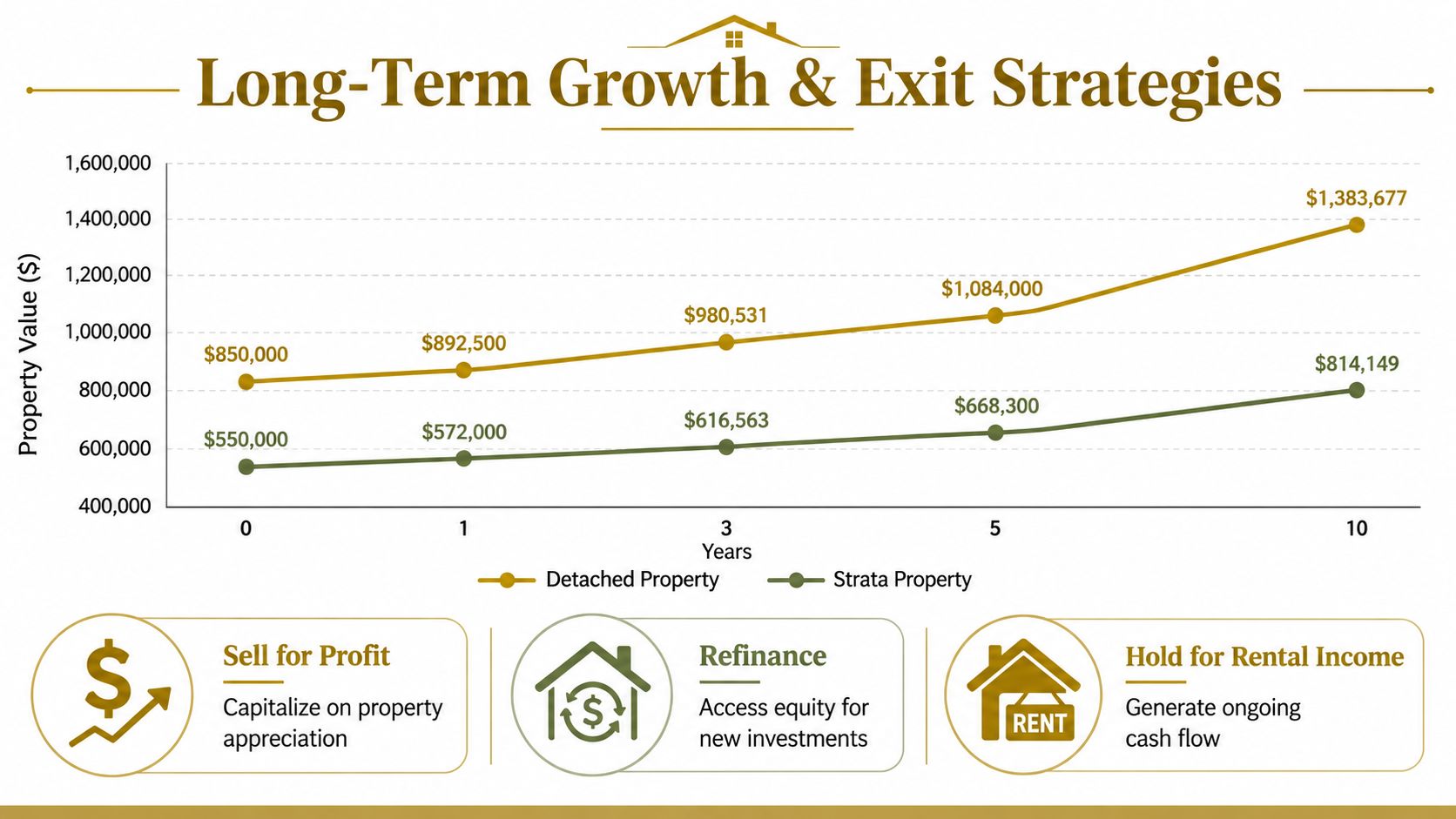
Long Term Growth and Your Exit Strategy
Cash flow gets most of the attention up front. Exit strategy decides whether the investment still makes sense years later.
Detached and strata properties usually appreciate for different reasons. Detached homes are tied more directly to land, lot utility, and neighbourhood positioning. Strata properties are tied more closely to the health of the building, the quality of management, and how well that form of housing serves future demand in denser parts of Maple Ridge.
Why detached often attracts long-hold investors
Research summarized by Journalist's Resource on institutional single-family rentals reported that the institutional single-family rental market grew from about 40,000 homes in 2012 to almost 120,000 by 2014, then added only another 40,000 homes by 2018 as competition from individual buyers increased. The same summary notes that neighbourhoods within one-quarter mile of an investor purchase saw home values rise 10.5% more within the next year than properties 50 to 75 miles away.
That history matters because detached rentals have often been valued not just as rent-producing assets, but as assets connected to neighbourhood price recovery and land-driven upside.
Strata exits are different
Strata can still be a strong long-term hold, but the exit logic is different. You're often counting on a healthy attached-home buyer pool, a building that ages well, and a strata corporation that doesn't create unnecessary friction for future buyers.
In Maple Ridge, that can work well in areas where density, convenience, and commuter access support ongoing demand. But buyers should remember that resale value in a strata setting isn't just about your unit. It's partly about how the whole building presents to the next owner.
Pick your ending before you buy
Before purchasing, decide which exit route fits your strategy best:
- Sell into owner-occupier demand: Often stronger when the property matches a clear lifestyle need.
- Refinance and hold: Works better when the property remains financeable and operationally stable.
- Keep as a long-term rental: Best for investors who can tolerate market cycles and occasional capital calls.
Detached usually suits investors who want long-term control and land exposure. Strata usually suits investors who want a more standardised asset with easier day-to-day ownership, provided the building is sound.
In Maple Ridge areas like Silver Valley, that distinction becomes clearer over time. Buyers there often think in terms of neighbourhood trajectory and liveability, not just immediate rent.
Investor Checklist Which Maple Ridge Rental is Right for You
If you want a simple decision filter, use this.

Choose strata if these sound like you
- You want lower complexity at the property level.
- You prefer more predictable monthly ownership costs, even if fees reduce net income.
- You're comfortable reading bylaws, minutes, and building documents before buying.
- You're targeting tenants who value convenience over yard space.
- You want an easier entry point into the Maple Ridge investment market.
Choose detached if these sound like you
- You value control more than predictability.
- You're prepared for full maintenance responsibility.
- You want a property tied more directly to land and neighbourhood appreciation.
- You're targeting families or tenants who need space, privacy, or flexible use.
- You can hold reserve funds without getting stretched.
If you're still unsure, don't force the decision based on listing photos. Run the property through a proper ownership checklist, compare the numbers, review the documents, and use practical planning tools like these real estate calculators and investor tools.
The right answer isn't “strata” or “detached.” The right answer is the one that still fits your finances, your tolerance for hassle, and your Maple Ridge exit plan after the excitement of the purchase wears off.
If you're weighing a condo, townhouse, or detached rental in Maple Ridge and want a local second look before you buy, Royal LePage Brookside Realty Property Management can help you compare the trade-offs, review the neighbourhood fit, and assess the ownership model from both a buying and landlord perspective.