
You've bought a rental in Maple Ridge, or you're about to. Maybe it's a basement suite in Cottonwood, a townhouse in Albion, or a condo near downtown where tenants want quick access to shops, schools, and commuter routes. The first big operating decision shows up fast. Do you manage it yourself, or hand it to a professional?
Most landlords start by looking at the monthly fee. That's too narrow. In Maple Ridge, this decision affects vacancy exposure, tenant quality, repair coordination, and how much legal risk you personally carry under BC rules. A rental here can perform well, but only if it's run like a business.
The Maple Ridge Landlord's Crossroads
A lot of Maple Ridge owners end up at the same point. They close on a property, collect the keys, and assume self-management will be simple because the rental is local. On paper, it sounds manageable. You post the listing, meet applicants, collect rent, and call a plumber when needed.
That works until real life starts. A showing falls through during dinner. A tenant texts on a Sunday morning. An inspection needs to be documented properly. You realise you haven't just bought an income property. You've taken on an operating role.

In neighbourhoods like Albion, Kanaka Creek, Silver Valley, and West Maple Ridge rental areas, the housing stock is different, tenant expectations are different, and the owner workload can look very different too. A newer townhouse often brings strata rules and coordinated access issues. A suite in a family home brings more direct landlord-tenant contact and less separation when something goes sideways.
Here's the practical question. Do you want to be the person doing the work, or the person directing the asset?
That's the core frame for self-managing vs hiring property management in Maple Ridge. It isn't just a personality preference. It's a business choice about time, systems, risk, and consistency.
The wrong choice usually doesn't fail all at once. It shows up as delayed replies, weak documentation, longer vacancies, and decisions made when you're already tired.
Some owners should self-manage. If you live nearby, know the rules, have strong contractor contacts, and don't mind evenings and weekends being interrupted, it can make sense. Others are far better off treating the property like an investment and outsourcing the operations.
Defining Your Role A Hands-On Manager or a Portfolio Director
Before comparing costs, it helps to define the job clearly. Too many landlords think self-management means “collecting rent.” That's one task. The role is much bigger.
What self-managing actually means
If you self-manage, you are the leasing department, front desk, maintenance line, bookkeeper, and first layer of legal process. In Maple Ridge, that usually means handling:
- Advertising the property: Writing the listing, taking photos, fielding inquiries, scheduling showings, and answering repetitive questions.
- Screening applicants: Reviewing documents, checking references, assessing fit, and making decisions that must still follow applicable housing rules.
- Move-in administration: Preparing the tenancy agreement, collecting deposits correctly, documenting condition, and setting expectations from day one.
- Rent collection: Tracking payments, following up on late rent, and documenting communication.
- Repairs and maintenance: Taking calls, triaging urgency, sourcing trades, approving work, and confirming it was completed properly.
- Inspections and notices: Managing access, timing, records, and tenant communication in a way that stands up if a dispute lands at the RTB.
- Disputes: Handling complaints, neighbour issues, lease breaches, and procedural steps if the tenancy breaks down.
That workload isn't theoretical. It lands in the cracks of your week. Between work, family, and traffic through the Lougheed corridor, even local landlords can struggle to stay responsive.
What hiring management changes
Hiring a property manager doesn't remove ownership. It changes your role. You move from operator to overseer.
A management company typically handles leasing, rent collection, inspections, maintenance coordination, tenant communication, and process compliance. You still make major ownership decisions, but you're no longer the one responding to every message or trying to remember which form and deadline applies in a tense situation.
For owners who want support materials and practical landlord education before deciding, Maple Ridge landlord resources are worth reviewing. They give a clearer picture of what daily management involves.
Self-managing gives you direct control. Professional management gives you structured control. Those are not the same thing.
One more distinction matters. A capable self-managing landlord needs systems, not just good intentions. If your process depends on memory, spare time, and being “pretty organised,” you're already exposed.
The True Cost of Property Management in Maple Ridge
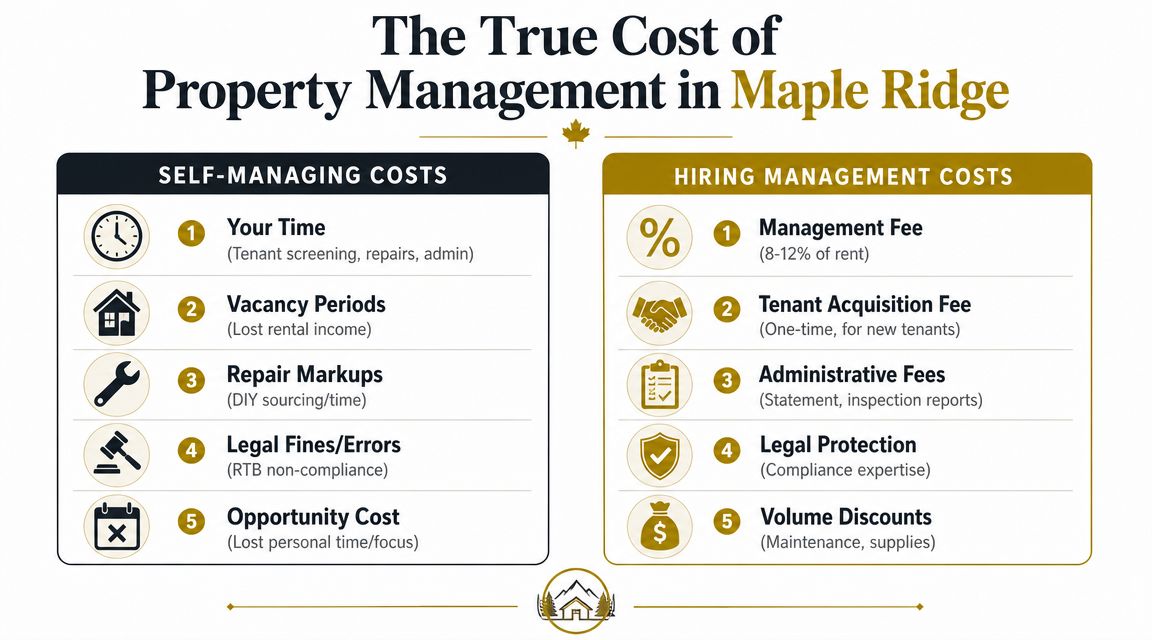
A Maple Ridge owner looks at a management quote, sees a monthly fee, and decides self-managing will save money. Then a tenant gives notice in the middle of winter, the unit sits for a few extra weeks, a repair call comes in after work, and the owner is still trying to sort records for a deposit dispute. That is how the actual cost shows up here. Not as one big invoice, but as a series of preventable hits to cash flow.
The visible expense is straightforward. Property management in BC is commonly priced as a percentage of collected rent, with separate charges for tenant placement, inspections, or coordination-heavy work, as outlined in BC property management fee guidance. The harder part is pricing the risk you keep on your own books when you manage the property yourself.
Early comparison table
| Cost area | Self-managing | Hiring property management |
|---|---|---|
| Monthly operating cost | No management fee, but owner absorbs time and coordination work | Ongoing management fee plus possible service-related charges |
| Leasing workload | Owner handles listing, inquiries, showings, screening, paperwork | Manager handles leasing workflow and tenant placement process |
| Vacancy exposure | Depends on owner speed, pricing judgment, and availability | Often reduced through faster response and more consistent leasing systems |
| Maintenance | Owner sources trades and coordinates every issue | Manager coordinates repairs through established vendor process |
| Documentation | Owner prepares records, notices, and inspection files | Manager typically runs standardised procedures and reporting |
| Owner time | High and unpredictable | Lower and more structured |
| Stress level | Spikes during turnover, disputes, and emergencies | More buffered because someone else handles front-line operations |
Vacancy is usually the most expensive line item
In Maple Ridge, leasing delays are rarely just about rent not collected. They also create carrying costs, extra showing time, more advertising, and pressure to accept a weaker application because the property has already been sitting too long.
That issue is sharper in a market like Maple Ridge, where demand can shift by neighbourhood, school catchment, commute pattern, and property type. A townhome near Albion Elementary rents differently from a basement suite in Hammond or a detached home closer to Silver Valley. If pricing is off, or inquiries are answered too slowly, the cost shows up fast.
A practical way to judge management fees is to compare them against one bad turnover, one avoidable vacancy stretch, or one weak tenant placement. Analysts at DoorLoop break down this owner-versus-manager math in their property management cost benefit analysis.
Compare the fee to the cost of delay, not to zero.
Owner time has a real dollar value
Many landlords in Maple Ridge still treat their own time as free because they never send themselves an invoice. That is a mistake. Time spent fielding calls, arranging trades, meeting contractors, following up on unpaid rent, and documenting issues is operating labour.
For owners with a day job, that labour usually happens at the worst time. Evenings, lunch breaks, weekends, and during work hours when a plumber needs access or an applicant wants a same-day showing.
Run the numbers against your financing, not just your rent. A rental property mortgage payment calculator helps show how thin the margin really is once carrying costs are fixed and your own time is treated as part of the investment.
The hidden BC cost is procedural error
This is the part many self-managing owners miss. In BC, a paperwork mistake can become a financial loss. A flawed notice, poor inspection records, weak move-in documentation, or inconsistent communication can delay enforcement and reduce your position if a tenancy dispute ends up before the Residential Tenancy Branch.
That risk belongs in your cost calculation. Maple Ridge landlords are not just choosing who answers tenant messages. They are deciding who carries the compliance burden tied to deposits, condition reports, notices, service rules, and record keeping.
The same principle is driving policy discussions elsewhere. The broader push toward tighter landlord obligations under private rented sector reform is a reminder that residential rentals are becoming more process-driven, not less.
Repairs cost more than the invoice
A $250 repair is rarely just a $250 repair. Someone has to confirm the problem, book access, choose the trade, approve the scope, update the tenant, check the work, and keep a record of what happened.
Self-managing owners in Maple Ridge tend to lose money in three predictable ways:
- Delay: The issue waits because life gets busy, then turns into a larger repair or a frustrated tenant.
- Retail pricing: The owner calls around one contractor at a time and pays whatever the market offers that day.
- Bad diagnosis: The first trade is the wrong trade, so the job gets done twice or drags out longer than it should.
Professional management does not remove repair costs. It often reduces downtime, cuts coordination mistakes, and keeps tenant communication tighter while the work is being handled. That is where part of the fee earns its value in real terms, especially for owners trying to keep a Maple Ridge rental performing like an investment instead of a second job.
Navigating BC's Strict Residential Tenancy Act
The biggest thing DIY landlords in Maple Ridge miss isn't usually maintenance. It's procedure. British Columbia is not a province where you can wing it and clean up the paperwork later.
In BC, the Residential Tenancy Branch sets out very specific requirements around notice periods, rent increase rules, dispute resolution, and entry and inspection procedures. That means a self-managing owner takes on full compliance risk, not just leasing and maintenance work, as summarised in this overview of self-management and RTB obligations in BC.

Where self-managing landlords get into trouble
The problem usually isn't bad intent. It's informal habits. A landlord uses the wrong notice, enters with poor documentation, handles a rent increase casually, or assumes a text thread is “good enough” evidence.
In BC, that can hurt you quickly. A procedural mistake can slow down enforcement, weaken your position in a dispute, and delay recovery when cash flow is already under pressure.
Common pressure points include:
- Entry notices: Access has to be handled properly, not casually.
- Rent increases: Timing and format matter.
- Inspections: Documentation needs to be complete and usable later.
- Eviction steps: The reason may be valid, but the process still has to be correct.
- Deposit handling: Small administrative errors can become bigger disputes.
Why this matters more than owners think
A lot of owners in Maple Ridge assume local ownership makes things simple. It doesn't. Being nearby helps with access and familiarity. It doesn't reduce your legal obligations.
That's why professional management is often less about convenience and more about process discipline. A licensed manager typically works from repeatable systems, standard forms, tracked dates, and documented communication. That reduces the chance that a preventable administrative mistake turns into a formal problem.
Broader landlord law is also shifting in other jurisdictions, which is why many owners keep an eye on resources about private rented sector reform even when the rules aren't BC-specific. The useful lesson is simple. Landlord compliance keeps getting more structured, not less.
If your tenancy paperwork only makes sense when you explain it verbally, it probably won't protect you in a dispute.
Comparing the Day-to-Day Operational Workload
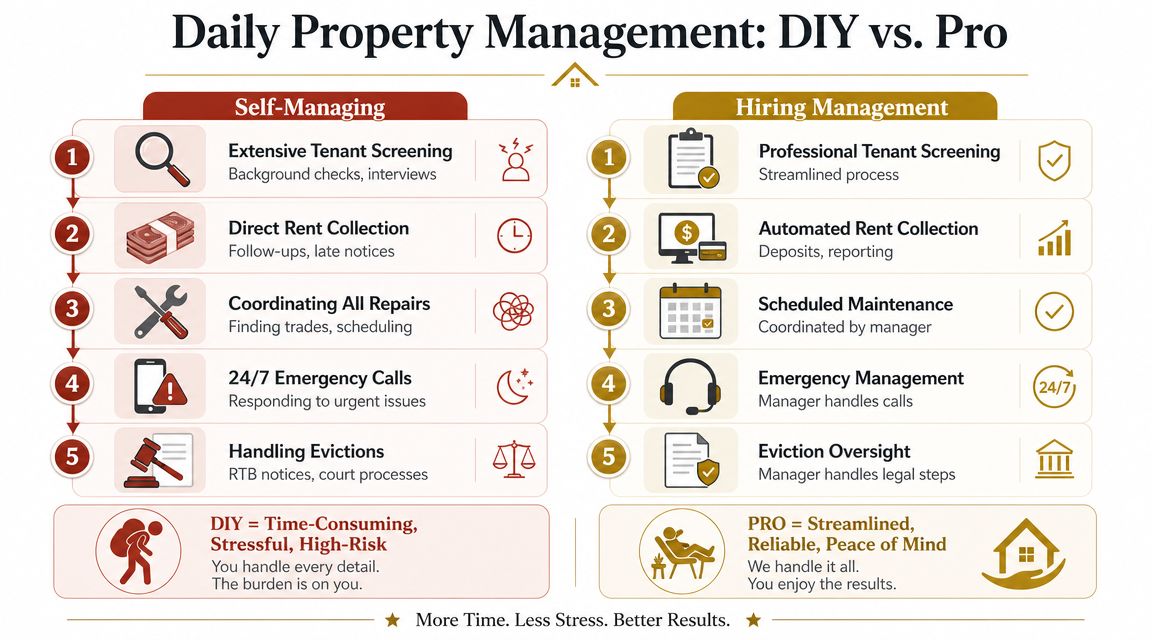
Friday at 4:45 p.m., a tenant messages about a leak under the kitchen sink. At 5:10, another prospect asks for a showing tomorrow. By 8:30, you are still sorting who needs an answer first, which trade can get to Maple Ridge on a weekend, and whether the issue is minor or the start of cabinet and flooring damage. That is what owners are really choosing between. Not effort in the abstract, but who absorbs the interruptions, the triage, and the follow-up.
A rental rarely creates steady, predictable work. The load comes in clusters. In Maple Ridge, that matters because travel between neighbourhoods like Albion, Silver Valley, Hammond, and East Central can turn a quick task into a half day once traffic, key handoff, or building access gets involved.
Leasing and screening
Leasing work looks simple until the inbox fills up.
A self-managing landlord has to write the listing, answer repetitive questions, coordinate showings, deal with no-shows, review incomplete applications, and decide which applicant is dependable. In a busy rental pocket, speed matters. So does judgment. The wrong tenant does not just create inconvenience. In BC, a weak screening process often leads to months of avoidable admin, payment issues, or a difficult move-out.
A professional manager runs leasing as a system. Inquiries are filtered, showings are grouped, application steps are consistent, and the owner reviews a recommendation instead of spending evenings sorting raw leads. That difference is operational, not cosmetic.
Maintenance and emergencies
This is the part self-managing owners tend to underestimate.
You are not only approving repairs. You are acting as dispatcher, scheduler, record keeper, and sometimes mediator between tenant expectations and trade availability. If a toilet backs up in a townhouse near Kanaka Creek on a Sunday, or a condo resident cannot provide access during normal trade hours, the problem is no longer just the repair. It is coordination.
Professional management changes the owner's role. The tenant reports the issue to the manager, the manager handles triage, access, and trade communication, and the owner steps in for approvals where needed. Owners who use full-service Maple Ridge property management are often paying for that response structure as much as for the lease-up work.
Small repair issues stay small when someone responds quickly, documents the work, and closes the loop with the tenant.
Rent collection and tenant communication
Rent collection is usually routine until it stops being routine.
Even with good tenants, the admin stack builds fast. Payment tracking, follow-up on partial rent, repair updates, scheduling inspections, confirming entry times, handling move-out questions, and keeping written records all take time. For an owner with one unit, it can feel manageable right up until a busy week at work lines up with tenant needs at the property.
The trade-off is not fee versus savings. It is gross yield versus your time, your responsiveness, and your ability to keep operating standards consistent every month. Owners who self-manage well usually have systems already in place. Owners who do it casually often discover they are reacting instead of managing.
A practical outside reference is this 2026 landlord responsibilities checklist. It is not BC-specific legal guidance, but it does a good job showing how quickly "collect the rent" expands into recurring tasks that need tracking and follow-through.
What Maple Ridge owners usually learn after a few months
The owners who do well with self-management tend to have the same setup. They live close to the property, they already know reliable local trades, they can take calls during the day, and they are disciplined about records and follow-up. They also do not mind being interrupted.
The owners who hand management off are usually not lazy or uninvolved. They are protecting time, reducing response delays, and putting a process around turnover, maintenance, and tenant communication before those jobs start affecting vacancy, repair costs, or tenant retention.
In Maple Ridge, that distinction matters more than people expect. The operational workload is not hard because each task is complex. It is hard because the tasks arrive unpredictably, and they still need a professional response every time.
Your Maple Ridge Landlord Decision Checklist
Some decisions are easier when you stop debating in the abstract and answer a few uncomfortable questions directly.
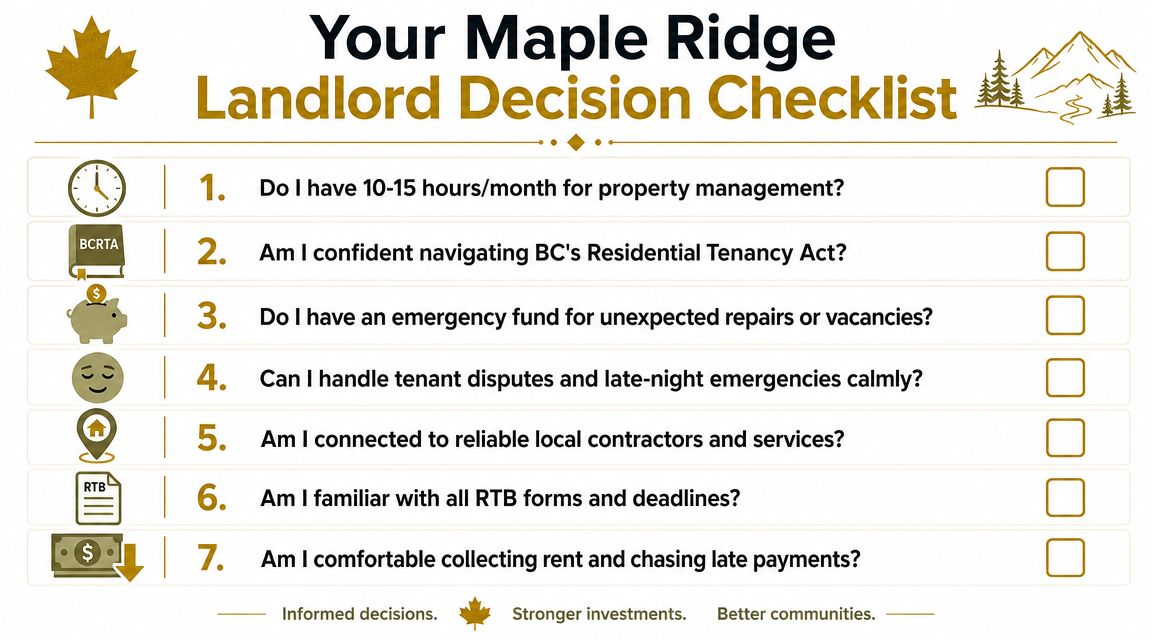
Questions that usually decide it
Use this checklist as a filter, not a scoring game.
- How close do you live to the rental? If your property is in Kanaka Creek or Albion and you can't respond quickly when access, repairs, or tenant issues come up, self-management gets harder fast.
- What happens when your workday goes sideways? A lot of landlords assume they'll manage the rental after hours. That works until your regular job gets busy at the same time the property needs attention.
- Are you comfortable with BC tenancy procedure? Not in a general sense. In a practical one. Can you handle notices, records, inspections, and communication in a way that would hold up under scrutiny?
- Do you have dependable local trades? If every repair starts with searching online and hoping the first callback is decent, that's not a system.
- How do you handle conflict? Late rent, complaints, lease breaches, and move-out disputes require calm, consistency, and documentation.
- Do you want income, or a second job? Some owners enjoy being involved. Others just want the asset to perform.
Signs self-management can work
Self-management usually fits when the owner is local, organised, legally cautious, and available. It also helps if the property itself is straightforward to run. A clean, well-maintained suite with stable tenants is a very different operational burden than a unit with high turnover, complex access, or recurring repair issues.
Signs hiring management is the safer call
Professional management usually makes more sense if any of these are true:
- You own more than one rental
- You don't live near the property
- Your schedule is already full
- You dislike conflict-heavy admin
- You want cleaner systems and records
- You're not confident with BC landlord procedure
The best decision is the one you can sustain for years, not the one that feels cheapest in month one.
When Professional Management Is the Smartest Move
For many Maple Ridge landlords, the smartest move is hiring management before the first problem forces the decision. That's especially true if you own multiple units, live outside the area, work long hours, or want the property to operate with more structure than your spare time allows.
Professional management is often the better fit when you want consistent leasing, organised maintenance coordination, cleaner documentation, and less exposure to avoidable process errors. It turns the rental from a reactive side task into a managed asset.
If you're comparing providers, look beyond the fee. Review how they handle communication, records, inspections, tenant placement, and maintenance workflows. It also helps to read real property management client experiences in Maple Ridge to see what owners find valuable once the service is in place.
One local option is Royal LePage Brookside Realty Property Management, which provides residential property management support in Maple Ridge and Pitt Meadows for owners who'd rather delegate the day-to-day operation and keep their focus on the investment itself.
If you're weighing whether to self-manage or hire help, Royal LePage Brookside Realty Property Management can help you look at the decision through a local Maple Ridge lens. If you're also buying, selling, or repositioning an investment property, getting clear on management strategy early usually leads to better decisions on pricing, neighbourhood fit, and long-term returns.