
March hits, the shoebox comes out, and you're staring at receipts for a basement suite in Albion, a few utility bills from Cottonwood, and a bank statement that makes the whole thing feel more complicated than it looked when the tenant first moved in. If that sounds familiar, you're not alone. Rental-property tax deductions can feel like a puzzle until you sort the costs into the right buckets, and the CRA's rules decide which bucket counts.
For Canadian landlords, the starting point is simple enough. The CRA lets you deduct reasonable expenses earned to make rental income, including property taxes, mortgage interest, insurance, repairs, maintenance, utilities paid by the landlord, advertising, professional fees, and management fees. That matters because rental income is often smaller after deductions than people expect, and Statistics Canada's data shows why, in 2020, 7.9% of Canadian families declared rental income, up from 7.0% in 2008, an increase of 335,850 families, with a median annual net rental income of $2,750 after deductions, calculated after costs such as property taxes, repairs, mortgage interest, condo fees, and capital-cost adjustments (CRA rental expense rules).
In Maple Ridge, that can mean very different things depending on the property. A Silver Valley owner with a regular long-term tenant has a different paperwork trail than a Pitt Meadows host running a short stay. Either way, the tax return is where those choices get translated into numbers, so it helps to have a practical map before you start typing into the form. For a local property-management lens on the day-to-day side of that work, this overview of Maple Ridge property management fits neatly beside the tax side.

Meeting Your Tax Return as a Maple Ridge Landlord
The first tax return often feels less like bookkeeping and more like sorting through a box of mixed receipts. You know money went out for the suite, the roof, the insurance, and the accountant, but the CRA wants clean categories, not a backstory. That is why the safest first move is to separate income, current expenses, and capital costs before you touch the form.
A basement suite in Albion does not need to be a full building file to deserve one. Treat the rental like its own folder, even if it sits under your family home or shares a yard with your own space. Keep the lease, rent deposits, insurance papers, utility bills, repair invoices, and management statements together from day one. If a cost helped earn rental income, the CRA usually wants to know whether it was reasonable and whether it belongs in the year you are claiming it.
First-time landlords often assume every expense is automatically deductible, but the CRA requires a clearer link to rental income. That is where confidence can turn into a mistake. A tenant-paid item, a mixed personal-and-rental bill, or a larger project can change how the expense gets treated, and some costs need to be capitalised rather than deducted right away.
Sort the year before you file
A simple way to handle the records is to separate them into three buckets. One bucket holds the day-to-day operating costs, another holds long-term property improvements, and the third holds anything tied to shared personal and rental use. That last bucket trips up many owners who live upstairs and rent downstairs, because the numbers have to be split with care.
Keep the paperwork before you need it. Tax season gets much easier when the receipt already says what it was for, who paid it, and whether it was for the rental or the owner's own use.
By the time you open the rental schedule, the core question is not what you hope to claim. It is which costs fit the CRA's definition of a deductible rental expense, and which ones belong somewhere else. That is the part that keeps the return grounded in the rules instead of guesswork.
For day-to-day management questions, the local view matters too. A practical rundown of Maple Ridge property management can help frame the paperwork side of the job, especially if you are balancing rent collection, tenant communication, and repair tracking. If collecting payments is still a work in progress, the article on how to collect rent from tenants is a useful companion piece.
Expenses Every Canadian Landlord Can Deduct
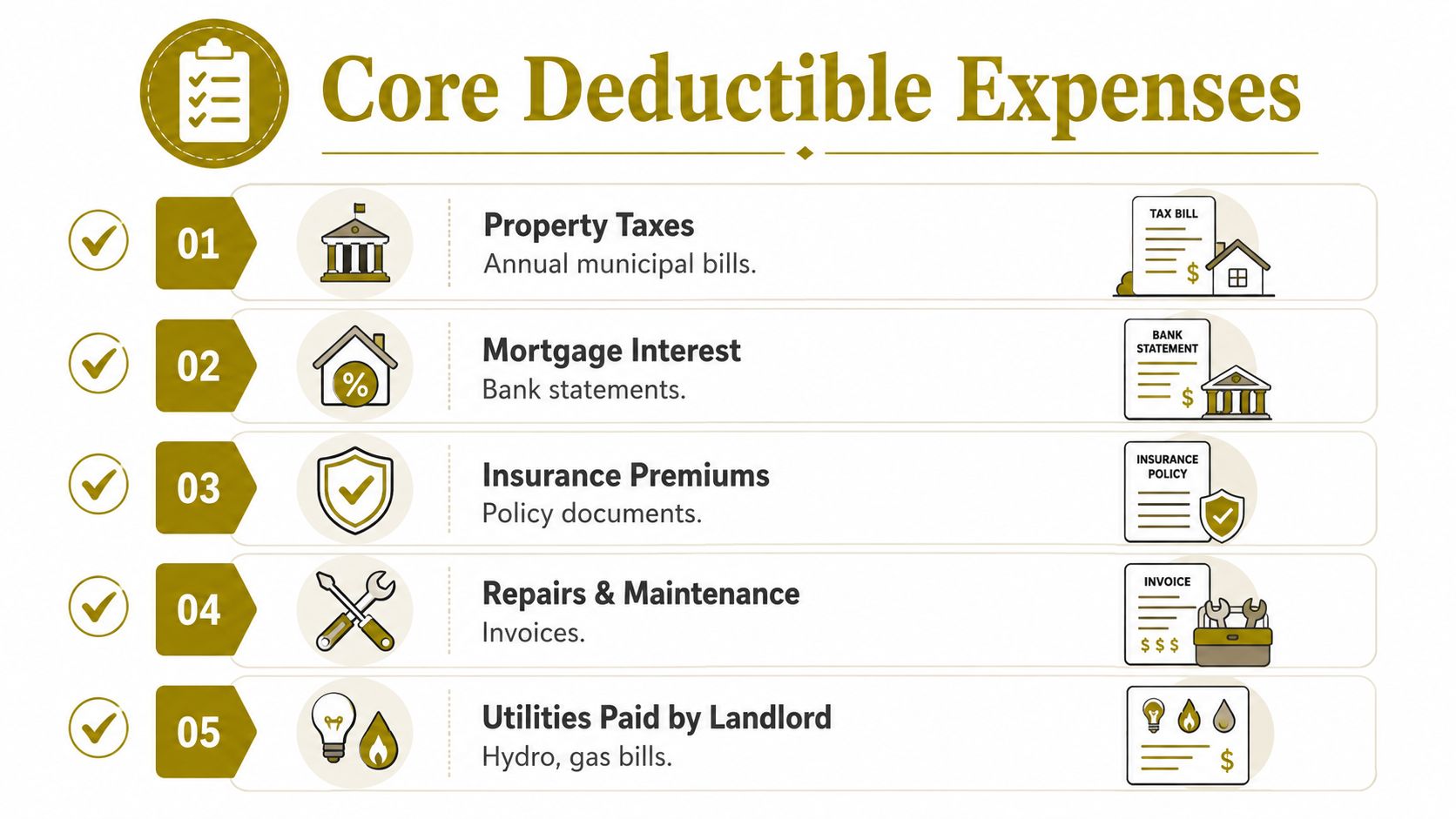
A Maple Ridge landlord can usually sort rental expenses by asking a simple question, did this cost help earn rental income, or did it belong to the owner's personal side of the property? That is the basic CRA test. The rental expense list is broad, but it is not open-ended. In practice, the usual claims include property taxes, mortgage interest, insurance, repairs and maintenance, utilities paid by the landlord, advertising, professional fees, and management fees.
The core list, in plain language
A Silver Valley landlord paying municipal property taxes can usually place those taxes in the rental records. A Kanaka Creek owner who hires a manager to screen tenants or collect rent has a management fee that fits the same general idea. If you used an accountant in West Maple Ridge to file the return, that professional fee usually belongs in the rental file too. Clean bookkeeping makes those entries easier to sort, which is why rental property accounting matters long before filing day.
Mortgage costs need a sharper eye. The deductible part is interest, not principal, so the lender statement matters more than the monthly payment total. Insurance, routine maintenance, and landlord-paid utilities are all common claims because they help keep the property rentable and producing income.
Practical rule: if the expense keeps the rental operating, and it is not part of the purchase price or a major improvement, it probably belongs in the current-year expense column.
What usually does not belong
Land transfer taxes, mortgage principal, and major upgrades do not sit in the current operating expense pile. They belong on the other side of the line because they either form part of what you paid to acquire the property or improve it in a longer-lasting way. The CRA treats those items differently from the repair bills you get after a tenant moves out.
A lot of landlords also miss the smaller but still real costs. If you advertise the unit, pay for a professional inspection, or cover a plumbing bill because the tenant did not damage the place but the fixture failed, those costs may belong in the rental record. The same goes for the practical side of rent collection, because clean payment habits usually lead to cleaner books, and a guide on how to collect rent from tenants can help you keep that side organized.
For a first-time landlord, the rule set can feel a bit like sorting tools into the right bins after a busy turnover. Repairs go here, interest goes there, personal spending stays out. Once the receipts are grouped that way, the tax return becomes much easier to prepare.
How Capital Cost Allowance and Recapture Work
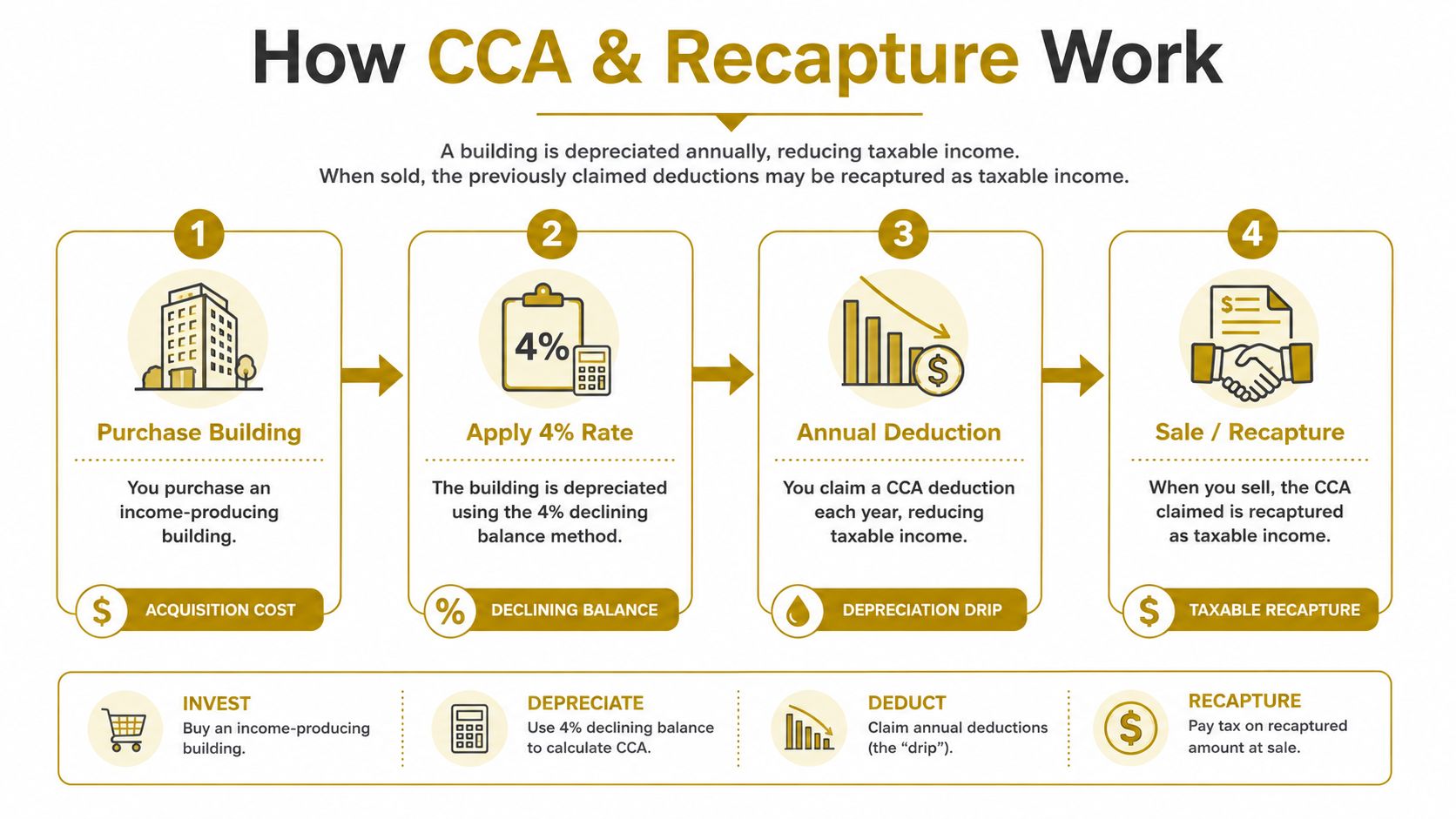
CCA sounds technical because it is technical, but the idea behind it is straightforward. Instead of writing off the building portion of a rental property all at once, the CRA lets you claim depreciation over time through Capital Cost Allowance, and for most residential rental buildings acquired after 1987, that generally means a 4% declining-balance rate on the building, not the land. That split matters in Maple Ridge, where a basement suite in Albion and a larger property in Silver Valley can have very different land and building values on the books, especially if you later review the sale with the sale-related tax rules discussed in selling a home and capital gains.
CCA works like a slow drip
A common mistake is treating CCA like a bonus deduction you should always grab. It is optional, and that choice affects the future as well as the present. If you claim it, you reduce taxable rental income now, but you also reduce the undepreciated pool that remains later.
That pool is the UCC, or undepreciated capital cost. Each year, the claimed amount comes off the balance, and the number carries forward. The form does not ask for a rough guess. It asks for the class and the balance, which is why purchase records and prior-year filings matter so much.
For a first-time landlord, that can feel a bit like keeping track of a paint can that gets smaller every year. The amount still helps, but it is not sitting there untouched.
Recapture is the part sellers forget
When you sell, the CRA can require you to add back some of the depreciation you claimed if the building has been written down more than the tax rules allow. That is called recapture, and it is where landlords feel the difference between a current tax saving and a later tax bill. A Silver Valley duplex that claimed CCA for several years before a sale can trigger this issue even if the sale itself felt straightforward.
CCA can help with cash flow, but it is not free money. It is better to treat it as a timing choice, with future consequences if the property is sold.
For Maple Ridge owners, this is one of the tax pieces that should be reviewed before the listing goes live, not after. It matters even more if the property started as personal use and later became a rental, because that change can affect how the numbers are read by the CRA. A broader planning note on that side of the transaction is available in selling a home and capital gains.
Repairs Versus Capital Upgrades and Why the Distinction Matters
Landlords frequently second-guess whether a $200 fixture replacement is a repair or a capital upgrade. That hesitation makes sense, because the CRA does not care what the receipt feels like. It cares what the expense did. A repair keeps something working as it was. A capital upgrade adds value, extends useful life, or changes what the property can do. The CRA treats those two categories differently, which is why the same cheque can land in different parts of the return depending on what it paid for.
A repair is about keeping the property going
A tenant move-out leaves a hole in the drywall, and you patch and repaint it. That is usually a repair. A faucet drips, and you replace the washer or swap in a similar fixture. That is usually still on the repair side. These are current expenses because they keep the property in working order rather than making it materially better.
A capital upgrade changes the property
Replacing all the windows in a Cottonwood home is a different story. So is building out a basement suite in Albion, adding a major appliance package as part of a broader renovation, or redoing landscaping in a way that changes the property's character and long-term value. Those costs are generally treated as capital and handled over time, not written off all at once. For a local example of how renovation choices can affect rental treatment, see this guide to short-term rental rules in BC.
| Expense Type | Example | Tax Treatment | Where It Goes on T776 |
|---|---|---|---|
| Repair | Patching drywall after tenant move-out | Current expense in the year incurred | Repair and maintenance line |
| Capital upgrade | Replacing all windows | Capital cost, usually depreciated over time | CCA schedule, not the repair line |
| Repair | Fixing a broken light fixture | Current expense | Repair and maintenance line |
| Capital upgrade | Basement suite buildout | Capital cost | CCA or added property cost |
The grey zone is where local owners get nervous. A new fridge for a rental unit might feel like maintenance, but if it forms part of a larger acquisition or renovation package, it may need capital treatment. The safest habit is to ask one question before you file, did this expense restore the property, or did it improve it in a lasting way? If the answer is the second one, it probably belongs with capital costs.
Short-Term Rentals, Shared Use, and the 2024 Denial Rule
The short-term rental rules changed the meaning of “deductible” for a lot of hosts. As of January 1, 2024, if a short-term rental is in a place where provincial or municipal rules don't permit it, deductions that might otherwise have been available can be denied, and the rule applies to properties rented for less than 90 consecutive days (Bennett Jones on the deduction denial rule). For Maple Ridge owners, that means the tax question now sits beside the local-law question, not apart from it.
Compliance comes first
A lot of people still ask, “Can I deduct Airbnb costs?” That's the wrong first question. The better one is whether the rental is lawful under the relevant provincial or municipal rules, because the CRA's denial rule ties deductibility to compliance. The CRA also states that expenses related to non-compliant short-term rentals are denied as income-tax deductions (IG summary of CRA treatment).
That matters in BC because many owners are trying to balance local registration, zoning, and stay-length rules at the same time. If the property is effectively a short stay, the compliance record needs to be as tidy as the booking calendar.
Shared-use properties need pruning, not guessing
If you live in the home and rent part of it out, the rental claim usually has to be prorated. That means only the portion of costs that relates to the rental space, and the rental period, belongs in the claim. A Pitt Meadows owner with a coach house, or a Maple Ridge homeowner renting a room while still living onsite, can't claim the whole utility bill just because the tenant used some of the electricity.
Simple rule: if a cost benefited both you and the tenant, split it fairly and keep the logic in writing.
That is where many people lose confidence, but the fix is usually basic. Note the personal-use days, note the rental-use days, and keep the split consistent. The deduction still exists, but the number has to match reality.
For a local summary of the BC side of this issue, short-term rental rules BC is a useful reference point, especially if you're wondering whether the property's use is still aligned with what the municipality allows.
Reporting Rental Income on CRA Forms
A first-time landlord in Maple Ridge usually meets T776, Statement of Real Estate Rentals at tax time. That form pulls the rental income, deductible expenses, and CCA details into one place, and it helps separate the property information from the numbers. If the property is a plain rental, T776 is usually the starting point. T2125 comes into play for the smaller group of owners who are treating the activity as a business rather than a standard rental.
Use the form as a sorting tool
Start with the property details and the income section. Then move through the expense grid and sort each item into its proper line, such as taxes, insurance, interest, repairs, and management fees. The CCA area sits beside those figures, so the form makes more sense when your records are already organized.
A clean form is easier to fill out than a messy one. If you run a basement suite in Albion, or you are renting a unit that has been in and out of short-stay use, the paper trail should match how the property was used. For the tax side of the short-term rental rules, the CRA explains how residential real property rentals are treated, including the point where a residential rental is exempt when it is for continuous occupancy or a right of occupancy of one month or more to the same individual, while shorter stays can fall into taxable-supply territory for registrants unless the consideration is $20 or less per day of occupancy (CRA residential real property rentals).
Keep the receipts tied to the line items
A receipt on its own can be hard to explain later. A receipt with the date, vendor, purpose, and property address gives the CRA a clear trail, which matters even more when you are claiming mortgage interest, repairs, or management fees across more than one unit.
That is also why a simple filing system saves stress. If you want one place for scans, PDFs, and year-end folders, document management software for small business can help keep the rental file out of the kitchen drawer and close at hand when you open the T776.
For a step-by-step walkthrough of filling out the form, see our rental income tax calculator guide. A local owner in Maple Ridge can use it to align the form with actual conditions, whether the income came from a long-term suite or from a property that had to be tracked carefully because municipal scrutiny changed how it was used.
Recordkeeping, Rental Losses, and Shared-Use Proration
Good recordkeeping is what makes the rest of the return possible. The CRA can ask for support later, so keeping receipts, invoices, bank statements, mortgage documents, tax bills, and a shared-use log in one system saves a lot of stress. A digital document workflow, such as document management software for small business, can help if you want one place for scans, PDFs, and year-end folders without stuffing everything into a kitchen drawer.
Keep the split honest
When a property is partly personal and partly rental, the proration has to reflect actual use. If you used the home for part of the year yourself, or a family member stayed in a suite without paying market rent, that personal side can reduce the claimable portion. The same logic applies to shared utilities and other mixed costs.
Rental losses need care too. In simple terms, a paper loss doesn't automatically let you offset every other kind of income, especially if the arrangement doesn't fit the CRA's business expectations or partnership rules. A Maple Ridge couple using a family member as a partner can't manufacture a loss on paper and expect that to wash across the return.
A monthly routine beats a year-end scramble
- Save receipts right away. Snap a photo or scan it the day you pay the bill.
- Match bank withdrawals to invoices. That makes your records easier to prove later.
- Keep mortgage paperwork together. Interest and principal need different treatment.
- Track property tax bills by year. That stops double-claiming or missed claims.
- Log personal use separately. Mixed-use claims depend on the split being defensible.
That routine sounds basic because it is basic. It also prevents the kind of year-end panic that leads people to guess, and guessing is where tax mistakes start.
Local Questions and a Maple Ridge Next Step
Landlords usually ask the same few questions once the forms come out. A CRA review is more likely when the numbers don't match the records, especially if the expense pattern looks too neat or the shared-use split isn't documented. A rental business name isn't usually the issue for a plain residential rental, but the form and the records still need to show who owns the income.
If the tenant pays a utility directly, that usually means it may not belong on your return in the same way as a bill you paid yourself. If you used the property personally for part of the year, the earlier proration rules matter more than any shortcut. The common thread is simple, the return has to reflect how the property was used, not how you wish it had been used.
For owners in Maple Ridge, Pitt Meadows, Albion, Silver Valley, Cottonwood, West Maple Ridge, and Kanaka Creek, that kind of clarity matters whether you're keeping the rental, buying another one, or thinking about selling the one you have.
Royal LePage Brookside Realty Property Management helps local owners keep rental records organised, understand the tax side of ownership, and handle the practical details that come with renting out a home in Maple Ridge and Pitt Meadows. If you'd like a local conversation about your rental property, visit Royal LePage Brookside Realty Property Management and connect with a team that works through these questions with you in plain language.