The offer has landed, the subject removal date is moving, and the contract is sitting open on the kitchen table while the coffee goes cold. That's the moment when a Maple Ridge buyer or seller realises the paperwork isn't just paperwork. One missed clause, one unclear deadline, or one sloppy addendum can turn a clean deal in Albion, Cottonwood, or Silver Valley into a deposit fight or a delayed closing.
In British Columbia, real estate contract review sits inside a regulated system, not a casual admin step. The Real Estate Services Act received Royal Assent in 2004 and came fully into force on January 1, 2005, replacing the earlier Real Estate Act and modernising licensing, conduct, and consumer protection rules for licensed professionals in the province source. For buyers and sellers in Maple Ridge, that matters because offers, disclosures, and agency obligations are handled within a framework built to reduce conflict and improve transparency, especially when benchmark pricing stays high across the Greater Vancouver area source.

Why Contract Review Matters in Maple Ridge
A Maple Ridge contract can look clean right up until the signatures are on the page. After that, the deposit is committed, the timeline starts to run, and every clause begins to carry real money risk. In a market where buyers may be comparing detached homes in Albion, townhomes in Cottonwood, or strata units near downtown, real estate contract review is what keeps the deal from drifting into a deposit dispute or a missed closing.
The contract is a control document, not a form
The shift in thinking matters. The purchase and sale agreement is not just a record of what both sides agreed to. It controls who pays, when notice must be given, what happens if financing slips, and whether conditions are removed on time. A wording issue can affect the deposit, the subject removal deadline, or the completion date without either side catching it until the clock is already tight.
That pressure is real in British Columbia because licensed professionals work inside a regulated system shaped by the post-2004 framework source. The rules on conduct, disclosure, and consumer protection do not replace careful reading. They make careful reading more important.
Practical rule: if a clause affects money, timing, or ownership transfer, it deserves a slow read before anyone signs.
Accepted terms can still hide problems. Buyers often relax once the offer is signed, but that is the point when the review needs to get sharper, especially around possession, repair credits, and what each side must do after subject removal. A house with visible charm can still come with repairs that change the actual cost of ownership, and the same is true for a strata where the form looks standard but the obligations do not. For a local market view that helps frame those decisions, Maple Ridge real estate market guidance gives useful context alongside the contract itself.
The contract is what turns price into an enforceable deal. If the wording is loose, the deposit and the closing date carry the risk, not the seller's or buyer's assumptions.
Key Clauses to Check First
The quickest way to review a purchase agreement is to start with the clauses that create the biggest financial exposure. Focus first on deadlines, repairs, and deposit handling. A staged review works better than reading straight through, because the highest-risk terms usually control every other deadline in the file.
Start with the clauses that move money
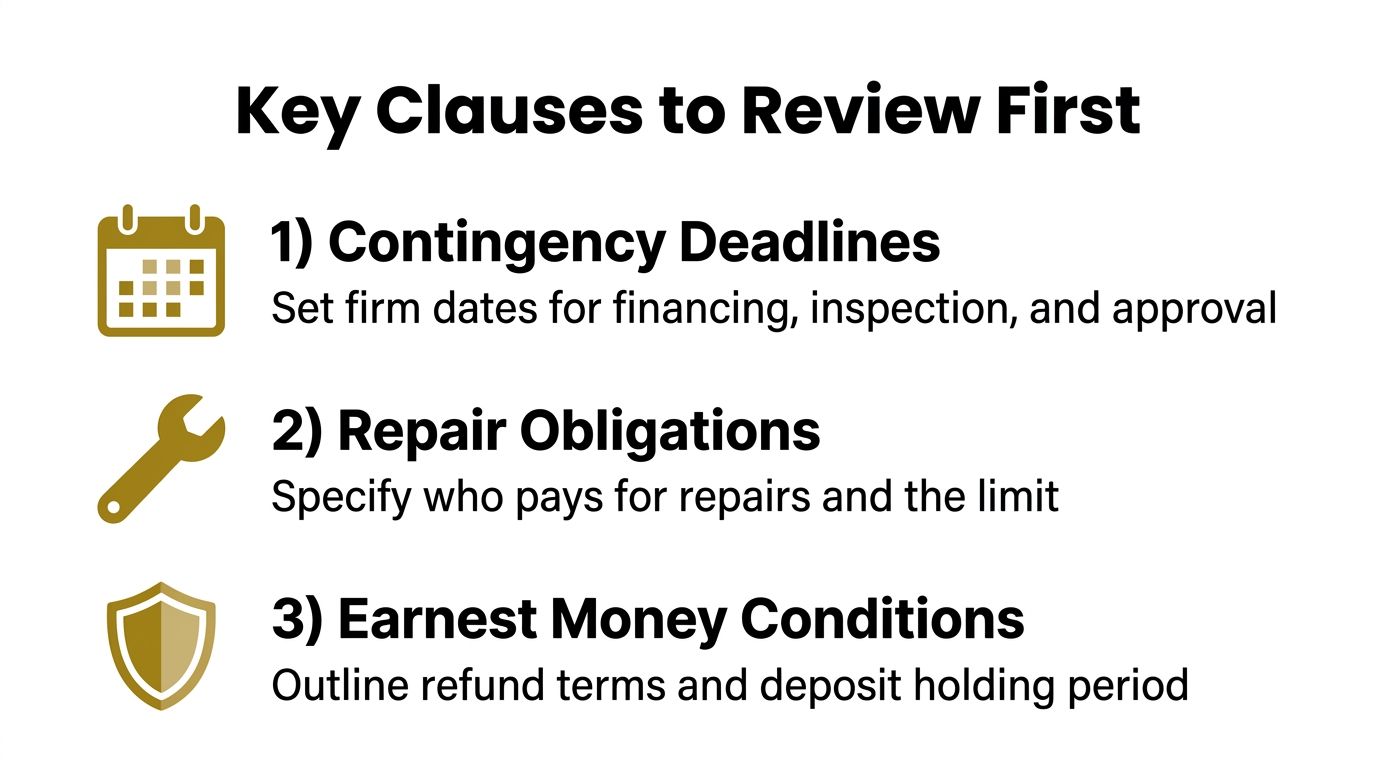
The highest-risk terms are usually contingency deadlines, repair obligations, and earnest-money conditions, because disputes and financial exposure gather there source. That order matters in Maple Ridge too. A clear deposit clause is worth more than a generic “standard terms” paragraph if the buyer later needs to show when the funds are released or refunded.
The legal description also deserves more attention than the street address. A home on a familiar street still needs the exact property identifier in the contract package, because the wrong legal description can create title or closing problems later. Price and deposit terms should be checked together, since those numbers shape financing, transfer of funds, and the closing-cost split.
Dates are part of the deal
Deadline language deserves its own pass. A one-day delay in the effective date can shorten inspection or financing windows when those clocks run from execution, not from acceptance in the abstract source. Buyers feel that pressure in real life, especially when they are booking inspectors, gathering lender documents, and keeping the seller comfortable with timing.
Ambiguous refund language can also create avoidable conflict. If the contract does not clearly state what triggers a deposit return, who holds the money, and what notice method counts, the parties may end up arguing about a clause they both assumed was obvious. That kind of problem shows up when a Cottonwood buyer wants protection but the seller expects an unconditional commitment.
For readers dealing with rental or mixed-use terms, required lease clauses rental agreement is a useful reference point for how carefully time, notice, and obligations need to be drafted in any occupancy-related agreement.
Closing and possession deserve separate attention as well. Closing date versus possession date explains why those terms can look close on paper while creating very different financial and practical outcomes at the table.
The clearest way to think about it is simple. If a clause affects whether the deal survives, who pays for a problem, or whether the deposit is safe, it gets checked first.
Local Risks Generic Checklists Miss
A generic checklist can tell a buyer to “review disclosures,” but that isn't enough in Maple Ridge. The core question is what happens after completion, because that's where local risks show up in strata bylaws, zoning limits, rental restrictions, or renovation history. A detached home in Silver Valley, a townhome in West Maple Ridge, and a condo near the centre of town each carry different contract-review pressure points.
Strata, rentals, and repair history change the real cost
BC deals often turn on documents beyond the purchase agreement itself. Strata bylaws, depreciation reports, special levy exposure, and renovation records can change the actual cost of ownership after closing, even when the contract price looks reasonable on paper. For condo and townhome buyers, those documents can matter just as much as the mortgage rate.
The Property Condition Disclosure Statement is not mandatory for every sale in British Columbia, but sellers commonly use it to disclose known defects and issues, and the standard residential purchase contract relies on written subject removal deadlines source. That means the full package, not just the offer page, needs a careful review before conditions are removed.
If a seller's document says one thing and the contract says another, the mismatch deserves attention before anybody signs off on subject removal.
Maple Ridge's local mix creates different risks
Maple Ridge buyers often compare homes with very different exposure profiles. A property in Kanaka Creek may raise zoning or land-use questions, while a strata unit near downtown may bring bylaws and rental rules into the conversation. A rural-feeling property can also hide assumptions about future use that a standard checklist won't catch.
The local issue isn't only whether the house looks sound. It's whether the contract allocates the risk of what comes next. That could be a special levy, a restriction on short-term renting, a past renovation that lacks proper documentation, or a condition that gets missed because the buyer focused on the headline price.
For a broader example of how property-specific risk can shape a deal, this local title-risk article shows why document review has to go beyond the purchase form itself. The same discipline applies in Maple Ridge, even when the issue is less dramatic and more expensive in the long run.
Your Three-Stage Review Checklist
A buyer in Silver Valley who skips the midpoint check often misses a repair request deadline, and that kind of miss can change the deal fast. In Maple Ridge, the contract should be read as a deadline-driven financial control process, because the true cost often shows up in timing, notices, and what still has to be signed off before completion. A clean file gets checked when the fully executed version arrives, again after inspections and appraisal, and one last time 48 hours before closing source.
| Three-Stage Contract Review Timeline | ||
|---|---|---|
| Stage | Timing | Key Checkpoints |
| Receipt | When the fully executed contract arrives | Parties, legal description, price, deposit holder, subject dates |
| Midpoint | After inspections and appraisal | Contingency notices, repair requests, extensions, updated disclosures |
| Final pass | 48 hours before closing | Signatures, dates, closing disclosure, cost allocation, possession details |
What to verify at each stage
At receipt, start with the basics that control the rest of the file. Confirm the buyer and seller names, the exact property description, the deposit amount and holder, and every subject deadline. If one line is wrong, the whole timeline can shift, especially when the subject removal date is tied to financing or inspection follow-up.
At the midpoint, the focus turns to what the inspection and appraisal changed. Check whether repair requests need to go out, whether an extension is needed, and whether the notice method in the contract has been followed exactly. That is the stage where a missing email, a late response, or an unclear amendment can still be corrected before the file turns into a closing problem.
At the final pass, nothing should be left to assumption. Signatures need to be complete, dates need to match, and the closing disclosure has to line up with the agreed terms. Deposit release instructions, possession timing, and any remaining cost allocations should be checked side by side with the signed contract and the closing package source.
A straightforward checklist usually covers around 19 checkpoint items across parties, legal description, price, financing, title, surveys, disclosures, special provisions, and execution source. The exact count matters less than the discipline. A contract that gets reviewed in stages is far less likely to spring a surprise on completion day.
When to Involve a Lawyer or Notary
A Maple Ridge file can move from routine to complicated quickly. Strata concerns, unusual financing, title defects, and zoning questions on rural or semi-rural property all change the risk profile, and once that happens, a realtor's role shifts to coordination rather than legal interpretation.
The warning signs are usually visible in the file
A buyer reviewing a strata unit with several document concerns needs more than a quick pass through the listing package. The same applies to a property in Kanaka Creek where land use, renovation history, or title position raises questions. If the contract starts to include custom language, unusual conditions, or unclear responsibility for a defect, legal review is the safer path.
Title and ownership issues can also change the closing path without much warning. For a local example of how quickly legal uncertainty can affect a transaction, this BC property title ruling update shows why anything outside routine conveyancing deserves a careful look.
Good coordination rule: the realtor handles the deal mechanics, the lawyer or notary handles legal interpretation, and both should see the same documents early enough to avoid deadline pressure.
Choose local knowledge, not just a generic service
A local lawyer or notary who works on Maple Ridge and Pitt Meadows files usually understands the timing pressure around subject removal, possession, and lender conditions. Delayed legal review can create a new problem instead of solving the one already in the file. Early, targeted review works best on the clauses that could change who owns what, when, and on what terms.
The closing budget should also leave room for legal review if the file is complex. That cost protects the deposit and helps prevent a bad assumption about title, occupancy, or disclosure. A clean file may only need normal conveyancing, but a messy one should not be pushed through a standard path.
From Review to Successful Closing
Strong contract review doesn't slow a deal down for no reason. It preserves negotiation flexibility, which matters when a few days can decide whether financing, inspection, or title review finishes on time. In a BC market that remained uneven across regions in 2025, with affordability still constrained and buyers more sensitive to rate changes and timing risk, deadlines carry more weight than casual readers expect source.
Review shapes leverage during the conditional period
The buyer who understands the contract can negotiate from facts instead of guesswork. If the inspection reveals repairs, the next move depends on what the contract allows, how the notice needs to be delivered, and whether there's still time to extend a deadline. If the lender needs more time, the wording around financing conditions matters just as much as the loan itself.
That's why local buyers in Albion, Silver Valley, or Cottonwood shouldn't treat subject removal as a formality. It's the point where the deal either stays controlled or starts drifting. A good review turns that period into a managed process instead of a scramble.
If the contract includes hidden tax or lien concerns, a practical reference like Omni Tax Help tax resolution can help frame the issue, but the key local move is still the same, identify the risk early and decide who is responsible for resolving it before closing.
The cleanest closings are usually the most prepared
The best closings in Maple Ridge tend to come from files that were read carefully at the start, checked again at the midpoint, and verified right before completion. That kind of discipline keeps the deposit protected, the date realistic, and the final paperwork aligned with the actual agreement. It also makes it easier to negotiate repairs or extensions without giving away negotiating power unnecessarily.
For a practical view of what should be budgeted around the deal, closing costs when buying a home in BC is a useful companion to the contract itself. When the numbers, dates, and documents all line up, closing feels orderly instead of rushed.
Royal LePage Brookside Realty Property Management helps Maple Ridge and Pitt Meadows clients handle real estate with the kind of local attention that keeps contracts, dates, and closing details under control. If you're buying, selling, or managing a property and want a team that understands how review, timing, and neighbourhood-specific risks fit together, visit Royal LePage Brookside Realty Property Management and connect with a local professional who can help you move forward with confidence.