
Owning a rental in Maple Ridge often starts as a smart long-term move. You buy in a neighbourhood you believe in, maybe near Kanaka Creek, West Maple Ridge, Albion, or Silver Valley, and the plan seems simple enough. Good tenant, steady rent, manageable upkeep.
Then real life takes over. A plumbing issue comes in after dinner. A showing request lands while you're at work. A tenant application looks fine on the surface, but you still have to decide whether the references are solid, whether the income is stable, and whether this person is likely to treat the property well.
That’s usually the moment owners realise they didn’t just buy an asset. They took on an operating business.
In Maple Ridge, that business has its own local pressures. Family-oriented rentals attract a different tenant profile than downtown condo markets. Detached homes come with yards, roofs, drainage, and seasonal maintenance. BC tenancy rules leave less room for guesswork than many landlords expect. If you’re trying to self-manage on evenings and weekends, the opportunity cost gets expensive fast, even when the cost doesn’t show up on a simple spreadsheet.
Is Managing Your Maple Ridge Rental Becoming a Second Job
A lot of landlords reach out after the same pattern repeats a few times. They’ve got a full-time job, a family, and one rental that was supposed to be fairly hands-off. Instead, they’re spending Saturdays arranging repairs, replying to tenant messages from the soccer field, and second-guessing every lease decision.

That’s especially common in Maple Ridge because many rentals here aren’t simple lock-and-leave units. They’re family homes in places like Cottonwood, Albion, or Kanaka Creek, often with more maintenance exposure than a condo tower. A tenant isn’t just renting four walls. They’re using the furnace, yard, drainage, appliances, and every system that can fail at the worst possible time.
Where self-management usually starts to break down
The first problem isn’t usually dramatic. It’s the accumulation.
- Tenant screening takes real time: Reading an application is easy. Verifying rental history, checking references properly, and spotting warning signs takes judgement.
- Maintenance never arrives on your schedule: Leaks, heat issues, and appliance failures tend to happen when owners are busy or out of town.
- Small delays become expensive: A missed repair follow-up can turn into tenant frustration, property damage, or a longer vacancy.
- Compliance adds pressure: Even well-meaning landlords make mistakes when they rely on memory instead of process.
Practical rule: If your rental keeps interrupting your work, evenings, or family time, you’re not just managing a property. You’re absorbing the operating load yourself.
The bigger issue is opportunity cost. Every hour spent coordinating a repair or chasing paperwork is an hour you’re not using to evaluate your next investment, improve the property strategically, or enjoy why you invested in Maple Ridge in the first place. Good property management maple ridge rentals work isn’t about doing more tasks. It’s about building a system that protects the home, the income, and your peace of mind.
What a Maple Ridge Property Manager Actually Does
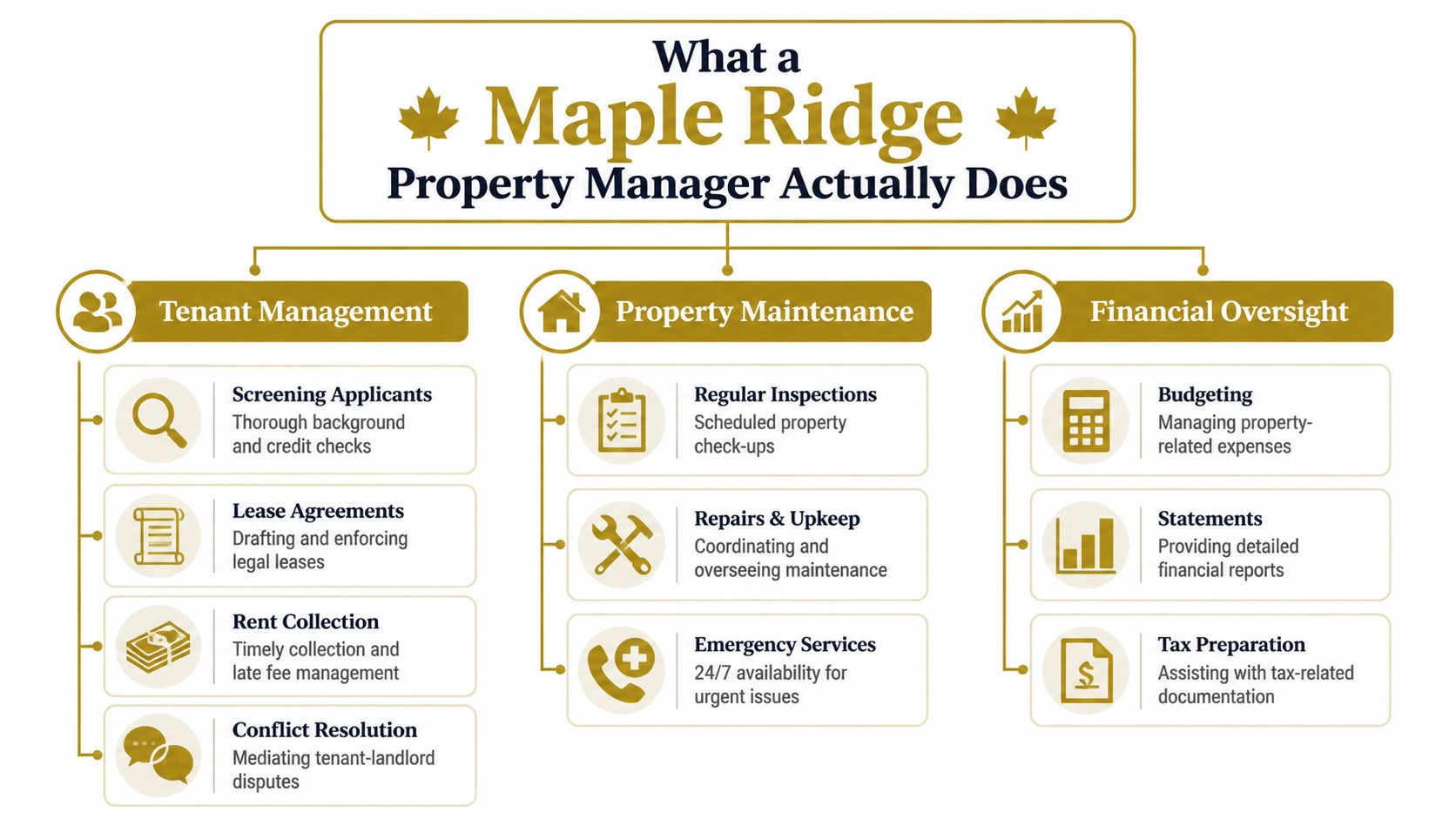
Most new investors know a property manager “handles the rental,” but that phrase hides the actual work. A competent manager doesn’t just collect rent and call a plumber. They run the day-to-day operation of the property with enough structure that problems get prevented before they become expensive.
In Maple Ridge, that matters because the rental stock is mixed. You’ve got basement suites, townhomes, condos, and detached houses across neighbourhoods that behave differently. A newer home in Silver Valley won’t be managed the same way as an older property in East Central or West Maple Ridge.
Tenant management that goes beyond filling the vacancy
The first job is attracting the right tenant, not just any tenant. That starts with pricing, presentation, and clear listing details. It also means responding quickly to inquiries, scheduling showings efficiently, and setting expectations early.
Screening is where a lot of self-managing landlords underestimate the work. Maple Ridge’s competitive rental market, driven by family-oriented demand in neighbourhoods like Silver Valley and Albion, requires data-driven tenant screening. Vetting that reviews rental history, credit, and references helps reduce vacancy periods and costly turnover, as noted by Axford Property Management’s Maple Ridge overview.
A capable manager also handles the parts owners often dislike most:
- Application review: Looking past surface-level income claims and checking consistency.
- Lease execution: Using the right paperwork and making sure the terms are understood.
- Move-in process: Documenting condition carefully so disputes are less likely later.
- Ongoing communication: Answering questions, handling friction early, and keeping boundaries clear.
One practical shift many landlords appreciate is that tenants stop treating the owner like an on-call help desk. Communication moves through a system instead of your personal phone.
For owners comparing service models, Brookside’s property management services in Maple Ridge outline the kind of operational support a full-service arrangement can include.
Maintenance is part triage, part prevention
Maintenance is where bad management gets expensive. Some owners think the job is just calling the cheapest available trade. It isn’t. The actual job is deciding what needs urgent action, what can wait, what should be documented, and how to protect both habitability and long-term property condition.
In Maple Ridge, preventive thinking matters because many homes deal with moisture, drainage, yard upkeep, and seasonal wear. Detached properties need more than reactive maintenance. They need oversight.
A manager typically handles maintenance in layers:
- Routine upkeep such as small repairs, seasonal checks, and turnover work.
- Inspections that catch wear before it becomes a larger claim or dispute.
- Emergency response for issues that can’t wait until Monday morning.
- Vendor coordination so the work gets booked, completed, and followed up.
A cheap repair that has to be redone is usually the most expensive option on the property.
For buildings or multi-unit setups, access control can also affect day-to-day operations. If you’re evaluating modern systems for tenant entry and contractor access, cellular access control for buildings is one example of the kind of tool owners now consider when trying to reduce key handoffs and simplify managed entry.
Financial oversight that keeps the numbers usable
A property manager’s financial job isn’t glamorous, but it’s one of the biggest reasons owners stay organised. Rent collection needs consistency. Owner statements need to be readable. Maintenance expenses need to be tracked in a way that makes sense later, not just at tax time.
Good financial oversight usually includes:
| Function | Why it matters |
|---|---|
| Rent collection | Keeps payment processes consistent and late follow-up professional |
| Owner statements | Shows income and expenses clearly each reporting period |
| Invoice management | Prevents missed bills and scattered record-keeping |
| Documentation | Makes year-end review and decision-making easier |
Self-management often gets messy. Owners use one app for e-transfers, another folder for receipts, and memory for the rest. That works until there’s a dispute, a vacancy, or a tax question.
Legal compliance is built into the process
The strongest property managers aren’t just handy organisers. They’re process-driven because BC rules leave very little room for improvised landlording. Entry notices, rent increases, deposits, documentation, and enforcement all need to be handled correctly.
That doesn’t mean management eliminates all problems. It means the response is structured when problems happen. In practice, that’s what owners are really paying for. Not convenience alone, but operational discipline.
Decoding the Maple Ridge Rental Market in 2026
A lot of Maple Ridge owners hit the same point. The property is rented, the mortgage is covered, and from the outside it looks passive. Then the market shifts, tenant expectations change, a listing sits longer than expected, and the rental starts demanding weekly attention. At that stage, market knowledge is no longer a nice extra. It affects revenue, turnover, and how much of your own time the property keeps taking.
Maple Ridge is not a set-and-forget rental market in 2026. It sits in an awkward but workable middle ground. There is still demand, especially from families priced out of other parts of Metro Vancouver, but tenants have become more selective on condition, layout, and value. That matters because the opportunity cost of self-management shows up fast here. A week of delay on pricing, follow-up, or showings can easily cost more than owners expect.
As of April 2026, the median rent for all property types in Maple Ridge is $2,000, which is 3% higher than the Canadian national average. Prices were stable month-over-month but down 5% year-over-year, according to Zumper’s Maple Ridge rent research. That combination usually points to a market that still has demand, but punishes guesswork.
What the current pricing actually means for owners
The wrong read on a balancing market is expensive.
Some landlords see softer annual numbers and assume they should wait, hold out for a higher rent, or test the market above where the unit will realistically clear. In Maple Ridge, that often backfires. Tenants shopping here usually compare options across Maple Ridge, Pitt Meadows, Langley, and sometimes Coquitlam. If your unit is overpriced for its condition or location, they move on quickly.
The better approach is tighter positioning. Price to the actual competition, not to last year’s peak or the number a neighbour claims they got.
A few benchmarks help frame the spread in this market:
- Median rent across all property types: $2,000 in April 2026, per Zumper
- Average rent reported by Zillow: $2,050 as of April 2025, per Zillow’s Maple Ridge market trends
- Average apartment rent: $1,590 as of May 2026, with a range from $1,281 to $2,780, according to Apartments.com figures cited in Brookside’s Maple Ridge rental market article
- Average 3-bedroom rent: $3,100, as noted in the same Zumper report
That spread is the real story. Maple Ridge is serving different tenant groups at once. Entry-level renters are watching monthly affordability closely. Families are often willing to pay more for space, storage, school access, and a yard, but they also expect the home to be clean, functional, and professionally handled. Those are different leasing conversations.
Demand is still there, but tenants are choosier
Supply has improved enough that owners cannot rely on scarcity alone. Brookside’s market summary cited a 3.1% one-bedroom vacancy rate in the Ridge-Meadows area, which is higher than what many landlords got used to during tighter years. That does not mean the market is weak. It means poor presentation and sloppy follow-up are easier for tenants to spot and easier for them to avoid.
In practical terms, inventory still feels limited, but not so limited that every unit rents itself. The same Maple Ridge discussion referenced 34 active rentals in Zillow’s local dataset. For an investor, that creates a clear business question. Is it worth spending your own evenings adjusting ads, answering incomplete inquiries, coordinating no-show viewings, and screening applicants, or is your time better spent protecting rent quality and reducing turnover with a more disciplined process?
That is the trade-off many self-managing owners underestimate.
Neighbourhood and property type change the strategy
A detached home in Albion or Silver Valley does not compete the same way a condo near the town centre does. Family homes tend to win on livability. Schools, parks, driveway parking, storage, and usable outdoor space matter more there than shaving a small amount off the rent. Condos and suites closer to central Maple Ridge compete more on commute convenience, finish level, and whether the monthly cost feels manageable.
Local judgment proves its worth. A generic listing strategy misses the point. The right asking rent, photo package, showing schedule, and screening standard depend on who the likely tenant is and what else they are considering that week.
Owners who want regular local commentary can follow the Brookside blog on Maple Ridge property management and rental trends.
Navigating Your Legal Duties as a BC Landlord
Most landlord stress doesn’t come from collecting rent when things are going well. It comes from the moment something goes sideways and the owner realises BC law is more procedural than they expected.

That’s why legal compliance has to be part of the operating system, not a document you skim once after buying the property. The Residential Tenancy Act governs everyday decisions such as notice, deposits, entry, rent increases, documentation, and dispute handling. If you improvise any of those, you can create a problem that costs far more than a month of management fees.
Recent amendments to BC’s Residential Tenancy Act added another layer. The 2026 rent increase cap is 3.5%, and stricter eviction protections have increased complexity for landlords. The same Brookside analysis notes that BC landlords reported 22% higher dispute rates in a 2025 Fraser Institute study, which is why process matters so much in practice. That discussion appears in Brookside’s review of property management in Maple Ridge and Pitt Meadows.
The duties landlords most often underestimate
Owners usually know the obvious rules. They know they can’t just show up unannounced or change rent whenever they feel like it. Where mistakes happen is in the details and timing.
Pay close attention to:
- Entry procedures: Notice has to be handled correctly and documented properly.
- Deposits and condition reports: If the paperwork is weak at the start, the end of tenancy gets harder.
- Rent increase timing: Even an allowable increase can create problems if notice or calculation is off.
- Eviction steps: The legal basis, documentation, and sequence all matter.
A manager’s value here isn’t that they “know the law” in a vague sense. It’s that they build routine compliance into ordinary actions, so small mistakes don’t pile up.
Why process beats instinct
A lot of self-managing landlords rely on what sounds fair. BC tenancy law doesn’t always reward what feels fair if the paperwork or notice was wrong. That’s a hard lesson to learn when a dispute reaches the Residential Tenancy Branch.
For a practical starting point, many owners review Brookside’s landlord resources for BC rental management to get their bearings on forms, procedures, and recurring obligations.
This short video is also useful if you want a more visual overview before you tighten up your own processes.
Bottom line: Good intentions don’t protect a landlord in a dispute. Clean records, proper notice, and consistent procedure do.
The Financials of Property Management Fees and ROI
A lot of Maple Ridge owners realize the math has changed when the rental starts interrupting dinner, weekends, or work calls. The monthly management fee is easy to see. The cost of self-managing usually hides in missed time, slower decisions, preventable vacancy, and stress that pulls your attention off your job or your next investment.
That opportunity cost matters more in Maple Ridge than many owners expect. You are dealing with a market that keeps shifting by neighbourhood, tenant expectations that are higher than they were a few years ago, and tighter rules around how rentals are run. If you own one condo or one basement suite, it can still feel manageable. If your time is worth anything, the key question is whether you are saving money or just doing unpaid work with legal and financial downside.
Fee structure matters less than operational results
Most Maple Ridge managers charge either a percentage of collected rent or a flat monthly fee. Some also charge a leasing fee when they place a new tenant, and some bill separately for coordinating larger repair work.
Here is the practical way to compare them:
| Fee Type | Typical Cost | What It Covers |
|---|---|---|
| Percentage of collected rent | Varies by company | Ongoing management, rent collection, tenant communication, coordination |
| Flat monthly fee | Varies by company | Predictable monthly cost, often with a defined service package |
| Leasing or placement fee | Varies by company | Marketing the property, showings, screening, lease setup |
| Project or maintenance coordination fee | Varies by company | Oversight of repair work or larger maintenance items |
The cheapest quote often costs more over a year. I have seen owners save a little on fees, then lose a full month of rent because pricing was off, photos were weak, showings were slow, or tenant screening was too loose. On the other side, paying more does not help if the manager is disorganized or hard to reach. The return comes from execution, not the fee model itself.
ROI usually shows up in avoided losses
Owners tend to calculate management fees against rent collected. That is too narrow.
A manager earns their keep by protecting the gaps. Shorter vacancy between tenants. Better rent positioning. Fewer late payments. Faster repair coordination before a small leak turns into drywall, flooring, and insurance trouble. Cleaner documentation that reduces the odds of an expensive dispute. In Maple Ridge, where growth has brought more renter demand but also more competition and higher service expectations, those details affect your yearly return more than a small difference in monthly fees.
There is also the value of keeping your own time free for higher-return work. If you are a tradesperson, business owner, or salaried professional, every hour spent answering tenant messages, arranging access, chasing quotes, or dealing with turnover has a real dollar value. Even for hands-on investors, self-management only works financially if your systems are tight and your time is low-cost.
Run the numbers like an investor, not a hobby landlord
Start with your annual rent, expected vacancy, repair budget, insurance, strata if applicable, and financing costs. Then compare two versions of the same property. One assumes self-management, including your time, leasing work, and the risk of slower problem-solving. The other includes professional fees and asks whether better operations offset that cost.
If you want a quick way to pressure-test the carrying-cost side, Brookside’s mortgage payment calculator for property planning is a useful starting point.
Taxes matter too. Good reporting makes year-end cleaner, and it helps your accountant sort legitimate expenses without chasing missing receipts or half-kept notes. If you are reviewing the broader topic of tax deductions for investment property, pair that with monthly statements and maintenance records that are organized.
The owners who do best usually stop asking, “Can I do this myself?” and ask a better question: “What is the highest-value use of my time, and what protects this asset best over the next five years?” In Maple Ridge, that is a business decision. Not a pride decision.
Your Checklist for Selecting the Right Maple Ridge Manager
You buy a rental to build equity and income. Six months later, your evenings are going to tenant messages, repair calls, and rent decisions you are not fully confident about. At that point, hiring a manager is not really about convenience. It is about whether you want to keep spending owner-level time on operator-level work.

The right question is simple. Will this company protect the asset, reduce avoidable mistakes, and free up your time for higher-value decisions?
Start with judgement and local fit
Fees matter, but low fees do not help if the property sits vacant too long, the rent is set poorly, or tenant problems are handled slowly.
Maple Ridge is not one uniform rental pool. A detached family home in Cottonwood gets a different tenant profile than a condo closer to town centre amenities. Silver Valley has its own leasing rhythm. Albion has its own expectations around schools, parking, and household size. A capable manager should talk through those differences without sounding scripted.
Ask direct questions:
- How do you price a rental when the market feels uneven? You want to hear how they weigh current competing listings, property condition, seasonality, and the type of tenant the home is likely to attract.
- What kind of applicants do you usually see for this specific property type in Maple Ridge? Their answer should reflect local renter demographics, not generic BC talking points.
- How do you decide whether to push for a higher rent or prioritize a faster placement? This tells you whether they understand opportunity cost.
- What do you do differently in a family-oriented neighbourhood versus a smaller condo building? Good managers adjust screening and communication to the asset.
A polished sales meeting is easy to stage. Sound operating judgement is harder to fake.
Ask for proof of process
Any manager can promise good communication. Ask to see how the work is run.
Request:
- A sample owner statement so you can see whether the reporting is clear enough to review in a few minutes.
- A sample inspection report with photos and notes, not just a verbal description of their process.
- Their leasing workflow from listing setup to screening, tenancy signing, and move-in documentation.
- Their maintenance process for routine repairs, urgent calls, and vendor approvals.
- Their arrears procedure so you know how missed rent is documented and addressed.
This part matters more than many new investors expect. In my experience, owners rarely regret hiring the company with stronger systems. They regret hiring the one that felt personable but ran the file loosely.
Check how they handle problems, not just calm periods
Anyone looks organized when the tenant pays on time and nothing breaks.
Ask what happens when a tenant disputes a charge, when a repair lands on a long weekend, or when the property needs firmer enforcement. You are listening for clear steps, timelines, documentation, and communication standards. Vague reassurance usually means you will be pulled back into the file when things get messy.
Reviews can help here if you read them properly. When you look through Brookside client testimonials from local property owners, or another company’s reviews, look for patterns in follow-through, problem handling, and whether owners felt informed during stressful situations.
Use a short screening checklist before you sign
A manager is taking over a business function. Treat the decision that way.
- Knows Maple Ridge by neighbourhood. They should speak comfortably about local tenant demand, property types, and common issues in the areas they manage.
- Explains trade-offs clearly. They should be able to tell you when higher rent targets make sense and when they increase vacancy risk.
- Has documented systems. Statements, inspections, notices, and repair approvals should be routine, not improvised.
- Responds with specifics. Clear timelines and named processes beat broad promises every time.
- Shows financial discipline. They should understand that preserving net income is not just about cutting costs. It is also about limiting vacancy, catching issues early, and keeping tenants on track.
- Reduces your involvement in the right places. A good manager does not copy you on every minor issue. They step in where your time is being wasted.
If a meeting leaves you with a good feeling but no clear picture of how the property will be run, keep interviewing. In Maple Ridge, professional management should buy back time, reduce friction, and protect the long-term performance of the asset.
Common Questions from Maple Ridge Rental Investors
Is professional management worth it if I only own one rental
Often, yes. A single property can still create outsized stress if it’s a detached home, if you travel often, or if you’re balancing a demanding job. The question isn’t unit count alone. It’s whether you have the time, legal confidence, and local systems to manage the property properly without sacrificing your own schedule.
Should I allow pets in my rental
That depends on the property, strata rules if applicable, and the tenant profile you want to attract. In Maple Ridge, many renters are looking for family-oriented housing, and pets are often part of that conversation. A blanket no-pet policy can narrow your pool. On the other hand, allowing pets without clear screening standards and documented expectations can create avoidable wear and conflict.
A sensible approach is to decide in advance what type of property can handle pets best, then apply the policy consistently.
What should I do if a tenant is always late with rent
Treat chronic lateness as a process issue, not a relationship debate. Document every missed due date, communicate in writing, and follow the legal steps correctly. The biggest mistake landlords make is tolerating a pattern informally for too long, then reacting emotionally when they’ve finally had enough.
Consistency matters more than intensity. If the issue is recurring, the response has to be structured.
Do newer homes in areas like Silver Valley manage themselves more easily
Not necessarily. Newer homes may have fewer age-related maintenance issues, but they also come with tenant expectations around responsiveness, cleanliness, and finish quality. Older homes in established parts of Maple Ridge may need more maintenance judgement, but newer homes can still produce expensive headaches if turnover, inspections, or warranty-related issues are handled poorly.
Can I self-manage and just hire help for tenant placement
You can, and some owners do that successfully. It works best when you’re comfortable with maintenance coordination, record-keeping, and BC tenancy compliance after move-in. Where owners get stuck is assuming placement is the hard part and ongoing management is easy. In reality, the ongoing part is where most wear on your time happens.
What’s the biggest mistake new landlords make in Maple Ridge
Trying to save money in the wrong place. They’ll spend carefully on management, screening, or documentation, then lose far more through poor pricing, slow repairs, weak records, or tenant turnover. Real estate investing rewards discipline. The rental only feels passive when the systems behind it are active.
Your Partner in Maple Ridge Real Estate
A rental property in Maple Ridge can be a strong long-term asset. It can also become a drain on your time if it’s run casually. The difference usually isn’t the property itself. It’s the quality of the systems around pricing, screening, maintenance, communication, and compliance.
That’s why property management maple ridge rentals work is really a business decision. You’re choosing whether to operate the asset yourself or hand it to someone with the time, structure, and local judgement to protect it properly.
If you’re thinking bigger than day-to-day management, that matters even more. Maybe you’re considering buying another rental, selling one you’ve outgrown, or rethinking where your investment capital should sit in Maple Ridge. Good property decisions rarely happen in isolation. They connect to your larger real estate plan.
If you want to talk through your rental, your next purchase, or whether it makes sense to sell and reposition, Royal LePage Brookside Realty Property Management is available for a straightforward local conversation about your Maple Ridge real estate goals.