
You’ve probably done what many do first. You typed pitt meadows realtors into Google, opened a few profiles, skimmed some reviews, and found that everyone sounds more or less the same.
That’s the problem.
In Pitt Meadows, the difference between a decent agent and the right agent usually comes down to local judgement. Not polished bios. Not generic promises. Not who bought the most ads. This is a market with floodplain realities, agricultural land around it, distinct micro-areas, and a constant push-pull with Maple Ridge buyers who are comparing neighbourhoods, commute patterns, schools, and property types at the same time.
A realtor who works this area properly should understand how a condo buyer compares Central Meadows to West Maple Ridge, why one seller’s lot will attract a different buyer pool than a similar-looking home a few blocks away, and where transactions get messy if diligence is weak. That’s the level that matters.
Choosing a Realtor is More Than a Google Search
Most buyers and sellers don’t start by asking the wrong question. They start by asking a question that’s too broad.
“Who’s a good realtor in Pitt Meadows?” sounds reasonable. But it usually leads to a list of agents who all claim local knowledge, strong marketing, and great service. None of that tells you who can guide a transaction in this market without wasting your time or costing you advantage.
What people usually miss
The mistake isn’t checking reviews. Reviews help. The mistake is stopping there.
A strong Pitt Meadows realtor should be able to talk comfortably about the overlap between Pitt Meadows and Maple Ridge buyer behaviour, explain the neighbourhood differences that matter in daily life, and flag practical issues early. That includes things like floodplain considerations, property-type fit, and the way buyers from Maple Ridge often compare value across municipal lines before they write.
If an agent can’t speak in specifics, you’re not dealing with local depth. You’re dealing with sales language.
Good agents answer your question. Strong local agents answer the question behind it.
Local fit matters more than broad reach
This isn’t downtown Vancouver where generic condo playbooks carry over building to building. Pitt Meadows has its own rhythm. Families look at school routes, access to parks, bridge and commuter trade-offs, and whether they want a more rural edge or a more central location. Sellers need pricing that reflects what buyers are comparing them against in both Pitt Meadows and Maple Ridge.
That’s why the right fit often becomes obvious once you hear how an agent talks about the area. If their advice sounds interchangeable with advice for any suburb in the Lower Mainland, keep looking.
If you want to see how real clients describe that difference in plain language, the Brookside client testimonials are worth a read.
The Pitt Meadows and Maple Ridge Market Connection
Pitt Meadows doesn’t operate as a standalone market in the way many listing sites pretend it does. Buyers shop it alongside Maple Ridge every day. Sellers compete for those same buyers. A realtor who doesn’t understand both sides of that comparison is working with one eye closed.

Why buyers cross-shop both communities
This is one of the most common patterns locally. A buyer starts in Maple Ridge because they know areas like Albion, Silver Valley, Cottonwood, or West Maple Ridge. Then they realise Pitt Meadows may offer a different mix of commute, neighbourhood feel, and property style.
Others move the opposite way. They begin in Pitt Meadows but widen out to Maple Ridge once they compare lot size, newer subdivisions, school preferences, or how far they can stretch their budget across attached and detached options.
That’s why local context matters more than a canned market summary. A proper conversation isn’t just “Pitt Meadows versus Maple Ridge.” It’s often:
- Central location versus newer development
- Quieter setting versus broader inventory
- Attached home affordability versus detached lifestyle goals
- Closer links to the Tri-Cities versus deeper Maple Ridge neighbourhood roots
A realtor who knows only one side of that equation tends to oversimplify the decision.
The shape of Pitt Meadows affects real estate decisions
Pitt Meadows has a very specific physical and civic profile. It spans 85.341 km², with 78% of its land agricultural. It was incorporated in 1914 with a population of 250 and has grown to 21,402 residents. The city also reports a 2025 project that broke ground on 115 non-market rental apartments and a 150-space child care facility on city-owned land, all noted in the City of Pitt Meadows annual report.
Those aren’t just civic trivia points. They shape how people live here and what homes appeal to them.
A market with deep agricultural character and suburban growth creates different priorities than a more uniform suburb. Some buyers love that mix. Some don’t. Some need more guidance on floodplain realities, future development context, and whether the neighbourhood feel they want is better matched in Pitt Meadows or in places like West Maple Ridge.
What a locally sharp realtor sees
A seasoned local agent should be able to tell you, without fumbling:
- Who’s likely to buy your home based on area and property type
- Which Maple Ridge neighbourhoods your listing is competing against
- What lifestyle objections buyers may raise
- Where Pitt Meadows wins in practical terms for the right client
- When a buyer should skip Pitt Meadows entirely and focus on Maple Ridge instead
That last point matters. True expertise isn’t forcing every client into the same map. It’s narrowing the right one.
The best local advice isn’t about defending one city. It’s about matching the right person to the right pocket of the market.
How to Interview a Realtor for the Pitt Meadows Market
Most realtor interviews are too soft. People ask how long someone’s been in the business, whether they know the area, and what their commission structure looks like. Those questions aren’t useless, but they won’t tell you who can perform under local conditions.
Ask questions that force specifics.
As of January 1, 2026, Pitt Meadows had 80 active listings, down nearly 50% from October 16, 2025. Single detached homes were at 30, townhouses at 20, condos at 19, and the most active sub-areas were Central Meadows with 21 listings, Mid Meadows with 19, and South Meadows with 17. For attached homes, average days on market were 66, with a median of 55, according to this Pitt Meadows market update.
A realtor serving this market should be able to discuss what those conditions mean. If they can’t, that tells you something.
Ask for interpretation, not just confidence
Don’t ask, “Do you know Pitt Meadows well?”
Ask things like:
- If I’m selling in Central Meadows, who are the likely competing listings right now?
- How would you price an attached home when attached properties are taking longer to move than many sellers expect?
- What changes in your buyer strategy between Mid Meadows and South Meadows?
- What would concern you most about my property before we hit the market?
You’re listening for judgement. Not memorised scripts.
Interview questions that expose real expertise
| Key Question to Ask | What a Generic Answer Sounds Like | What a Great Local Answer Sounds Like |
|---|---|---|
| How would you price my home in this market? | “We’ll look at comparables and price it competitively.” | “I’d start with the closest true comparables by micro-area and property type, then look at how buyers are behaving in your segment. In Pitt Meadows, attached homes have been taking longer than some owners think, so pricing has to reflect buyer caution, not just seller expectations.” |
| What does low inventory mean for me as a seller? | “Low inventory is good because there’s less competition.” | “Less competition helps, but it doesn’t excuse weak pricing or weak presentation. With only a limited number of listings on the market, buyers notice every flaw faster. You want urgency, not overconfidence.” |
| How do you work with buyers in Pitt Meadows? | “I help them find the right home and negotiate the best price.” | “I narrow property type first. A buyer looking at condos or townhomes may need a different strategy than a detached buyer, especially if they’re comparing Pitt Meadows with Maple Ridge at the same time.” |
| What neighbourhood differences matter here? | “Every neighbourhood has its pros and cons.” | “Central Meadows attracts buyers who want convenience and familiar neighbourhood access. Mid Meadows and South Meadows can attract different priorities. I’d speak to commute, home style, and what buyers tend to compare in Maple Ridge before they commit.” |
| What risks do you watch for in Pitt Meadows? | “We always do our due diligence.” | “I want to know early if there are floodplain concerns, disclosure issues, strata complications, or pricing assumptions based on the wrong comparable area. Those are the deals that get messy if they’re handled late.” |
Listen for a working process
A strong answer should include a method. Not vague reassurance.
You want to hear how the agent thinks through:
Property type first
Detached, townhouse, condo, duplex-style product, and mixed-use buyer demand don’t behave the same way.Micro-location second
Pitt Meadows isn’t one uniform map. Good agents talk in sub-areas, not just postal codes.Buyer competition set
Your home isn’t competing against every listing in the Fraser Valley. It’s competing against the homes your likely buyer is also touring that weekend.Risk management
Realtors who only talk about exposure and offers often miss the parts that kill deals.
What weak answers usually reveal
Sometimes the answer sounds polished because the agent has rehearsed it. Slow the conversation down.
If they dodge specifics, bounce everything back to “marketing,” or talk about Pitt Meadows in broad Lower Mainland language, they likely don’t work the area enough. The same goes for agents who can’t explain local trade-offs without opening a generic portal.
Practical rule: If a realtor can’t walk you through neighbourhood differences, pricing logic, and likely buyer objections in plain language, they won’t suddenly become sharper once the listing goes live.
One more useful test
Ask them to show you how they’d search for your next home or your direct competition.
A capable local agent should be able to build a targeted search and explain why each area is in or out. If you’re buying, that might include refining options through a focused Pitt Meadows home search. If you’re selling, it means identifying the properties buyers will stack up against yours before they decide whether to book a showing.
That practical exercise tells you more than a polished listing presentation ever will.
Crafting a Winning Listing and Pricing Strategy
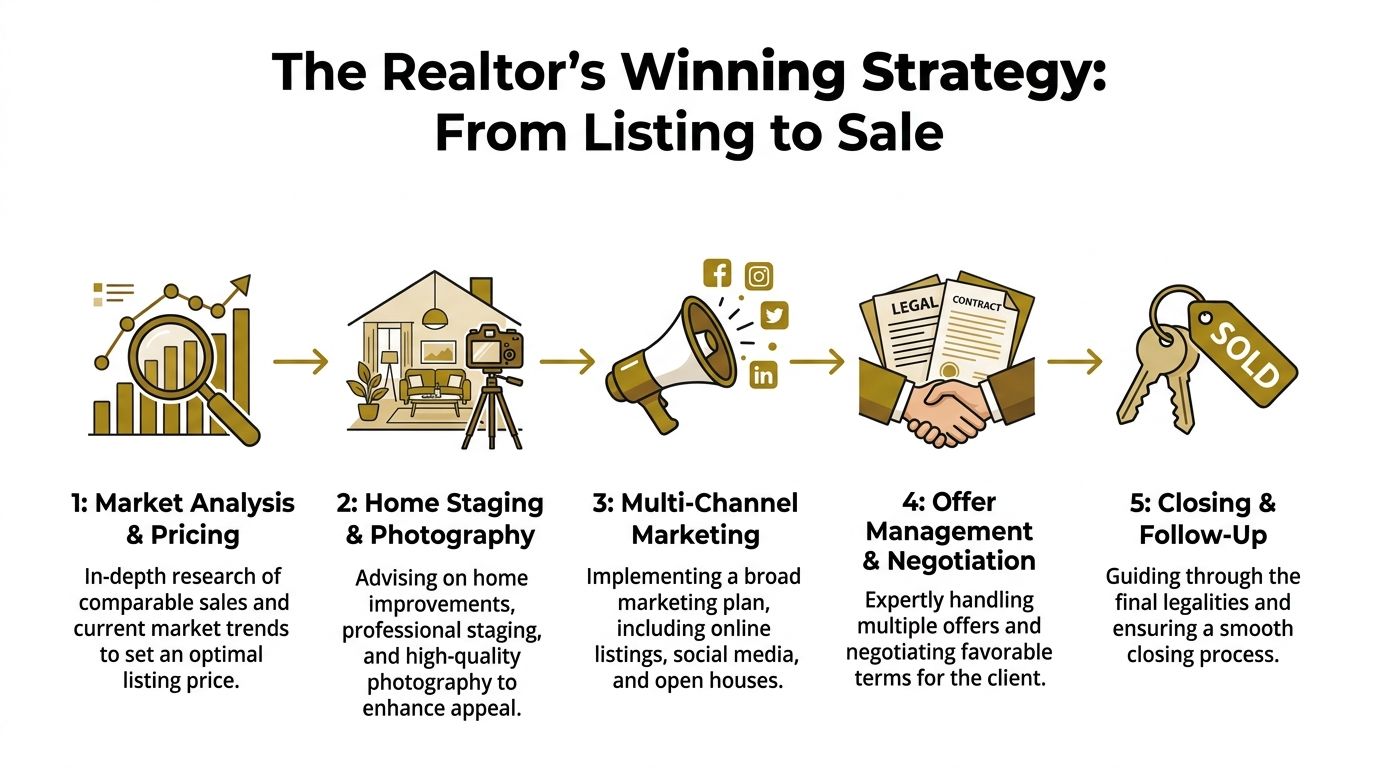
A listing strategy isn’t a sign on the lawn and a few photos online. In Pitt Meadows, it’s a campaign. If the strategy is lazy, the market exposes it quickly.
The useful benchmark here is straightforward. Pitt Meadows detached homes sit around a $1,250,000 benchmark price, and the sales-to-new-listings ratio is 28%, which points to a balanced market. One reported approach used a hyper-local pricing method, listed homes 3% to 5% below benchmark, and aimed to trigger multiple offers. That strategy was tied to sales in under 21 days versus a market average of 35 days, as outlined in these Pitt Meadows market statistics.
That doesn’t mean every seller should underprice. It means pricing has to be intentional.
What works in practice
A proper listing strategy usually has a few essential elements.
Hyper-local CMA work
Broad area comparables aren’t enough. Pitt Meadows pricing needs to account for sub-area, lot characteristics, updates, and what buyers are cross-shopping in Maple Ridge.Controlled pricing logic
Pricing slightly below where a seller emotionally wants to start can make sense when the goal is to create competition. Pricing above the realistic range kills momentum.Presentation that matches the target buyer
Staging isn’t decoration. It’s positioning. The same goes for photography, floor plans, and showing flow.Offer planning before launch
Sellers should know in advance how they’ll handle pre-emptive interest, offer dates, and terms that may matter more than headline price.
What does not work
These are the patterns that stall listings:
| Weak approach | Likely result |
|---|---|
| Pricing off the highest sale a seller remembers | Fewer serious showings |
| Using broad comparables from outside the true buyer search area | Confused pricing and poor buyer response |
| Skipping prep because inventory feels tight | Buyers notice the gaps immediately |
| Waiting to “test the market” without a clear adjustment plan | Lost momentum |
Marketing is only useful when it supports the strategy
A lot of agents talk about marketing as if more exposure automatically fixes weak pricing or poor presentation. It doesn’t.
Marketing should be built around the likely buyer. That includes the sequence of photos, the language used in the listing remarks, where the property is promoted, and how quickly the agent follows up after early showings. If you want a broader sense of what smart campaigns can include, these effective real estate marketing strategies offer useful context.
One practical option sellers in this area can consider is requesting a free home evaluation through Royal LePage Brookside Realty Property Management, then comparing that pricing rationale with what other local agents provide. The value isn’t in getting the highest number. It’s in seeing who can justify their strategy.
A pricing plan should sound like a sequence of decisions, not a guess with a smile attached.
Successfully Navigating Offers and Negotiations
Negotiation is where a lot of people lose ground because they focus on the wrong number.
Yes, price matters. It just isn’t the only thing that matters.

As interest rates rose, buyer demand shifted toward townhouses and apartments, and buyer preference changed with affordability pressures, as discussed in this MoneySense piece on Langley, Pitt Meadows, and Maple Ridge. That matters because attached-home negotiations don’t always play out like detached-home negotiations. Different buyers, different concerns, different negotiating positions.
For sellers, the strongest offer is not always the highest
A clean offer can beat a higher one if the higher one comes with headaches attached.
When reviewing offers, look closely at:
Subjects
Fewer or tighter subjects can make an offer stronger, but only if the buyer is credible.Closing date fit
A date that aligns with your move may save more stress than a slightly higher price with terrible timing.Deposit strength
Serious buyers usually show seriousness in the deposit.Buyer preparedness
Financing confidence, document review, and responsiveness all matter.
A good local realtor should help you rank offers by risk, not just by excitement.
For buyers, strong doesn’t mean reckless
Buyers often think they have only two options in a competitive situation. Go in hard or lose. That’s not how good negotiation works.
A better approach is to build an offer that solves the seller’s problem while protecting your own position. If you want a plain-English primer on structure, this guide on how to make an offer for a house is a helpful starting point.
In practice, local buyers usually need to decide:
- Where to stay firm
- Where to shorten timelines
- When to avoid a property entirely
- What terms are likely to matter to this seller
Attached homes require a different negotiation mindset
Townhomes and condos bring another layer. Strata documents, bylaws, depreciation concerns, insurance questions, and monthly carrying costs all shape buyer confidence.
That means negotiation isn’t only about pushing price. It’s about understanding what will make the buyer hesitate, what the seller can clarify early, and which issues should be cleaned up before they become deal friction.
Here’s a quick local video resource that helps frame the offer side from a practical angle:
The sellers who handle offers best do this
They decide their priorities before the first offer arrives.
That usually means answering three questions early:
- Do you want speed, certainty, or maximum price?
- Which terms are acceptable and which are not?
- Will you counter one buyer, invite improvement from more than one, or hold your ground?
If you’re preparing to list, the practical groundwork matters just as much as the marketing. The guidance on selling your home should include this part, not just prep and photos.
In multiple-offer situations, discipline beats adrenaline. Sellers who stay organised make better choices. Buyers who stay disciplined avoid paying for someone else’s panic.
From Accepted Offer to Closing Your Pitt Meadows Home
An accepted offer feels like the finish line. It isn’t. It’s the start of the part where details can still go sideways.
That’s especially true in Pitt Meadows, where local due diligence matters. In the townhome segment, benchmark prices go up to $950,000, and issues like missed strata bylaw review or skipped flood zone disclosure can trigger 10% to 15% renegotiations or lead to failed deals. The same source notes that experienced local realtors improve closing reliability with stronger due diligence and pre-qualified buyers, as outlined in this Pitt Meadows lifestyle and real estate guide.

What happens after acceptance
The exact sequence varies, but the core steps are familiar.
Subject period
Buyers complete the checks that support their offer conditions during this time. Depending on the property, that may include financing, inspection, document review, insurance confirmation, and strata review.
This stage moves fast. Delays usually come from poor preparation, not bad luck.
Subject removal
Once subjects are removed, the transaction becomes much firmer. That’s why buyers need to be confident before they sign off, and sellers need to know whether the buyer’s process has been handled properly.
A local realtor earns their keep here by keeping deadlines visible and pushing the right professionals when something stalls.
Conveyancing and closing prep
Lawyers or notaries handle the legal transfer work, but they rely on accurate, timely information from the transaction. Names, dates, inclusions, adjustments, and paperwork need to line up.
Small mistakes at this point create avoidable stress.
Local issues that need attention
Pitt Meadows transactions can carry extra layers that out-of-area agents sometimes underplay.
Floodplain disclosure
This is not something to mention casually at the last minute. Buyers need clear information early enough to ask questions and check insurance implications.Strata bylaws
Townhouse and condo buyers need to know what they’re buying into. Rental rules, pet rules, parking, storage, and use restrictions all matter.Property-type fit
Some homes appeal to buyers who understand the local setting. Others need more explanation around land use, access, or ongoing ownership realities.
What smooth closings usually have in common
The deals that close calmly tend to share the same habits.
| What helps | Why it matters |
|---|---|
| Early document review | Problems surface while there’s still time to solve them |
| Honest disclosure | Buyers are less likely to renegotiate when issues are clear upfront |
| Tight communication | Lenders, lawyers, inspectors, and agents all need the same timeline |
| Realistic timelines | Rushed conditions create mistakes |
Closing goes smoothly when the hard questions were asked before the offer was accepted.
Begin Your Real Estate Journey with Confidence
Finding the right realtor in Pitt Meadows isn’t about picking the loudest brand or the first profile that shows up online. It’s about finding someone who can read this market properly and tell you the truth, even when the answer is less convenient.
That means understanding how Pitt Meadows connects to Maple Ridge. It means asking better interview questions. It means knowing the difference between a listing that’s merely posted and a listing that’s positioned. It also means handling negotiations and closing work with enough care that the deal doesn’t fall apart over something that should have been caught earlier.
The practical takeaway is simple. Local knowledge isn’t a bonus here. It’s the job.
If you’re buying, that knowledge helps you avoid forcing the wrong property type, the wrong neighbourhood, or the wrong terms. If you’re selling, it helps you price with discipline, market with intent, and evaluate offers based on risk as well as price.
That’s what people usually need from pitt meadows realtors. Not more noise. Clear judgement.
If you’re weighing a move in Pitt Meadows or comparing it with Maple Ridge neighbourhoods like Albion, Silver Valley, Cottonwood, Kanaka Creek, or West Maple Ridge, a short conversation with someone local can save you a lot of circling. Even if you’re not ready to move tomorrow, it helps to understand what your options look like before the market forces the decision for you.
If you’re planning a purchase, sale, or rental-related move in Pitt Meadows or Maple Ridge, Royal LePage Brookside Realty Property Management offers local real estate and property management support with practical guidance and no-pressure conversation.