Owning a rental in Maple Ridge often starts with a simple idea. You have a basement suite in Albion that could help with the mortgage, a townhome near Kanaka Creek you kept after moving up, or a condo closer to the town centre that seems too good to sell right now.
Then the practical questions show up fast. Who answers the call when a toilet backs up on a Sunday night? How do you price a unit properly for your street, not just for Maple Ridge in general? What happens if a tenant pays late, stops communicating, or pushes back on notices?
That's where Maple Ridge property management stops being an abstract service and starts looking like an operating system for your investment. Good management isn't just collecting rent. It's tenant selection, maintenance judgement, legal timing, documentation, local pricing, and a steady hand when something goes sideways.
Is Professional Property Management Right for Your Maple Ridge Rental
A lot of landlords in Maple Ridge don't start out wanting to become landlords. They start with a house that has a suite, a former primary residence they'd rather hold, or an investment purchase that looked manageable on paper. The work feels light at first. Post photos, answer a few messages, sign a tenancy agreement, done.
That version rarely lasts.
A suite in Albion attracts different renters than a condo near Port Haney. A family-oriented townhome near schools and parks often brings more detailed questions about storage, parking, and move-in timing. A smaller unit closer to transit usually moves on a different rhythm. If you don't know your likely tenant profile before you advertise, you can waste weeks attracting the wrong inquiries.
What self-managing usually feels like
The first challenge is time. The second is judgement.
You're deciding which applicants are reliable, which repairs need same-day attention, how to document entry, and how firm to be when a tenant asks for an exception. None of that is impossible. It just becomes harder when you're learning it while protecting an expensive asset.
Practical rule: If you own a rental but don't want a second job, management usually makes sense.
Professional management is often the right fit for owners who value consistency more than control over every small task. It can also be the smarter choice for landlords who live outside Maple Ridge, travel often, or do not wish to have their personal number tied to tenant issues.
When it's worth the cost
Management tends to earn its keep when the property has enough moving parts that delays get expensive. That includes detached homes with yards, older properties with more maintenance variables, and rentals where one mistake with screening or notices can create months of stress.
It's also useful if you want decisions grounded in process instead of guesswork. A clear system for applications, inspections, documentation, rent collection, and communication will usually outperform an owner trying to improvise between work and family obligations. If you're comparing what that support involves day to day, Brookside's landlord resource library is a useful place to get familiar with the owner side of the process.
The Four Pillars of Comprehensive Property Management
Think of full-service management as a small operations team built around one property. The job isn't one task. It's a chain of decisions that all affect income, condition, and risk.
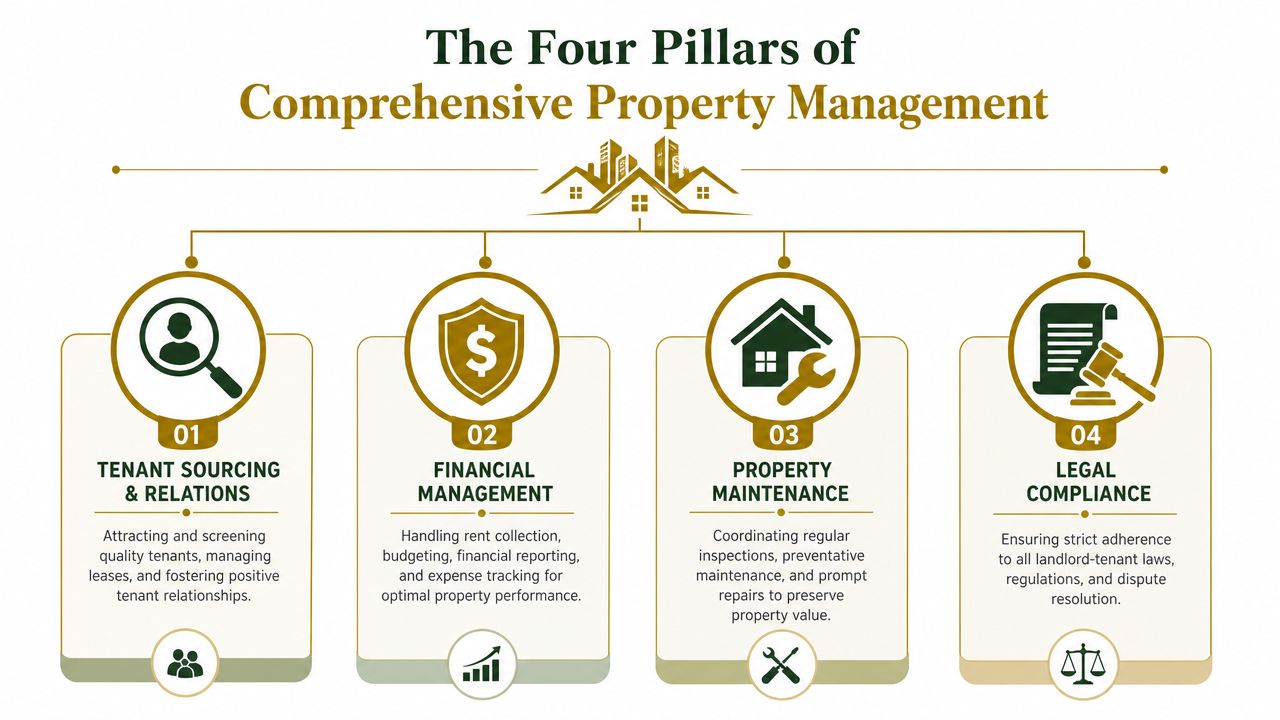
Tenant management
Most owners focus here first, and for good reason. A strong tenancy solves a lot of downstream problems. A weak one creates them.
Tenant management starts well before a lease is signed. It includes listing preparation, inquiry handling, showing coordination, application review, reference checking, lease execution, move-in documentation, and ongoing communication. The practical goal is simple. Put the right person in the property, on clear terms, with clean records from day one.
What works in Maple Ridge is specificity. A family rental in Cottonwood should be marketed differently than a compact condo near the West Coast Express. Good listings answer the questions the right renter is already asking. How many vehicles fit? Is there outdoor space? What's the layout like for children, work-from-home use, or shared occupancy?
Once the tenancy is active, communication matters more than many owners expect. Prompt, calm communication prevents small misunderstandings from turning into formal disputes.
Physical asset management
Properties don't stay in good condition by accident. They stay in good condition because somebody notices issues early and deals with them before they get expensive.
That means regular inspections, maintenance coordination, contractor scheduling, quotes, repair approvals, emergency response, and follow-up. In Maple Ridge, this matters even more for detached homes, basement suites, and properties with drainage, roofing, yard, or moisture concerns.
A common self-management mistake is reacting only when something fails. That approach usually costs more because emergency repairs are disruptive, tenants lose patience, and secondary damage can spread. Preventative attention is less dramatic, but it protects value better.
A good manager also knows when the cheap fix is the wrong fix. Repeated patchwork repairs on the same issue often cost more than one proper repair with the right trade.
Financial management
This pillar is about more than collecting rent. It's about keeping the rental legible.
Owners need clean monthly statements, clear repair invoices, documented owner disbursements, and straightforward records at tax time. They also need a manager who treats arrears, partial payments, and unusual charges with discipline, not casual texts and hopeful follow-ups.
Here's what useful financial management usually includes:
- Rent collection: A consistent process, documented due dates, and immediate follow-up when rent doesn't arrive as expected.
- Expense tracking: Repairs, maintenance, and recurring costs recorded in a way an owner can easily review.
- Owner reporting: Statements that tell you what happened without making you decode them.
- Budget awareness: Not a corporate spreadsheet exercise. Just practical judgement about what should be approved now versus scheduled later.
If you want a sense of the operational side of this work, including the kinds of systems managers rely on, Brookside's property management tools page gives useful context.
Legal and risk management
This is the pillar owners tend to underrate until something goes wrong.
In practice, legal risk management means using the right forms, serving notices correctly, documenting inspections, handling deposits properly, and keeping communication professional and traceable. It also means knowing when a situation is drifting toward a dispute and tightening up the file before it gets there.
The best legal defence in property management is usually boring administration done on time.
That may not sound exciting, but it's true. Sloppy records, verbal side deals, undocumented damage, and vague payment arrangements create most of the avoidable trouble in residential rentals.
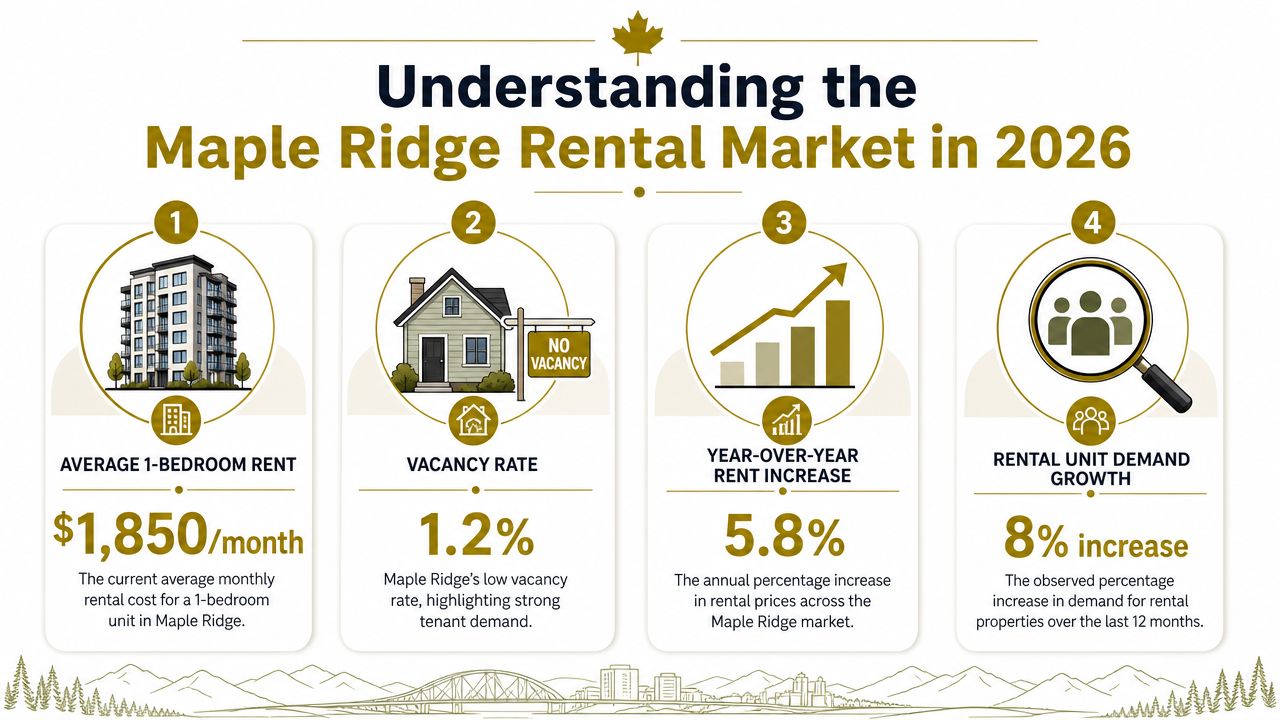
Understanding the Maple Ridge Rental Market in 2026
Maple Ridge isn't one rental market. It's a collection of sub-markets with different tenant expectations, property types, and leasing patterns.
That local variation matters more than broad regional headlines. A basement suite in Silver Valley, a townhome near Thomas Haney Secondary, and a condo around the Haney and Port Haney area won't compete for exactly the same renter, even if they're all technically in the same city.
Growth is the backdrop
The most useful hard signal for local demand is population growth. Maple Ridge had a population of 82,256 in the 2021 Census, up from 76,052 in 2016, an 8.2% increase over five years, according to Axford Property Management's Maple Ridge market page. That matters because household formation drives rental demand, especially in neighbourhoods such as Albion, Silver Valley, Cottonwood, and the Haney/Port Haney area.
In plain terms, more people means more pressure on the rental system. Some are new renters. Some are first-time buyers still saving. Some are downsizers waiting for the right move. That mix increases turnover and raises the value of accurate pricing and efficient placement.
Neighbourhoods attract different tenants
Owners get into trouble when they price based on emotion or broad averages instead of neighbourhood fit.
A family-oriented home in Albion or Cottonwood often draws renters looking for stability, school access, parking, and practical living space. A condo near the town centre or transit appeals to a different profile, often prioritising commute convenience, lower maintenance living, and walkability to daily errands. Silver Valley can attract tenants who specifically want a quieter setting and more outdoor access.
What works is matching the listing, showing strategy, and screening criteria to the tenant pool the property naturally fits.
- Albion and Cottonwood: Strong fit for households that care about bedrooms, storage, and proximity to schools and parks.
- Haney and Port Haney: Better fit for renters who value access to transit, the town core, and simpler day-to-day mobility.
- West Maple Ridge: Often appeals to tenants balancing access, established streets, and practical commuting routes. For a closer look at that pocket, Brookside's West Maple Ridge neighbourhood page is useful context.
Pricing needs local discipline
A property doesn't sit vacant because Maple Ridge is weak. It usually sits because the price, presentation, or positioning is off.
The mistake I see most often is listing a unit based on what the owner hopes to get rather than what competing renters will compare it against. Renters don't judge your unit in isolation. They judge it against every active option they can see that week.
Good pricing is less about squeezing for the top number and more about getting the right tenant on the right timeline.
For owners who want to sharpen how they think about local positioning, RealEstateCRM's guide for brokers is a useful read on market analysis. The framework is brokerage-focused, but the logic applies well to rental pricing too. You need to know your competition, your likely audience, and where your property wins or loses.
A Transparent Look at Property Management Fees
Most landlords don't mind paying for management. What they mind is not knowing what they're paying for.
In Maple Ridge, fee conversations usually go sideways when an owner compares one quote to another without checking what's included. A lower monthly fee can still be more expensive if every lease-up task, inspection, renewal, and maintenance coordination item gets billed separately.
The two main fee models
The first common structure is percentage-based management. That means the monthly fee is tied to collected rent. This model usually makes sense when the manager's workload tracks with the rent level and the property has active moving parts.
The second is a flat monthly fee. Some owners prefer it because it's predictable and easier to budget. It can be a good fit for simpler rentals with stable tenancies, provided the service scope is clear.
Neither model is automatically better.
A percentage model often aligns well with active leasing and ongoing oversight. A flat fee can work well when the property is straightforward and the owner wants stable billing. The important part is the management agreement. Read what's included, what triggers extra charges, who approves repairs, and how after-hours issues are handled.
Fees outside the monthly management charge
In this context, clarity matters most. Ask about:
- Tenant placement fees: Charged when the manager markets the property, runs showings, screens applicants, and signs a new lease.
- Lease renewal fees: Sometimes charged when an existing tenancy is renewed or updated.
- Inspection charges: Some firms include routine inspections. Others bill them separately.
- Maintenance administration: Ask whether coordination is included or if there's a markup or project admin charge.
- Vacancy work: Clarify whether listing updates, re-showings, and move-out coordination are bundled.
A clean quote should let you compare apples to apples.
Example fee layout
Below is a simple example format for how an owner might review a proposal for a townhome in Maple Ridge. It's not a market-wide price sheet. It's a checklist for understanding the structure.
| Service | Typical Cost Structure | Example Calculation |
|---|---|---|
| Ongoing monthly management | Percentage of collected rent or flat monthly fee | A manager charges either a share of rent collected or one set monthly amount |
| Tenant placement | One-time leasing fee | Charged when a new tenant is sourced, screened, and placed |
| Lease renewal | Flat renewal fee or included | Either billed separately or built into the monthly service |
| Routine inspections | Included or per inspection | Confirm whether move-in, move-out, and periodic inspections are covered |
| Maintenance coordination | Included, admin fee, or markup policy | Ask how contractor coordination and larger repair oversight are billed |
| Emergency response | Included within management or billed by event | Important for after-hours plumbing, heat, lock, or leak issues |
One practical note. If you're deciding whether to rent or sell, run the numbers soberly. Mortgage costs, vacancy periods, repairs, strata rules, and management all affect the final outcome. Brookside's mortgage payment calculator can help frame the ownership side before you commit to becoming a long-term landlord.
Your Checklist for Selecting a Maple Ridge Property Manager
Hiring a manager is less like hiring a tradesperson and more like choosing an operating partner. You're handing over access to your property, your rent flow, your legal paperwork, and often your reputation with tenants.
That means your interview questions should go past “What do you charge?” and “How long have you been in business?”
Ask about workload, not just service promises
One of the better questions an owner can ask is how many communities or properties a manager handles, and how often they are onsite. As Magnum York notes in its guidance on hiring a condo property manager, “full-service” is not automatically better, and the right model depends on site complexity and actual service levels.
That idea applies directly to rental management in Maple Ridge. A manager can promise responsiveness, but if their portfolio is stretched thin, delays show up in showings, follow-ups, inspections, and repair coordination.
Ask the uncomfortable questions:
- How much is one manager carrying? You're trying to understand bandwidth, not catch someone out.
- Who covers holidays and sick days? Small teams can be excellent, but only if they have backup.
- How often is the property physically seen? Remote-only management tends to miss things.
- Who answers after-hours calls? Owners need a real process, not a voicemail hope-and-pray system.
Look for local operating knowledge
A manager should know the difference between leasing a condo near the town core and a detached rental in a more family-oriented pocket. They should understand how local schools, parks, transit access, and parking realities affect demand and tenant fit.
That doesn't mean they need a polished sales speech. It means they should be able to discuss Maple Ridge like someone who works the area.
A few strong prompts:
- Ask how they would price your specific property. The answer should sound local, not generic.
- Ask what tenant profile suits your unit. Good managers think in likely renter types, not just square footage.
- Ask how they handle slower response periods. You want process, not excuses.
- Ask what they document at move-in and move-out. The documentation during these stages often decides whether disputes are won or lost.
Technology helps, but process matters more
A decent owner portal is useful. Digital statements are useful. Online maintenance tracking is useful. None of those tools fix weak judgement.
Still, it's fair to ask what software stack a manager uses and how owners see updates. If you want a sense of what modern software for real estate property managers can include, that overview is a practical starting point. The right setup should make communication cleaner, records easier to review, and approvals simpler to track.
A polished dashboard doesn't matter much if nobody follows up with tenants, contractors, or owners on time.
Warning signs that deserve attention
Some firms sound fine in a sales meeting and then under-deliver because the operation is too thin.
Watch for:
- Vague answers about communication: If they can't tell you response expectations, expect inconsistency.
- No clear screening workflow: Screening should be a repeatable process, not a gut feeling.
- Confusing fee language: If the agreement is muddy before you sign, it won't get clearer later.
- No examples of reporting: Owners should know what statements and updates look like.
- Defensive posture around references: A solid firm shouldn't mind scrutiny. If you want to hear from other owners, Brookside shares client feedback on its testimonials page.
The Brookside Realty Advantage Our Local Commitment
Local experience only matters if it changes outcomes. Otherwise it's just a slogan.
Here, the useful distinction is operational depth. Royal LePage Brookside Realty states that it has been serving the Fraser Valley since 1982, which gives it more than 40 years of local market experience, and its Maple Ridge property management platform uses a 7-point tenant screening process while reporting a 99.2% rent collection rate, according to Brookside's property management page.

Why those details matter
The founding date matters because long-term local operators usually develop sharper instincts about neighbourhood-specific leasing behaviour. They've seen different tenant cycles, product types, and maintenance patterns across Maple Ridge and Pitt Meadows. That kind of memory helps when pricing a unit, judging an application, or deciding how quickly to act on a repair issue.
The 7-point screening process matters because tenant quality is still the hinge point for most rental outcomes. Better screening doesn't eliminate risk, but it improves the odds of stable payment, cleaner communication, and fewer preventable issues.
The reported rent collection rate matters for one reason. Cash flow is the centre of the landlord experience. Owners can handle the occasional repair invoice. What throws the whole plan off is inconsistent income.
The practical local edge
A Maple Ridge manager should understand the differences between a rental near the downtown core, a family home in Albion, and a unit serving commuters or downsizers. They should also know how local lifestyle factors shape demand. School catchments, park access, parking realities, older home maintenance quirks, and transit convenience all affect who rents what.
That's the kind of practical work a local brokerage can do well. Royal LePage Brookside Realty Property Management is one option for landlords who want a Maple Ridge-based service that handles rental operations from a local brokerage setting rather than from a remote call-centre model.
Navigating BC Tenancy Laws with Confidence
The legal side of being a landlord in British Columbia usually feels manageable until timing matters. Then it gets serious quickly.
Maple Ridge property management is shaped by the Residential Tenancy Act, and compliance isn't a side issue. As FirstService Residential notes in its Maple Ridge strata management overview, even small mistakes in notice timing or deposit handling can increase legal exposure and extend downtime in a tight rental market.
Where landlords get tripped up
Most problems don't start with dramatic misconduct. They start with routine tasks handled casually.
That includes taking deposits without clear records, entering the property without following proper notice requirements, using the wrong form, or trying to negotiate around formal process when rent is late. Owners often think they're being flexible. What they're doing is weakening their own position.
The practical areas that need discipline are usually these:
- Deposits: Handle security and pet deposits exactly as required, with documentation that can stand up later.
- Entry notices: Lawful entry is procedural. Good intentions don't replace proper notice.
- Rent increases: Timing and format matter. If the notice is wrong, the increase can fail.
- Disputes: By the time a file reaches the Residential Tenancy Branch, records matter more than memory.
Confidence comes from process
A good manager reduces legal risk by making routine tasks routine. Standard forms. Consistent notices. Written records. Inspection reports. Clear payment history. Calm communication.
When a landlord says, “I thought texting the tenant was enough,” the file is usually already weaker than it should be.
That's why legal compliance and operations can't be separated. In practice, the safest rentals are usually the ones run with steady administration, not improvisation.
Frequently Asked Questions for Maple Ridge Landlords
What happens if a tenant needs to be evicted
In BC, you don't just tell a tenant to leave and change the locks. The process is formal, notice-driven, and document-heavy. A manager's job is to serve the proper notice, keep the file organised, and follow the Residential Tenancy Branch process correctly if the matter turns into a dispute.
Can I use my own contractors for repairs
Usually, yes, if the contractor is qualified, available, insured where appropriate, and able to respond at the speed the tenancy requires. The main issue isn't preference. It's whether the person can do the work promptly and communicate clearly. For urgent issues, most managers will rely on vendors who can attend quickly and document the job properly.
How are after-hours emergencies handled
Good management treats after-hours response as an actual system. Water ingress, no heat, plumbing failures, lockouts, and electrical concerns can't wait for the next business day. Owners should ask exactly who takes those calls, who authorises emergency work, and how updates are sent afterward.
Will I still have a say in decisions
Yes, but the best arrangements are clear about decision thresholds. Routine items can move quickly under agreed authority. Larger repairs, unusual tenant issues, and strategic choices should come back to the owner with context and options.
Is renting always better than selling
Not always. Some properties make excellent long-term rentals. Others are better sold if the maintenance burden is high, the layout is hard to lease well, or the owner doesn't want the ongoing obligations. The right answer depends on your numbers, your tolerance for involvement, and your long-term plan for the asset.
If you own a rental home, condo, townhouse, or suite in Maple Ridge or Pitt Meadows and want a clear read on whether to self-manage, rent it professionally, or sell instead, Royal LePage Brookside Realty Property Management is a practical place to start the conversation. A local review of your property, neighbourhood, and likely tenant fit can make the next decision much easier.