

You’ve probably done it already. Opened one tab for maple ridge homes for sale, then another for school catchments, then another for commute times, then another because the first listing sold before you could book a showing. After a while, the search stops feeling exciting and starts feeling noisy.
That’s where local context matters. A listing can tell you square footage, bedroom count, and lot size. It usually won’t tell you whether a street feels tucked away or busy at school pickup, whether a home style suits a young family or a downsizer, or whether a “great opportunity” is overpriced for the pocket it sits in.
In Maple Ridge, those details change the decision. Albion doesn’t feel like West Maple Ridge. Silver Valley doesn’t live like East Central. A townhouse near the urban core solves a different problem than a detached home near Kanaka Creek. Buyers who understand those trade-offs usually make calmer, stronger decisions.
Starting Your Maple Ridge Home Search
Most buyers begin with a simple goal and quickly hit complexity. They want more space, a yard, better access to parks, a mortgage that still leaves room for real life, and a neighbourhood that feels right. Maple Ridge can absolutely offer that, but not every area solves the same problem.
A common pattern looks like this. A buyer starts by saving detached homes because that’s the ideal. Then they realise one pocket offers more house but longer commute trade-offs, another has a stronger neighbourhood feel but more competition for the best-kept properties, and a third has newer townhomes that fit their day-to-day routine better than an older detached option. The shortlist changes once lifestyle enters the conversation.
That’s why the search works better when it starts with three filters instead of one.
- Daily routine first: Think school drop-offs, West Coast Express access, shopping, dog walks, and how often you want to drive.
- Home type second: Detached, townhouse, and condo buyers are playing different games in Maple Ridge.
- Compromise line third: Decide early what you’ll bend on, and what you won’t.
If you’re just getting serious, it helps to review a practical home buying process for Maple Ridge buyers before booking showings. Buyers who understand the process early tend to move faster when the right property appears.
Practical rule: Don’t search for a “perfect” home in Maple Ridge. Search for the right fit in the right pocket, at the right terms.
That shift sounds small, but it changes everything. It turns endless browsing into a focused plan.
The 2026 Maple Ridge Real Estate Market Snapshot
The headline for buyers is straightforward. There’s more choice, less pressure to rush blindly, and better room to negotiate than buyers had in more aggressive market phases.
As of late 2025, Maple Ridge had 979 active listings, up 25%, while average days on market for detached homes reached 105 and the median detached price adjusted to $1,499,000, according to this REBGV-based Maple Ridge market update. For buyers looking at 2026, that combination matters more than any single headline. More inventory gives you comparison power. Longer market time gives you patience. Price adjustments give you room to test value instead of reacting to panic.

What more inventory actually changes
When buyers hear “more listings,” they often think it just means more houses to scroll through. In practice, it shifts the balance of power.
You can compare condition more carefully. You can reject listings that are clearly reaching on price. You can notice when two similar homes in different neighbourhoods offer completely different value. That’s a major advantage in Maple Ridge because the market isn’t one uniform block. Street-by-street differences matter.
The bigger inventory jump also spread across property types. Detached homes led the supply increase, while townhouses also rose sharply and condos dipped slightly in that late-2025 snapshot. That tells buyers something important. If you’re searching detached, there’s more room to be selective. If you’re searching attached, you still need to stay alert for the better-run complexes and stronger locations.
Why days on market matters
A detached home sitting longer isn’t automatically a red flag. Sometimes it’s poor presentation. Sometimes it’s overpricing. Sometimes the seller started with last year’s expectations and the market didn’t agree.
What matters is what that timing allows you to do. You can book a second showing. You can compare nearby sales with more care. You can include reasonable conditions without feeling like you’re sabotaging your chances.
A lot of buyers misuse market softness by assuming every seller is desperate. That’s not how strong negotiations work. The smarter move is to identify listings where the seller’s expectations and the market are out of sync, then write a clean, well-supported offer.
Homes with more exposure time often create the best opportunity for buyers who stay disciplined on value and condition.
What Maple Ridge buyers should watch in 2026
The market is giving buyers space, but space only helps if you use it well. Focus on these signals:
- Price reductions: They often show a seller adjusting to current reality, not weakness in the home itself.
- Relisted properties: Sometimes this reflects strategy. Sometimes it means the first pricing approach missed the market.
- Neighbourhood-specific supply: More choice in one area can create better negotiating conditions than another.
- Condition versus price: In a higher-inventory market, tired homes can sit while well-prepared homes still attract attention.
If you want a feel for the issues local buyers and sellers are actively dealing with, the Maple Ridge real estate news hub is a useful place to track practical topics like inspections, pricing, and local market shifts.
What works and what doesn’t
A buyer-friendly market doesn’t reward indecision forever. Good homes still sell when the price, location, and presentation line up. What doesn’t work is assuming every listing should accept a deep discount. Sellers may be more flexible, but they still compare your offer against other interest, timing, and certainty.
What works is being selective without being passive. Know your financing. Know your neighbourhood priorities. Tour enough homes to recognise value quickly. Then act when the numbers and the fit make sense.
That’s the sweet spot in today’s Maple Ridge market. You don’t need to rush. You do need to be ready.
Finding Your Fit A Neighbourhood Guide to Maple Ridge
The best home search in Maple Ridge usually gets easier once the buyer stops asking, “What can I buy?” and starts asking, “Where will my life work best?” That’s the true dividing line between browsing and buying.
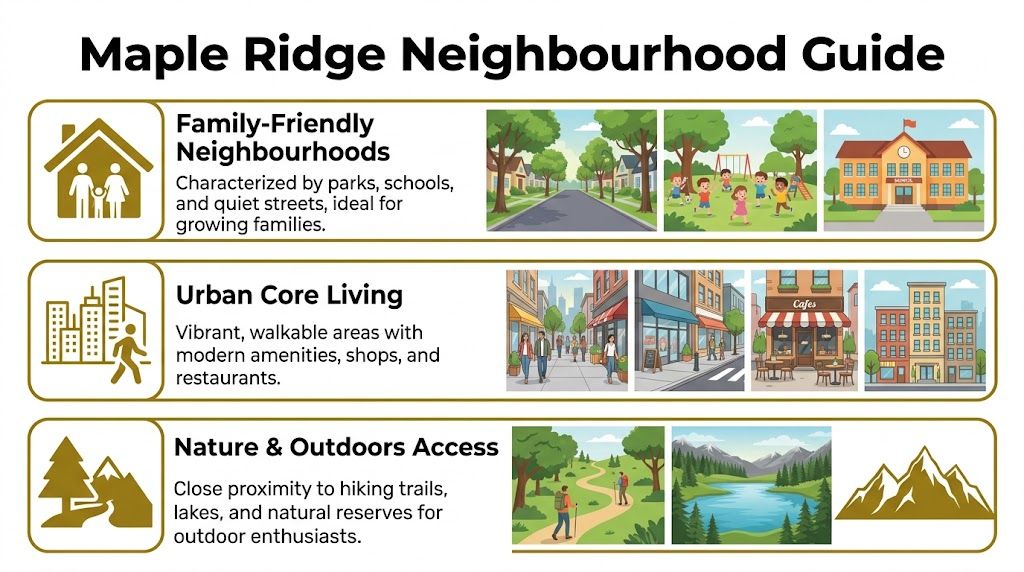
Some neighbourhoods deliver convenience. Others deliver space, trails, or a stronger sense of separation from busier routes. A few offer a mix that appeals to both end users and investors. The right answer depends on whether you want walkability, school access, yard space, newer construction, or future upside.
Albion
Albion is one of the first areas many family buyers ask about, and for good reason. It tends to attract buyers who want neighbourhood feel, a higher concentration of family-oriented housing, and a community setting where parks, schools, and local routines shape daily life.
You’ll find a mix of detached homes and townhome options here, including streets where front porches, laneways, and smaller lot patterns create a more connected feel than some older suburban layouts. That appeals to buyers who want children playing nearby, neighbours who know each other, and easier access to schools and recreation.
The trade-off is simple. Buyers often accept less lot size or less privacy than they’d get in more rural-feeling pockets, in exchange for community design and practical family convenience.
Local insight: Albion suits buyers who want Maple Ridge to feel active and social, not isolated.
There’s also an investment angle worth noting. Some Albion properties are marketed for development potential, including RS-3 zoned lots described as opportunities for subdivision into duplex-oriented configurations, as noted in this Maple Ridge development property roundup. That won’t apply to every property, and buyers should verify zoning and approvals carefully, but it does make Albion a neighbourhood where end-user and investor interest can overlap.
Silver Valley
Silver Valley appeals to a different buyer profile. This area often attracts people who want a stronger connection to nature, more visual relief from dense urban form, and access to trails, forested surroundings, and a quieter residential atmosphere.
The homes here often feel tied to their natural surroundings. Buyers looking in Silver Valley usually care about more than square footage. They want setting. They want a sense that weekends can start at the trailhead, not in traffic.
That lifestyle comes with trade-offs too. Some buyers love the tucked-away feeling. Others decide they’d rather be closer to everyday services. Silver Valley works best for people who value the outdoor setting, not for buyers who say they want nature but still expect everything to be five minutes away.
A practical step if this area is on your shortlist is to browse current Silver Valley homes for sale alongside a map of parks, schools, and your likely commute routes. It helps you judge whether the location supports your actual routine.
Cottonwood
Cottonwood often lands in the middle of the conversation because it balances family functionality with relative convenience. It tends to attract buyers who want established residential appeal without moving too far from schools, amenities, and broader Maple Ridge connections.
This is a neighbourhood where many move-up buyers feel comfortable. The housing stock often appeals to families looking for more room, a practical floor plan, and a community pattern that feels established rather than transitional. If Albion feels a bit more intentionally community-designed, Cottonwood can feel more traditionally residential.
What buyers should pay attention to here is micro-location. Not every part of Cottonwood feels the same. Some pockets feel quieter and more family-centred. Others sit closer to busier routes or more mixed surrounding uses. In this area, one street can sell the home and the next can weaken it.
West Maple Ridge
West Maple Ridge often suits buyers who put commuting convenience and broader accessibility high on the list. For some households, especially those with regular travel westbound or stronger reliance on transit connections, that matters more than a newer home or a mountain-edge setting.
The housing mix can be broader here, and so can the feel. Some streets deliver established neighbourhood charm. Others feel more utilitarian. Buyers who do well in West Maple Ridge don’t shop loosely. They focus on specific pockets, road exposure, lot usability, and how the immediate surroundings influence long-term enjoyment and resale.
This area can also appeal to downsizers and buyers who want to stay connected to services without stepping fully into condo living. A detached home with simpler outdoor maintenance in the right west-side pocket can be a very smart fit for that buyer.
Kanaka Creek and nearby pockets
Kanaka Creek and nearby areas speak to buyers who want breathing room. The appeal here is often tied to green space, a more relaxed pace, and homes that feel a bit more removed from the urban core.
For some households, that’s the dream. For others, it becomes a challenge after move-in when school runs, errands, and regular commuting start to define the week. This is one of those neighbourhood choices where honesty matters. If you want calm and space, it can be a strong fit. If you need quick convenience, it may feel farther out than it looked on a map.
Buyers should also pay close attention to lot features, drainage, slope, privacy, and inspection findings in these areas. Natural beauty is a real asset, but it comes with more property-specific variation than you usually see in flatter, more uniform subdivisions.
East Central and the urban side of Maple Ridge
Not every buyer wants a detached home on a quiet crescent. Some want access. They want shops, services, transit options, and a shorter list of weekend maintenance jobs. East Central and surrounding urban-oriented pockets can make more sense for first-time buyers, downsizers, and buyers who prioritise convenience over yard size.
This part of Maple Ridge tends to offer more variety in housing type and a more practical feel for buyers whose lifestyle is less about lot size and more about location efficiency. It may not deliver the same curb-appeal experience as some family-focused subdivisions, but it can solve essential day-to-day problems that matter most.
A quick side-by-side way to think about fit
| Neighbourhood | Best for | Watch for |
|---|---|---|
| Albion | Families who want community feel and parks nearby | Lot size trade-offs and property-specific pricing |
| Silver Valley | Buyers who want nature access and a quieter setting | Commute practicality and service access |
| Cottonwood | Move-up buyers seeking established family housing | Big differences from one micro-pocket to another |
| West Maple Ridge | Convenience-focused buyers and practical downsizers | Street selection and surrounding uses |
| Kanaka Creek | Buyers wanting green space and separation | Property conditions tied to terrain and setting |
| East Central | First-time buyers, downsizers, convenience seekers | Balancing walkability with building or street quality |
What works when choosing a neighbourhood
The buyers who make the best decisions usually tour neighbourhoods at the wrong time on purpose. They drive through during school pickup, early evening, and weekends. They test the route to work. They walk the nearest park. They check whether the area feels the same in person as it did online.
What doesn’t work is choosing a neighbourhood only by list price. A cheaper home in the wrong pocket often costs more in stress, resale limitations, or daily inconvenience than buyers expect.
Maple Ridge gives you real variety. That’s a strength, but only if you use it deliberately.
Decoding Property Types and Price Points
Once buyers settle on an area, the next question is usually harder than the neighbourhood choice. Should you stretch for detached, stay practical with a townhouse, or keep flexibility with a condo?
That decision isn’t just about budget. It affects maintenance, privacy, monthly costs, future resale pool, and how much compromise you make elsewhere.
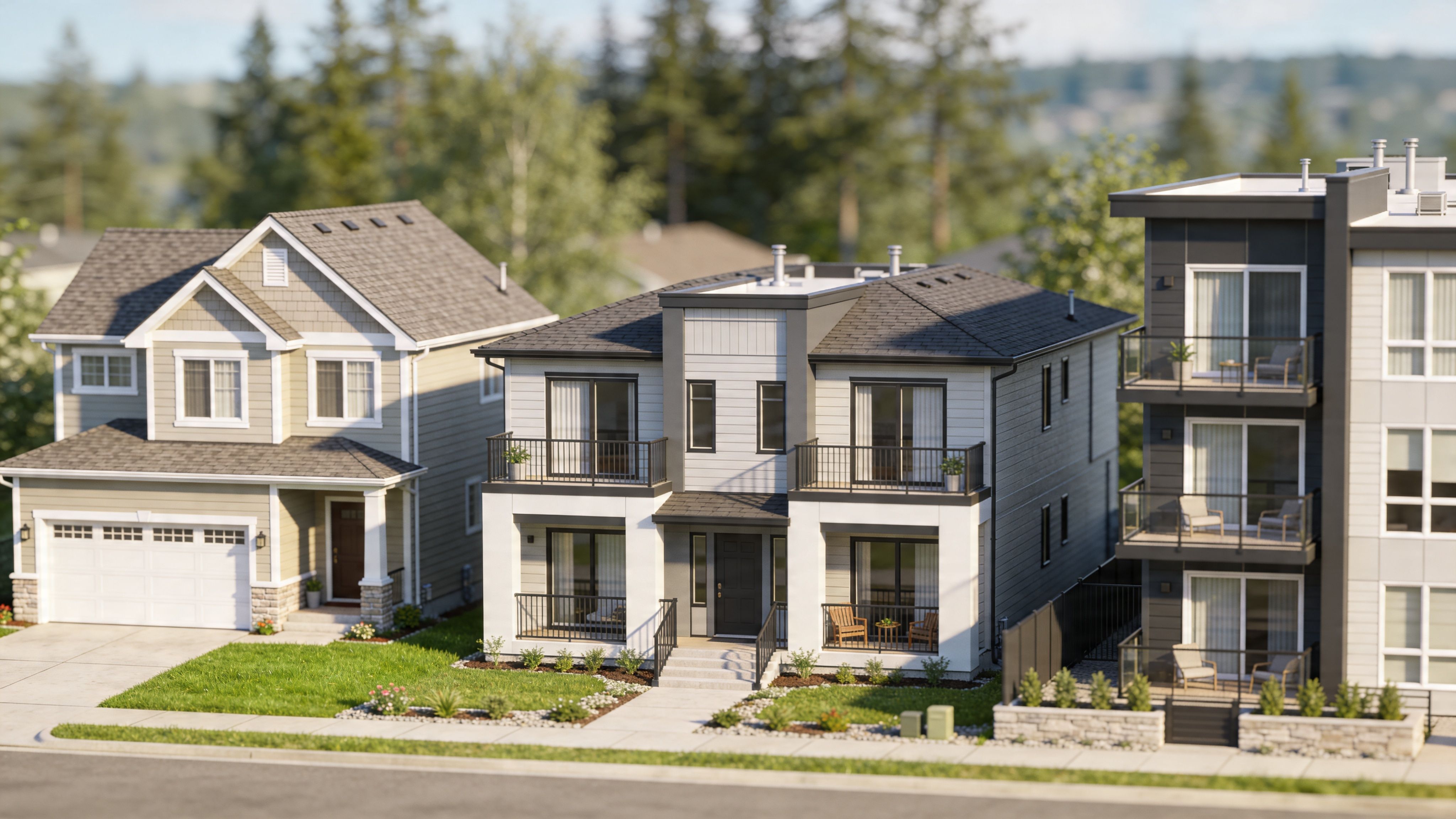
Maple Ridge shows a clear split by property type. The benchmark for a detached home is $1,224,600, compared with $731,900 for an attached property, which puts detached homes 68% higher than attached in this Maple Ridge housing market breakdown. That pricing gap tells buyers two things at once. Detached ownership carries a meaningful premium. It also tends to create more negotiating opportunity when detached supply outpaces demand.
Detached homes
Detached homes still represent the aspiration purchase for many buyers. You get land, more separation from neighbours, more renovation control, and often a better fit for multigenerational living, larger households, or buyers who want long-term flexibility.
The premium is real, though. Buyers who push too hard for detached sometimes end up sacrificing location, condition, or carrying comfort just to say they bought a house. That’s rarely the smartest version of the move.
Detached can make sense when:
- You need long-term space: Growing families, home office needs, or extended family living can justify the jump.
- You want control: Renovations, yard use, storage, and future configuration are usually easier.
- You can absorb maintenance: Roofs, drainage, exterior repairs, and landscaping become your problem, not strata’s.
Townhouses
Townhouses often hit the best balance in Maple Ridge for buyers who want more space than a condo offers but don’t want the full cost or workload of detached ownership.
This segment works well for first-time buyers moving up from renting, young families who need bedrooms and a garage, and downsizers who still want multi-level living without a large lot. The trade-offs usually involve strata rules, shared walls, and less control over exterior decisions.
For many buyers, this isn’t a compromise in the negative sense. It’s a smarter allocation of budget. A well-run townhouse complex in the right neighbourhood can outperform a detached home that needs immediate work or sits in a weaker location.
If part of your thinking includes rental potential later, it helps to understand the basics of what makes a good rental property for investors. The same factors matter in Maple Ridge too. Location convenience, layout efficiency, maintenance profile, and tenant appeal often matter more than chasing the biggest unit.
A short market overview can help clarify how these categories behave in practice:
Condos
Condos usually attract buyers who value affordability, simpler upkeep, and centrality. In Maple Ridge, that can include first-time buyers, solo buyers, downsizers, or investors who want a lower-maintenance entry point.
The biggest mistake condo buyers make is focusing only on the unit. In reality, the building matters just as much. Strata management, maintenance history, bylaws, parking, storage, and the feel of common areas all affect daily life and resale.
Buy the building as carefully as you buy the suite.
A simple decision lens
| Property type | Strongest advantage | Main trade-off |
|---|---|---|
| Detached | Space, land, control | Higher entry cost and full maintenance responsibility |
| Townhouse | Balance of space and affordability | Strata rules and shared walls |
| Condo | Lower-maintenance ownership and convenience | Less privacy and stronger dependence on building quality |
The right choice comes down to what you’re trying to protect. If it’s space, detached may win. If it’s financial breathing room, townhouse often makes more sense. If it’s simplicity, condo can be the strongest option of all.
Navigating Your Home Search and Financing
It often plays out the same way. A buyer spends two weekends touring homes, finds one that feels right, then learns the monthly cost is higher than expected or the property raises lender concerns. By that point, the search has already drifted off course.
In Maple Ridge, the strongest searches start with two filters before the first showing is booked. One is financial comfort. The other is neighbourhood fit. Listing sites can sort by price and bedroom count, but they do not tell you why one block in Hammond feels practical for a commuter while a similar-looking pocket in Silver Valley may ask for a different budget, a different vehicle setup, and a different tolerance for hills, weather, and drive times. Buyers who understand both the numbers and the street-level reality make better decisions faster.
What to look for beyond the listing
Online photos are useful, but they rarely answer the questions that affect day-to-day ownership. A wide-angle lens can make a compact main floor look generous. A tidy listing description may skip the steep driveway, traffic noise, awkward parking, or the yard drainage that becomes obvious after heavy rain.
At a showing, check the property in the same order you would live in it. Start at the street. Look at how cars move, where guests would park, and whether the lot feels exposed or private. Then assess the house itself, especially natural light, storage, stair layout, window condition, and signs that water management has been handled properly.
A practical showing checklist should include:
- Street and approach: Busy route, school traffic, corner exposure, slope, and ease of parking
- Light and layout: How the home feels without listing photography doing the work
- Exterior clues: Gutters, grading, retaining features, rooflines, and deferred maintenance
- Daily function: Entry flow, laundry location, storage, noise, and whether the floor plan suits your routine
These details matter because Maple Ridge inventory is diverse. Two homes at a similar price can produce very different ownership experiences depending on lot shape, elevation, road exposure, and upkeep.
Why pre-approval changes the search
Pre-approval does more than set a ceiling. It gives the search shape.
Buyers with financing lined up usually make cleaner decisions because they know the payment range, down payment limits, and lender expectations before emotion gets involved. That matters with detached homes that may have suite income, townhomes with strata fees, or older properties where condition can affect the mortgage file.
For early budget planning, a Maple Ridge mortgage payment calculator helps estimate monthly ownership costs before you spend time chasing the wrong price bracket.
Pre-approval also helps you separate affordability from comfort. A lender may approve a number that works on paper, but your real limit should still leave room for property tax, strata fees, insurance, utilities, and repairs. I tell buyers to solve for the full monthly picture, not just the purchase price.
Local financing advice tends to be more useful than generic content
Broad mortgage articles can help with terminology, but Maple Ridge buyers usually get better direction from a broker or lender who knows the local housing stock. That includes how suites are viewed, how strata documents can affect timelines, and why some properties draw more lender scrutiny than others.
That local context matters. A newer condo in the town core raises a different set of financing questions than an older detached home on a sloped lot or a townhouse with higher monthly strata costs. The rate is only one part of the file. Property type, condition, and document review can change the buyer's options just as much.
For readers comparing financing programs more broadly, especially if they have come across U.S. lending terms online, what is a VA loan offers a useful example of how another system is structured. It is not a Canadian mortgage product, but it is a good reminder that loan rules, eligibility, and buyer benefits do not transfer neatly across borders.
Financing first. Showings second. Offer third. Buyers who reverse that order usually create their own stress.
Making a Winning Offer in a Buyer-Friendly Market
A buyer-friendly market doesn’t mean you can be careless. It means you can be strategic.
Maple Ridge is operating with 12 to 13 months of inventory, and that buyer’s-market setup gives purchasers stronger bargaining power. In the same market context, properties that sit beyond 40 days tend to face more downward pressure, making conditioned offers more workable, according to this Maple Ridge inventory and negotiation analysis. That’s the opening buyers should understand.

The strongest offers are not always the highest
A lot of buyers still think in old market terms. They assume success means pushing hard, dropping conditions, and trying to “win.” In this market, that’s often unnecessary and sometimes reckless.
A strong offer usually does three things well. It reflects current value, it respects the seller’s situation, and it protects the buyer from avoidable risk.
That often means keeping core conditions in place, especially:
- Financing condition: Essential if lender review is still needed.
- Home inspection condition: Particularly important in Maple Ridge where property age, moisture exposure, slopes, and maintenance variation can matter.
- Document review condition: Key for strata properties.
Where leverage actually shows up
Buyers having an advantage doesn’t mean every seller folds on price. It means you have more room to ask for terms that would have been harder to secure in a tighter market.
You may be able to negotiate on:
- Price alignment: Especially where a home has been exposed for a while.
- Subject conditions: Sellers are often more open to them when inventory is plentiful.
- Completion timing: Flexibility can matter as much as price to some sellers.
- Included items: Appliances, storage pieces, or other practical inclusions sometimes become easier to secure.
Don’t use leverage to be aggressive for the sake of it. Use it to reduce risk and improve terms.
What buyers should avoid
The biggest mistakes usually fall into two extremes. Some buyers go in unrealistically low and lose credibility. Others get spooked by a property they like and write too fast, giving away terms the market no longer requires.
A better approach is to build the offer around evidence. Compare the home to realistic alternatives. Consider how long it has been competing. Factor in condition, updates, and what a seller may value beyond price alone.
If a seller counters, that’s not bad news. It often means there’s a deal to be made. The key is not reacting emotionally. Review the revised terms, confirm what still works for your budget and risk tolerance, and negotiate from there.
A simple offer mindset
Think of an offer in this market as a package, not just a number. Price matters, but so do conditions, deposit strength, dates, and clarity. Buyers who keep that full package in view tend to secure better outcomes than buyers who focus only on one headline figure.
That’s what a buyer-friendly market gives you. Not shortcuts. Better options.
Your Next Steps to Owning a Home in Maple Ridge
Buying in Maple Ridge gets easier when the search is grounded in real local decisions. The market matters, but so does the neighbourhood. The property type matters, but so does how you’ll live in it. Financing matters, but so does how you structure the offer once the right home appears.
That’s why successful buyers usually move through this process in a clear order. They narrow the area, choose the right type of home, get financing lined up, and then negotiate with discipline instead of urgency. It’s a much better way to buy than chasing every new listing and hoping one works out.
If you want specific guidance on maple ridge homes for sale, neighbourhood fit, pricing strategy, or what kind of offer makes sense for your situation, you can start the conversation through our Maple Ridge contact page. A focused conversation early usually saves a lot of time later.
If you’re buying, selling, or weighing an investment move in Maple Ridge, Royal LePage Brookside Realty Property Management offers local real estate and property management support built around practical guidance, neighbourhood knowledge, and clear next steps.