

A seller in Albion calls one agent who says the market is strong and another who says to price low for a bidding war. A buyer looking at Silver Valley hears that newer homes always hold value better. Both can sound convincing. The problem is that broad answers do not help when your budget, street, and timing are specific.
That is why people start with searches like “experienced realtor maple ridge.” The useful test comes after the search. You need an agent who can tell you, in plain language, how a West Maple Ridge condo, an Albion townhome, and a Kanaka Creek family home behave as separate markets, especially when borrowing costs are forcing buyers to draw harder lines on price, condition, and commute.
Years in the business matter, but they do not settle the question. Real expertise shows up in the details: which pockets attract young families, where newer inventory creates pricing pressure, how school catchments and lot utility affect demand, and when a listing strategy should change because buyers in one price band have lost flexibility. If an agent cannot walk you through those trade-offs clearly, they are giving you a sales pitch, not advice.
You can also learn a lot from how an agent presents their work. A credible track record, clear local case studies, and Maple Ridge client testimonials usually tell you more than polished slogans. Strong online marketing matters too. Not because branding alone sells property, but because organised digital execution often reflects how an agent promotes listings, follows up with buyers, and reaches the right audience. The same logic shows up in SEO strategies for real estate. Process beats noise.
Your Guide to Finding the Right Maple Ridge Realtor
A lot of people start by asking the wrong question. They ask, “How long have you been in real estate?” That matters, but it's incomplete. The better question is, “How do you think about Maple Ridge today?”
A capable agent should be able to talk plainly about local conditions, buyer hesitation, neighbourhood differences, and pricing discipline. If they can't explain those things in a way that makes sense to you, they're not ready to guide a major financial decision.
Why generic experience isn't enough
Maple Ridge isn't one uniform market. Family buyers comparing Albion and Cottonwood care about different trade-offs than downsizers looking in West Maple Ridge. Buyers considering Silver Valley often weigh newer construction, hillside settings, and commute practicality differently than someone focused on established lots closer to schools, parks, and daily amenities.
That's why surface-level vetting falls short. Reviews matter. Licensing matters. Professional presentation matters. But those are screening tools, not decision tools.
Practical rule: Don't hire the agent who sounds most confident. Hire the one who explains your specific sub-market most clearly.
You should also look at how an agent communicates online. Not because fancy branding sells homes by itself, but because digital presentation often reflects how organised their marketing process is. If you want a useful outside perspective on positioning and visibility, this overview of SEO strategies for real estate is a solid primer on how serious agents think about discoverability and lead flow.
What to look for early
Before you book interviews, review an agent's recent client feedback and ask whether their strengths match your situation. The fastest way to do that is to read through local Maple Ridge real estate testimonials and pay attention to specifics. Did clients mention pricing guidance, communication, negotiation, or local knowledge? General praise is nice. Detailed praise is more useful.
A strong experienced realtor maple ridge clients can rely on usually does three things well from the first conversation:
- Answers directly: No vague market talk, no recycled scripts.
- Thinks locally: They speak in neighbourhood terms, not just citywide averages.
- Respects trade-offs: They'll tell you what works, what doesn't, and where expectations need adjusting.
What Real Experience in Maple Ridge Looks Like
Some agents react to the market. Experienced agents track it. That difference shows up in the advice you get.
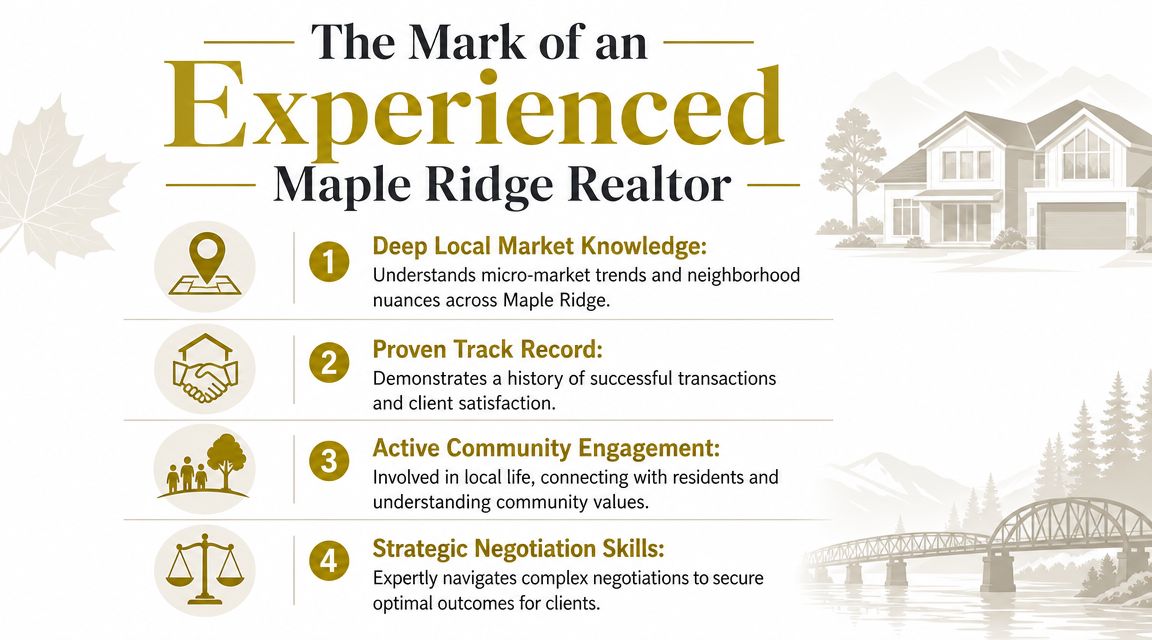
A Maple Ridge market-statistics source notes that experienced agents distinguish themselves by monitoring local conditions over time, not relying on a single snapshot. It also points out that rising inventory and longer listing times suggest buyers have more negotiating power, while low inventory points to a seller's market, and that advice should be grounded in recent local data from at least the last six months rather than generic provincial assumptions (Maple Ridge market conditions and trend monitoring).
Four signs the agent actually knows the market
An agent with real local depth should be able to discuss your area without reaching for clichés. Listen for substance.
- They track inventory behaviour: Not just whether listings are up or down, but what that means for your home type and timing.
- They understand sales velocity: They know when homes are moving cleanly and when buyers are hesitating.
- They watch price reductions: Reductions tell you where sellers missed the market and where buyers may expect negotiating room.
- They tie data to action: Numbers are useless unless they change strategy.
That last point matters most. A less experienced agent may tell you the market is “balanced” or “shifting.” A better one tells you how that affects launch timing, offer strategy, showing expectations, and negotiation posture.
Local knowledge should be practical
Real experience also shows up in how an agent talks about streets, school access, parks, property style, and buyer profile. West Maple Ridge is a good example. It draws interest for different reasons than newer hillside areas, and the homes there often need a different conversation around lot character, layout, and commute convenience. If you're comparing inventory there, a focused West Maple Ridge property search helps you see quickly how varied that pocket can be.
A seasoned local agent doesn't just know where things are. They know how buyers rank them when choosing between similar homes.
There's also an operational side to experience that clients often overlook. Realtor.com's study of newer agents found that only 4 in 10 reported confidence in a long-term career, and identified mentorship, cash reserves, and full-time commitment as key success factors. The same study found networking and word-of-mouth were top offline channels for 6 in 10 agents, while 44% of newer agents ranked open houses as a top channel (Realtor.com study on agent success factors).
For clients, the takeaway is simple. You want an agent with a repeatable business process, not someone living deal to deal.
Navigating Maple Ridge's Unique Neighbourhoods
Maple Ridge rewards local nuance. A citywide opinion won't help much if your home sits on a quiet Cottonwood street, backs onto green space in Silver Valley, or competes with newer attached product in Albion.

A useful industry source makes the point clearly: a realtor's value isn't just general experience, but the ability to explain why detached homes, townhomes, and condos behave differently across areas like Albion, Silver Valley, Cottonwood, and Kanaka Creek, where inventory and benchmark prices can shift materially by property type (questions to ask a realtor about local sub-markets).
Albion and Cottonwood
Albion often attracts family buyers who want newer homes, practical floor plans, and proximity to parks, trails, and schools. Cottonwood can appeal to a similar buyer pool, but the stock, lot feel, and street character can produce different pricing conversations. A detached home with a functional yard and family layout won't be judged the same way as a compact newer build with less outdoor space.
If you're browsing homes there, an Albion home search in Maple Ridge helps show why broad average pricing doesn't tell the whole story. Buyers compare block by block. Sellers need to understand that.
Silver Valley and Kanaka Creek
Silver Valley tends to draw buyers who like newer development patterns, mountain views, access to trails, and a quieter hillside feel. That appeal is real, but so are the trade-offs. Commute patterns, lot usability, slope, and seasonal presentation can all affect buyer response.
Kanaka Creek can create a different kind of demand. For some buyers, proximity to nature and family-oriented streets is a major draw. For others, day-to-day convenience matters more. An experienced agent has to know which features create emotional pull and which ones trigger hesitation.
If an agent gives the same pricing logic for a condo near central amenities and a detached home near trail-oriented neighbourhoods, they're not reading the buyer pool properly.
West Maple Ridge and attached housing
Condos and townhomes in West Maple Ridge often move on a different set of criteria. Walkability, access to shops and services, building condition, strata realities, and affordability pressure can matter more than yard size or lot frontage. That changes marketing language. It also changes how buyers negotiate.
Here's the practical issue:
| Property type | What buyers usually focus on | What the agent should focus on |
|---|---|---|
| Detached family home | Yard, school access, layout, parking | Comparable family-home demand and neighbourhood fit |
| Townhome | Strata feel, bedroom count, functionality | Competing active listings and monthly ownership reality |
| Condo | Building quality, convenience, affordability | Buyer sensitivity to fees, financing, and resale positioning |
A strong experienced realtor maple ridge homeowners hire should be able to explain these differences without sounding rehearsed. If they can't, they're probably relying on citywide talking points.
Key Interview Questions for Vetting Agents
Most agent interviews are too soft. Sellers ask about commission and marketing. Buyers ask if the agent “knows the area.” Neither question tells you much.
Use sharper questions. Good agents won't be bothered by them. They'll welcome them.
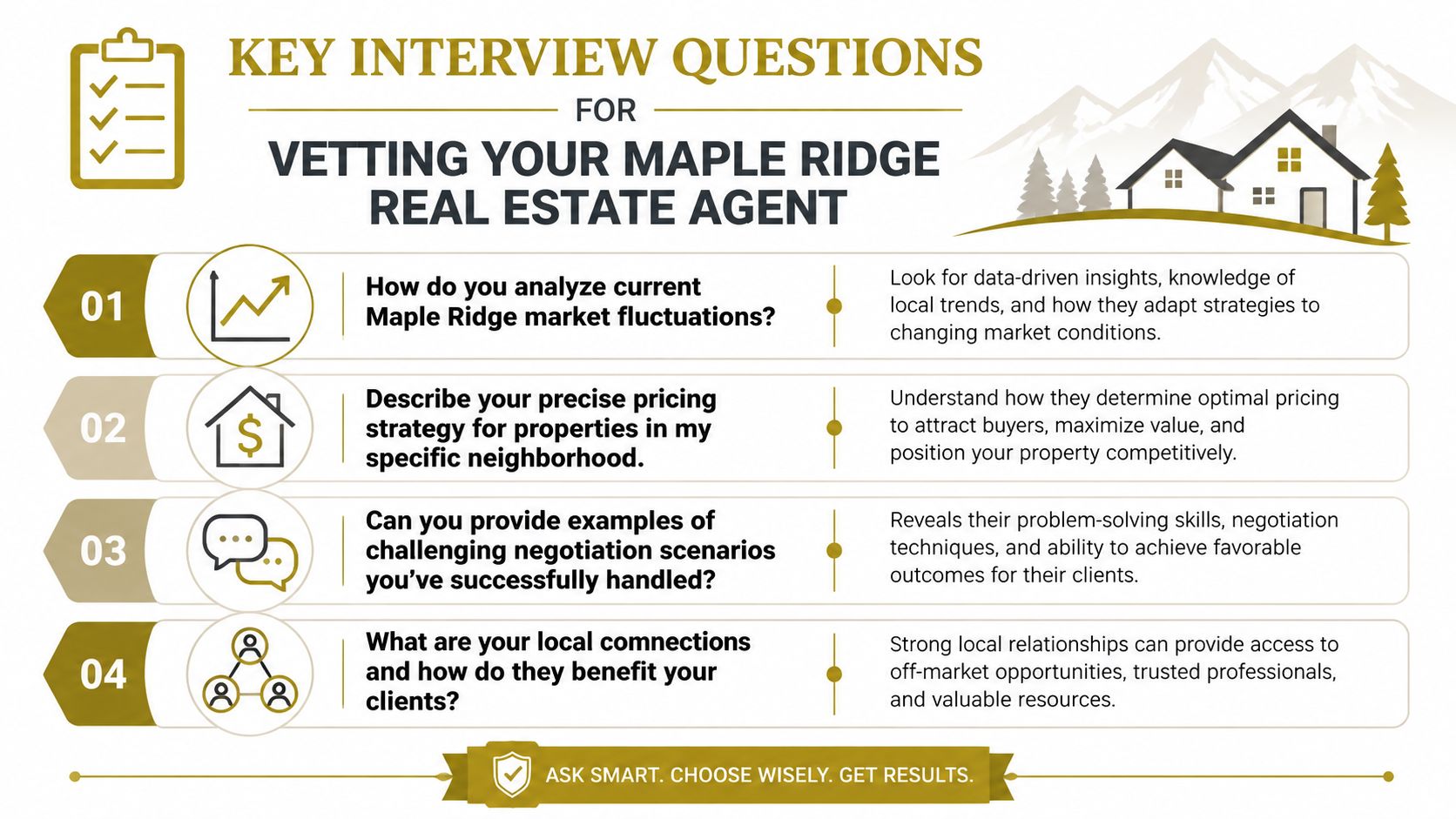
One useful guidance source points out that in a market where affordability is strained, the right realtor must translate macro conditions into local advice. It specifically suggests probing how an agent uses recent comparable sales and explains carrying costs, so client expectations reflect current financing conditions rather than last year's peak pricing (questions about affordability, comps, and carrying costs).
Ask questions that force real answers
Try these instead of generic prompts:
“How would you price or negotiate this property type in this exact neighbourhood today?”
This forces the agent to leave the script and talk about your actual situation.“What current buyer objections are you seeing in my price range?”
Strong agents hear objections repeatedly and adjust strategy around them.“How do current financing conditions change your advice?”
You want someone who understands buyer affordability pressure, not someone quoting an old peak-market mindset.“What would make you recommend a price adjustment or a change in strategy?”
This reveals whether they have a process or just hope momentum appears.
What strong answers sound like
A credible answer usually includes recent comparable sales, likely competition, and buyer behaviour. It should also include trade-offs. For example, if your seller expectations are ahead of current demand, the agent should say so directly.
Weak answers usually sound like this:
- “We'll test the market.” That often means they don't want to challenge your price.
- “The market is still strong.” Maybe. For whom, and where?
- “I have buyers.” That's not a strategy by itself.
The right interview question isn't the one that gets a polished answer. It's the one that reveals how the agent thinks under pressure.
A short scorecard you can use
After each interview, rate the agent on these points:
- Specificity: Did they talk about your area and property type clearly?
- Discipline: Did they explain what they would do if the market pushed back?
- Transparency: Did they say what could go wrong, or only what you wanted to hear?
- Local network: Did they show useful connections to trades, staging help, mortgage contacts, or local exposure channels?
If you're comparing multiple candidates, keep notes. People often remember personality better than substance, and that can lead to the wrong hire.
The Strategic Art of Pricing a Maple Ridge Home
A Maple Ridge home can get plenty of showings and still miss the market.

I see it often. A seller looks at one standout sale in Albion, or a polished new build in Silver Valley, and assumes their home belongs in the same bracket. Buyers do not price homes that way. They compare your property against the other options they can afford this month, with current rates, current stress tests, and current inventory.
That is why pricing is one of the clearest ways to judge an agent's real skill. A serious Maple Ridge realtor should be able to explain where your home sits inside its micro-market, what buyer pool it attracts, and how much room the market gives you before interest drops.
A sound pricing process has four parts. First, the agent selects the right comparables. That means recent solds that match the home's area, product type, lot function, finish level, and buyer profile. A basement-entry family home near schools in West Maple Ridge does not compete the same way as a newer home near the trails in Silver Valley.
Second, they adjust the comps properly. Square footage matters, but so do layout, suite potential, yard usability, parking, updates, and the condition buyers see the minute they walk in. Third, they check current market behaviour. That includes days on market, active competition, price reductions nearby, and whether buyers are paying close to list or negotiating hard. Fourth, they match the price strategy to your timeline. A seller who needs a firm sale in a defined window should price differently than one who can wait and accept more uncertainty.
That last part gets missed a lot.
Overpricing usually starts with a conversation the seller enjoys and ends with a listing that sits. The first two weeks matter most because that is when the market is paying attention. If the price is out of line, buyers hesitate, showings cool off, and the home starts to look stale. Once that happens, the next offer usually comes with more conditions, more pushback, and less negotiating power.
Here is the practical difference:
| Pricing approach | Likely outcome |
|---|---|
| Data-backed and matched to current competition | Strong early interest and more reliable market feedback |
| Aspirational launch price based on a best-case comp | Buyer hesitation and weaker urgency |
| Late corrections after a slow start | Tougher negotiations and more suspicion from buyers |
Good agents will say the hard part out loud. The right list price is not the highest number you can defend in conversation. It is the number that gives you the best chance of attracting the right buyers before your listing loses momentum.
If you are comparing opinions, get more than one CMA and read them closely. The useful question is not which agent gave the highest number. It is which one explained the Maple Ridge buyer pool most accurately, showed the best comparable logic, and gave you a clear plan if the first week underperforms.
If you want another data point, Brookside offers a free Maple Ridge home evaluation. For a broader look at how firms are using technology to improve client communication and follow-up, see DialNexa's guide for real estate CXOs.
Find Your Real Estate Partner in Maple Ridge
You meet two agents. One talks about being a top producer. The other looks at your street, asks whether your buyers are likely to be upsizers, downsizers, or first-timers, and explains how that changes pricing, timing, and negotiation. In Maple Ridge, that second conversation is usually the one that leads to a better result.

By this point, you have already seen why generic advice is not enough. Maple Ridge is full of small market differences that matter. Albion family homes attract a different buyer than a newer Silver Valley build. West Central condos move on a different logic than acreage properties near Webster's Corners. A capable agent should be able to explain those differences without speaking in generalities.
Choose the agent who can think at street level
The right fit is the agent who can answer practical questions with specific Maple Ridge context:
- How does my immediate area behave compared with the rest of Maple Ridge?
- Which buyer group is still active at my price point, and which group has pulled back because of borrowing costs?
- What features matter most in my pocket of the market right now?
- If showings are decent but offers are weak, what gets adjusted first?
- What would make you change strategy in week one instead of waiting for the listing to go stale?
Those answers tell you whether the agent knows the market or just knows how to present.
Good clients should also pay attention to operations. Real estate is not only local knowledge. It is response time, follow-up, document control, showing feedback, and keeping a deal together when financing or inspection issues show up late. Teams and brokerages that invest in better systems usually serve clients more consistently. If you want a broader view of how firms are improving communication and follow-up, DialNexa's guide for real estate CXOs is a useful read.
A practical next step
Interview a few agents. Then compare the quality of their thinking.
The strongest agent is often the one who gives you a narrower, more realistic answer. They will tell you where your home fits, where buyers will push back, and what plan they will use if the market response is softer than expected. That kind of honesty matters more than polished branding.
If you want to talk through your next move with someone who knows the difference between broad Maple Ridge advice and property-specific strategy, start with a conversation through the Brookside contact page for Maple Ridge real estate questions.
If you're buying, selling, or weighing your options in Maple Ridge, Royal LePage Brookside Realty Property Management is available for a low-pressure conversation about neighbourhood fit, pricing strategy, and next steps that make sense for your situation.