
Before you even type "best real estate agent near me" into a search bar, the real work begins with a simple question: what do you actually need? The agent who's a top performer for luxury condos in Yaletown brings a totally different game plan than an expert who specializes in guiding first-time homebuyers in Langley. Getting clear on your own goals is the critical first move in finding the right professional partner.
Defining Your Ideal Real Estate Partner

Before you start scrolling through agent profiles and making calls, you need to map out what a successful partnership looks like for you. The real estate market across the Vancouver area and into the Fraser Valley is incredibly dynamic; every community has its own unique flavour of opportunities and challenges.
Let's be real: your needs as a seller with a detached home in Mission are worlds apart from a buyer hunting for a townhouse in Maple Ridge.
This initial clarity is your compass. It keeps your search focused and efficient. Without it, it’s easy to get distracted by impressive sales numbers that have nothing to do with your property type or what you personally need from an agent.
Creating Your Agent Wishlist
Think of this as drafting a job description for your perfect real estate guide. A successful agent-client relationship is always built on expectations that are aligned from day one. To get there, you need to build a practical agent wishlist.
Start by thinking through these key areas:
Transaction Type and Experience: Are you buying, selling, or trying to do both at the same time? Does your situation have any unique wrinkles, like a downsizing move, an estate sale, or an investment property? You want an agent whose background is a direct match for the journey you're on.
Communication Style and Frequency: How often do you want to hear from your agent? Are you a "quick text is fine" person, or do you prefer a detailed weekly email or a proper phone call? A mismatch here can cause a lot of unnecessary frustration, so get this on the table early.
Negotiation Approach: Are you looking for a bulldog who will fight for every last dollar, or a more collaborative problem-solver who excels at finding the win-win? Both styles can be incredibly effective, but one will definitely fit your personality and comfort level better than the other.
Figuring out these non-negotiables takes your search from a vague hunt to a targeted mission. It helps you see past the basic credentials and zero in on someone who can be a genuine partner in the process. For those looking to invest, clarifying these needs is just as crucial as understanding market nuances—it's the kind of detailed attention that successful residential property services are built on.
A great agent doesn't just sell your house; they understand your goals, anticipate your needs, and guide you through a complex process with confidence. The 'best' agent is the one who is best for you.
Getting this groundwork done now sets you up for a much more productive and successful vetting process down the road.
How Real Estate Commissions Work in BC
Before you can trust an agent with one of the biggest financial decisions of your life, you need to understand exactly how they get paid. It’s a crucial part of building a transparent, professional relationship. When you’re looking for the best local agent, you’re not just hiring a salesperson; you’re investing in a suite of expert services.
In British Columbia, the commission structure is pretty standard across the industry, especially in hot markets like the Fraser Valley. Most agents work on a tiered model.
A common structure you’ll see is 7% on the first $100,000.00 of the sale price and 3.5% on the remaining balance. It’s important to remember this isn't a single fee going into one person's pocket. The total commission is split between the seller's agent (the listing brokerage) and the buyer's agent (the cooperating brokerage). From there, each brokerage pays their respective real estate professional.
What Does the Commission Cover?
Think of the commission as an investment in a successful sale. It’s what powers the entire process, covering all the professional services that separate a home that just sits on the market from one that’s proactively and strategically sold. Top agents like James and Nicole Isherwood use these funds to run a powerful marketing plan designed to pull in qualified buyers and get you the absolute best price.
Here's a breakdown of what that fee typically covers:
- Professional Photography and Videography: In today's market, you can't skimp on visuals. High-quality photos and video are non-negotiable if you want your listing to pop.
- Comprehensive Digital Marketing: This is a big one. It includes getting your home on the Multiple Listing Service (MLS®), running targeted social media ad campaigns, and placing it on other key real estate websites.
- Expert Staging Advice: An experienced agent knows how to prepare your home to appeal to the broadest audience possible. This guidance is invaluable.
- Skilled Negotiation and Representation: This is where great agents really earn their keep. They advocate for your best interests through every offer, counter-offer, and right up to the closing day.
- Contract and Paperwork Management: A mountain of legal documents needs to be handled perfectly. A good agent ensures every ‘i’ is dotted, every deadline is met, and the whole process runs smoothly.
For a closer look at all the moving parts, you can learn more about the complete process of selling your home in the Fraser Valley and see how a detailed plan makes all the difference.
A Real-World Commission Example
Let’s make this real. The Fraser Valley Real Estate Board often reports benchmark prices for detached homes. As of early 2024, these prices are often well over a million dollars. So, let's use a recent benchmark of $1,489,000 for our example.
Applying the typical commission structure, here’s how the math breaks down:
- First $100,000: $100,000.00 x 7% = $7,000
- Remaining Balance: $1,389,000 ($1,489,000 - $100,000.00) x 3.5% = $48,615
- Total Commission: $7,000 + $48,615 = $55,615 (+GST)
That total of $55,615 would then be split between the seller's and buyer's brokerages. This structure is designed to make sure both sides of the deal have dedicated, professional representation fighting for them.
When you walk into an interview with a potential agent armed with this knowledge, you’re in a much better position to have a confident, informed conversation about the value and service you should expect.
How to Properly Vet Potential Agents

Alright, you've got a shortlist of agents who look promising. Now it's time to roll up your sleeves and dig a little deeper than a quick Google search. Vetting an agent properly is about more than just reading a few online reviews; it’s about doing the hands-on work to confirm they have the credentials, the track record, and the genuine local clout to get the job done right.
Think of this as your quality control. This is the stage where you protect your investment and ensure you’re partnering with a credible, effective professional who’s going to be transparent from day one.
Verify Their Professional Standing
First thing's first: make sure the agent is licensed and in good standing. This isn't just a suggestion—it's a critical first step. In British Columbia, every real estate professional is regulated by the BC Financial Services Authority (BCFSA).
The BCFSA has a public registry that makes this check incredibly simple. You can look up any agent in a matter of seconds. Use it to:
- Confirm their licence is active and valid.
- See if there have been any public disciplinary actions filed against them.
- Make sure you’re actually dealing with a regulated professional who is held to high ethical standards.
This quick check is non-negotiable and provides instant peace of mind. If an agent isn't in good standing with the BCFSA, take them off your list. No exceptions.
You're about to navigate one of the biggest financial moves of your life. Checking an agent's licence with the BCFSA is the absolute baseline for ensuring you're working with a legitimate, accountable professional.
Analyze Their Digital Footprint
An agent’s online presence is their modern-day resume, and it’s a direct window into their marketing skills. A clean, professional website is a good start, but you need to go further. How do they actually present properties to the world?
Take a look at their social media channels and current listings. Are the photos crisp and professional, or are they dark and blurry? Do they use video tours to bring properties to life? Is the written content compelling and detailed? This is exactly how your own home would be marketed. Experts like James and Nicole Isherwood know that a top-tier digital strategy is what draws in qualified buyers in hot markets like Vancouver and the Fraser Valley. A weak or lazy online presence is a major red flag.
Scrutinize Their Sales History
This is where the rubber meets the road. An agent's recent sales history—specifically in your neighbourhood and for your type of property—is the most telling metric of all. Being a top seller across the entire Fraser Valley is great, but it's that hyper-local expertise that gives you a real advantage.
Ask them for a list of homes they've sold in the last year. Are there properties on that list that look a lot like yours in price, size, and location? An agent who consistently closes deals for homes like yours brings invaluable, on-the-ground knowledge that a generalist just can't offer.
This kind of proven track record is more powerful than any slogan, and you'll often see it backed up by fantastic client feedback. As you look into their history, you'll start to see how past performance builds a strong reputation when you read through their real estate testimonials. They have their finger on the pulse of the local market, knowing exactly what buyers are looking for and which features are in high demand right now.
Interview Questions That Reveal True Expertise
The interview is your final and most important filter. This is where you move past an agent's polished online profile and impressive sales history to really understand their strategy, their local market knowledge, and how they perform under pressure.
Asking generic questions will only get you generic answers. You need to dig deeper than the typical, "How long have you been an agent?" That question only tells you about their time in the industry, not their effectiveness. Your real goal is to see how they think and problem-solve in real-world scenarios specific to the Fraser Valley and Vancouver markets.
This quick overview shows the simple path to finding and choosing the best local real estate agent for you.
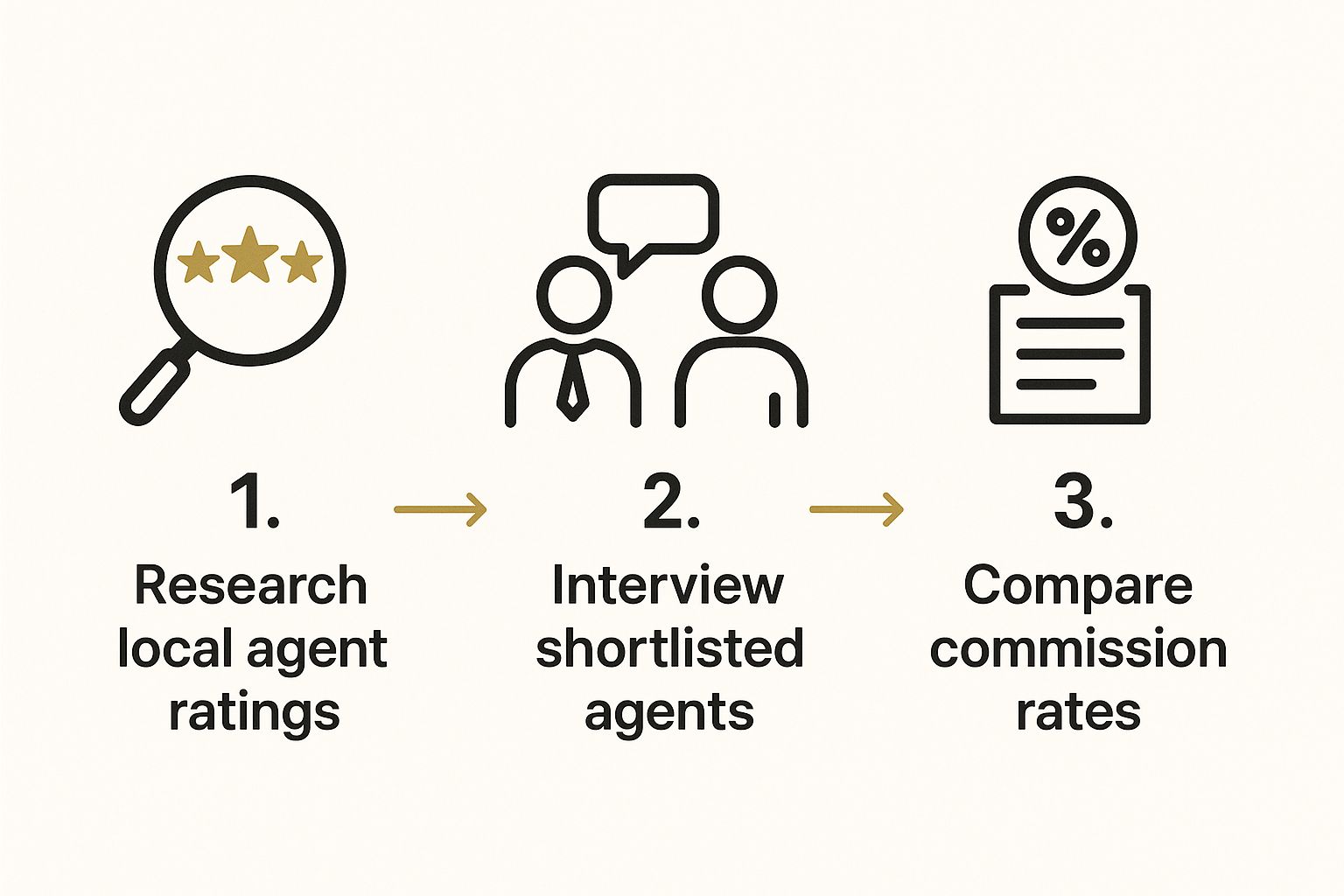
As you can see, a successful search is all about combining solid initial research with direct, insightful interviews and a clear understanding of the costs.
Questions for Home Sellers
When you’re putting your home on the market, your main focus should be on an agent's marketing prowess and pricing strategy. The current market conditions in BC demand a proactive, not a passive, approach.
So, ask them this directly: "Walk me through your specific marketing and pricing strategy for a home like mine in this current market."
A weak answer will be vague, full of generalities like, "We'll list it on the MLS and run some social media ads." A strong answer from a seasoned professional, like James or Nicole Isherwood, will sound completely different. They’ll lay out a multi-channel plan, mention specific local platforms, and explain their data-driven approach to pricing, referencing recent comparable sales right in your neighbourhood.
This is also the perfect time to get a clearer picture of what your home is actually worth. You can get a head start with a free home evaluation online.
Questions for Home Buyers
For anyone buying a home, especially in competitive areas like Langley or Maple Ridge, an agent’s negotiation skills and offer strategy are everything. Multiple-offer situations are incredibly common, and how an agent handles them can be the difference between getting your dream home and losing out again.
Present them with this scenario: "What are your specific tactics for crafting a winning offer in a multiple-bid situation without simply overpaying?"
An inexperienced agent might just suggest throwing more money at the problem. An expert, however, will talk you through a whole toolkit of strategies:
- Writing a compelling personal letter to the sellers to make a human connection.
- Conducting a pre-offer inspection to submit a clean, subject-free offer.
- Building rapport with the listing agent to gather crucial intelligence.
- Structuring the offer with flexible closing dates that cater to the seller's specific needs.
To keep track of their answers, try using a simple scorecard. It helps you compare agents objectively instead of just relying on a gut feeling after the interviews.
Agent Interview Comparison Scorecard
Jot down some notes during each conversation. You'll be surprised how quickly this simple chart can reveal who truly has a plan and who is just winging it.
An agent's response reveals more than just technical skill; it showcases their communication style, creativity, and ability to truly advocate for you. The best real estate agent near you will have a clear, confident, and specific plan of action.
Listen for the specifics. Vague promises won’t cut it when thousands of dollars are on the line. The right agent will provide detailed, actionable strategies that prove they’ve successfully navigated these exact scenarios many times before.
Making the Final Choice and Signing On
You’ve done the interviews, and you’re feeling good about your top contender. Now, you’re on the home stretch. Just two more steps will lock in your choice and officially kick off your partnership. This is the moment you shift from vetting to committing, so you can move forward with total confidence.
First things first: check their references. Honestly, an agent's track record with past clients is the single best predictor of your future experience. Don't just settle for the glossy testimonials on their website; ask your top agent for the contact info of one or two recent clients.
Speaking directly with someone who just went through the process gives you an unfiltered look at how that agent really operates. Were they on the ball? Did they follow through on what they promised? This simple conversation is what separates a good salesperson from a truly great real estate partner.
Understanding the Representation Agreement
Once you've heard great things and your decision is made, the final piece of the puzzle is the representation agreement. This is the legal document that makes your relationship official. In British Columbia, these agreements are standardized, which is great because it means they're designed to protect both you and the agent.
Don't let the legal jargon intimidate you. A pro like James or Nicole Isherwood will walk you through every clause, but you’ll want to pay extra attention to a few key areas:
- Length of the Contract: This spells out how long the agent will be working exclusively for you. The term is negotiable, so make sure it’s a timeframe you're comfortable with.
- Agent’s Duties: The agreement will clearly list out the agent's responsibilities, from marketing your home to negotiating offers and giving you solid advice.
- The Commission Structure: This section details the exact compensation, which should line up perfectly with what you discussed in the interview. A common structure here in BC is 7% on the first $100,000.00 and 3.5% on the balance of the sale price.
Signing this agreement should feel like a natural, satisfying end to a very thorough search. It’s the signal that you’ve done your homework and are ready to move forward with a trusted professional who has absolutely earned your confidence.
This last step creates total transparency. When you understand the terms of your partnership from day one, you can move ahead knowing you’ve found the best local agent to guide you through the tricky—but exciting—Vancouver and Fraser Valley market.
Your Top Questions About Finding a BC Realtor Answered

When you're diving into the Fraser Valley and Vancouver real estate markets, a few questions always pop up. It makes sense—this is a huge decision. Let's clear the air and get you some straightforward answers.
What Is a Typical Real Estate Commission?
This is usually the first thing people want to know. In British Columbia, a common commission structure is 7% on the first $100,000.00 of the sale price and 3.5% on the balance.
But here's a key point: that fee isn't just for one person. It's almost always split between the agent representing the seller and the one working for the buyer. When you partner with us, that commission covers everything from a robust marketing plan to expert-level negotiation, all designed to get the absolute best outcome for you.
Is a Neighbourhood Specialist Really Necessary?
In a word: absolutely. A true local expert who lives and breathes your target neighbourhood in Vancouver or the Fraser Valley has an advantage that a generalist just can't compete with.
They know the subtle shifts in the market, have deep community roots, and understand the real value of a property, street by street. This kind of hyper-local knowledge is a game-changer, whether you're trying to price your home to sell or craft a winning offer. As you map out your finances, our mortgage payment calculator can help you see what's comfortable in different price ranges.
Choosing an agent with a proven track record in your specific area isn't just a preference; it's a strategic advantage that can significantly impact your financial outcome.
Can I Work with Multiple Agents?
It's a bit different for buyers and sellers. As a buyer, you can definitely chat with a few different real estate salespeople when you're just starting out. However, once you find an agent you click with and sign a buyer's representation agreement, you're committed to working exclusively with them for a set amount of time.
For sellers, it's more direct—you'll sign a listing agreement with a single brokerage. Honestly, building a loyal, trusting relationship with one dedicated professional almost always leads to a more focused and successful experience.
How Do I Verify an Agent's Licence?
This is a fantastic question and a crucial step. It's surprisingly easy to do your homework.
You can verify the licence status of any real estate agent in British Columbia by visiting the public registry on the BC Financial Services Authority (BCFSA) website. You can also check their disciplinary history there. This simple check ensures you're partnering with a regulated professional who is held to high ethical and professional standards. And while you're thinking about due diligence, it's also wise to be aware of other potential costs, as highlighted in this homebuyers warning regarding stamp duty and property repairs.
Ready to partner with a top real estate team that combines local expertise with a proven track record? Contact Royal LePage Brookside Realty Property Management today to discuss your buying or selling goals in the Fraser Valley.