You're probably starting from one of three places.
You want a few acres so the kids can grow up with space, maybe with a shop, a garden, and a couple of animals. Or you're looking at Langley land with a builder's eye and wondering which parcels have frontage, servicing, and a realistic path to higher-value use. Or you want the private-estate version of acreage living, where the house sits well back from the road and your neighbours disappear behind trees, hedges, or rolling pasture.
Those are not the same search.
That's the biggest mistake people make when they look for acreage for sale in Langley BC. They treat all acreage as one category, when in practice there are really three different markets living under the same label: the hobby farm, the development play, and the private estate. Each one comes with different pricing logic, different lender appetite, different municipal questions, and different risks if you assume too much.
The Dream and Reality of Owning Langley Acreage
Langley sells a powerful idea. You can drive past equestrian fences, farm stands, berry fields, and tree-lined roads, then be back near major commuter routes and daily services without feeling cut off from the Lower Mainland. That mix is why acreage buyers keep circling back to the Township. It feels rural, but it's not remote.
The dream is usually easy to describe. Buyers talk about a detached workshop, room for horses, a long driveway, or enough distance from neighbours to make outdoor living feel private again. Some want a house with land. Others want land first and will figure out the house later.
Three buyers, three very different searches
The first group is chasing the hobby farm. They want usable land, not just square footage on title. Drainage, outbuildings, fencing, vehicle access, and practical layout matter more than a dramatic gate or architectural finish.
The second group is looking for the development play. They're not buying romance. They're buying frontage, servicing potential, future flexibility, and the possibility that the parcel's highest value isn't its current use.
The third group wants the private estate. They care about privacy, topography, setback from the road, mature landscaping, and whether the property feels quiet once you stand on it.
Practical rule: Before you book showings, decide which of those three buyers you are. If you don't, you'll waste time comparing properties that shouldn't be compared.
Where people get into trouble
The part that catches buyers off guard isn't usually the house. It's the land. A property can look perfect online and still have limits that affect everything from a second dwelling to farm use to financing conditions. Some parcels are attractive because they seem “cheap per acre,” but that's often the wrong lens. Raw size doesn't tell you enough.
What works is a disciplined search built around use. If the property is for horses, inspect it like horse property. If it's a holding property, review it like land. If it's an estate, walk it for noise, privacy, grading, and access. Buyers who stay focused usually make clearer decisions and avoid overpaying for features they'll never use.
That's especially true in Langley, where regulatory context, servicing, and parcel type can matter just as much as the visual appeal.
Understanding the 2026 Langley Acreage Market
Acreage in Langley isn't just a bigger version of a suburban home search. It's a scarce, segmented asset class inside an already active local market.
A recent Langley land search on Zillow showed 56 listings, including a 23.59-acre parcel priced at C$1,800,000, an 8,276 sq ft lot at C$890,000, and a 50-acre lot listed at C$32,500,000. In that same source, Langley's broader housing market posted 706 new listings and 223 homes sold over a recent 28-day period, with an average home price of about C$1,100,924 and a median of 21 days on market. That comparison matters because it shows how small the acreage pool is relative to the wider market.

Why the price spread is so wide
Buyers often expect pricing to move in a straight line with acreage size. It doesn't. In Langley, pricing often follows use, zoning, location, and servicing long before it follows raw land area.
A modest parcel can command strong pricing if it sits in the right location with a usable shape, good road exposure, and easier service access. A much larger piece may appeal to a completely different buyer if it's agricultural, constrained, or intended as a hold rather than an immediate residential build.
That's why the hobby farm, the development play, and the private estate sit in different pricing worlds even when they all use the word “acreage.”
How to read listings more critically
When a listing says “acreage,” treat that as a starting point, not a conclusion. Ask which market it belongs to.
- Hobby farm listing means you should look at usable ground, drainage, outbuildings, fencing, and how the land functions day to day.
- Development-oriented parcel means frontage, servicing pathway, surrounding context, and municipal planning matter more than whether there's a charming house on site.
- Private estate property should be judged on privacy, topography, access, and whether the setting matches the premium.
A buyer who compares all three categories on price per acre alone usually ends up confused. A buyer who compares them by intended use starts seeing why one parcel is expensive and another isn't.
There's also a mindset shift that helps. Recreational and rural property buyers across Canada often behave differently than standard suburban buyers, and that broader pattern is worth keeping in mind when you read the Canadian recreational property market stability outlook. The point isn't that Langley acreage is “recreational” in a simple sense. It's that lifestyle property buyers tend to weigh land utility and long-term fit differently than buyers shopping for a conventional house in a subdivision.
What works in this market
The buyers who do well here usually do three things early.
First, they narrow the search by use case. Second, they review the land before they fall in love with the residence. Third, they stay realistic about competition for well-positioned parcels because low inventory means the best opportunities don't feel interchangeable.
That discipline matters more than trying to force one simple benchmark onto every listing in the Township.
Where to Find Acreage Opportunities in Langley
Not every part of Langley offers the same kind of acreage. If you're searching broadly without matching area to goal, the process gets slow and expensive. You'll spend weekends touring properties that fit somebody else's plan, not yours.
A current Township of Langley land search on REALTOR.ca shows 83 land listings with entry pricing starting at C$614,000. That same source makes the main point buyers need to understand: this is a segmented market that includes small infill parcels, serviced development land, and larger agricultural holdings, with value driven heavily by frontage, utility access, and the likely zoning pathway. A roughly 1-acre development property with 200 feet of frontage can sit in a very different value category than a larger unserviced parcel.
South Langley for hobby farms and equestrian use
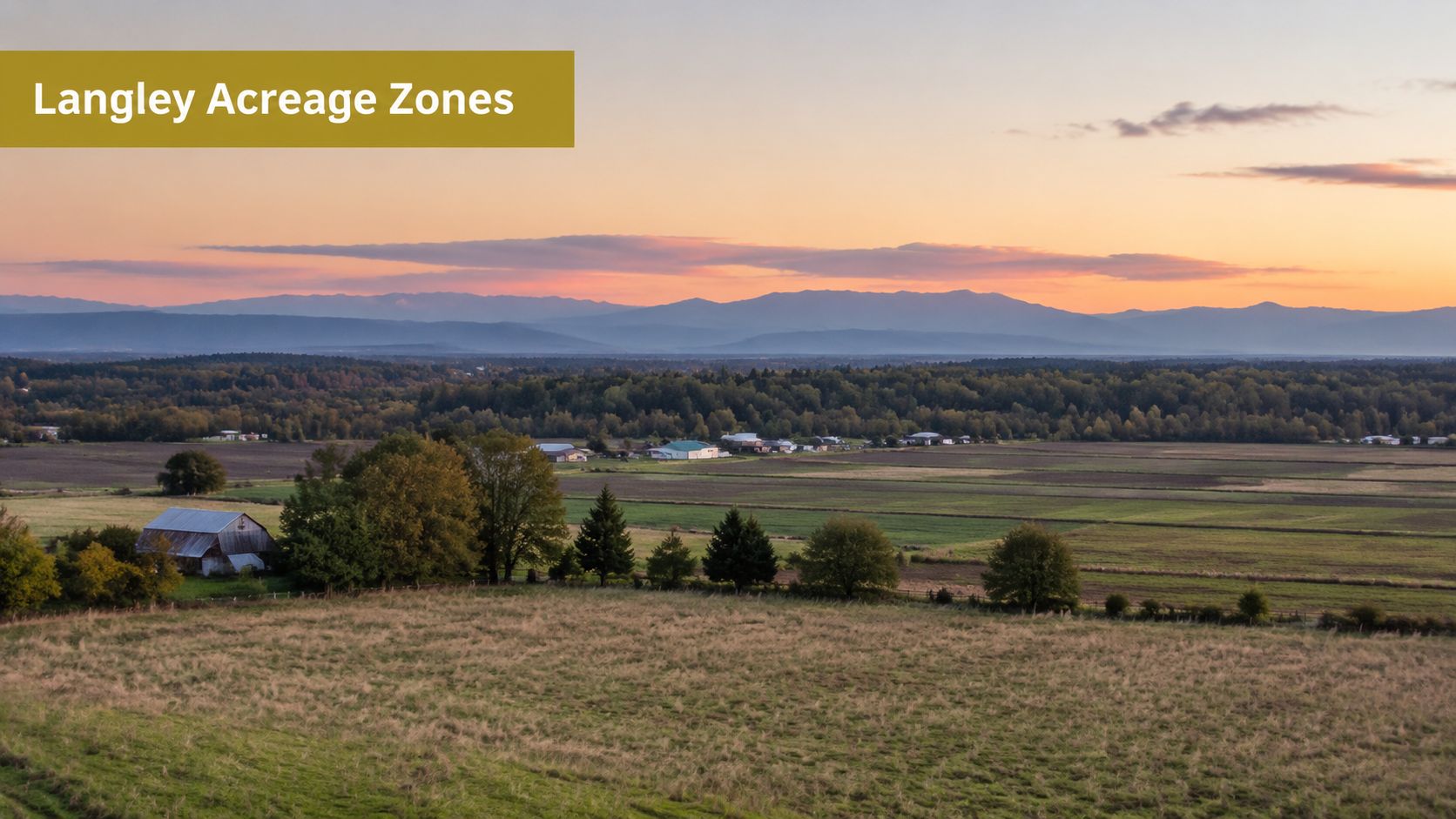
When buyers talk about a classic Langley acreage lifestyle, they're often describing parts of Salmon River, Glen Valley, and other rural pockets in South Langley. These areas tend to attract buyers who want practical land use first. Think horses, hobby farming, shops, machinery storage, and room to move.
What matters here isn't just scenery. It's whether the land is workable. A beautiful property with awkward layout, poor drainage, or limited access for trailers and equipment can disappoint quickly if the buyer plans to use it as a real rural property.
Campbell Valley and similar pockets for private estates
Some buyers aren't looking for agricultural function at all. They want distance from neighbours, mature landscaping, and a property that feels sheltered from surrounding activity. In those searches, areas near Campbell Valley often stand out because parkland, mature trees, and established estate-style settings can deliver the atmosphere buyers are paying for.
Many often oversimplify the search. A large parcel does not automatically feel private. Road noise, lot shape, exposure, and neighbouring uses matter a lot more than the listing headline.
If privacy is the brief, don't judge from aerial photos alone. Stand on the property. Listen. Check sightlines. Watch how close nearby structures actually feel.
Urban edge parcels for the development-minded buyer
The development-oriented buyer usually looks differently at Langley. They care less about whether the pasture is picturesque and more about whether a parcel sits near growth corridors, has meaningful frontage, and offers a plausible servicing story.
Those buyers should spend more time reviewing surrounding context than interior finish. A dated house can be irrelevant if the parcel has the right characteristics. A beautiful house can be a distraction if the underlying land doesn't support the strategy.
A helpful cross-check is to compare how different Fraser Valley communities position detached homes, land, and future-use opportunities in the broader Fraser Valley homes market guide. It sharpens the contrast between a standard home purchase and a true land-driven acquisition.
Match your goal before you match your budget
A faster search usually starts with one question: what must the land do for you?
- For horses or hobby farming, focus on usable terrain, access, fencing potential, and outbuilding logic.
- For a development hold, focus on frontage, utility context, planning environment, and parcel shape.
- For a private estate, focus on setbacks, privacy, topography, and the feel of the site in person.
The area should follow the use. Not the other way around.
Navigating Langley Zoning and the ALR
If you buy acreage in Langley without understanding the Agricultural Land Reserve, you're taking unnecessary risk.
Langley sits in one of British Columbia's most important agricultural regions, and the Township is a key municipality within the provincial ALR system. A recent Langley market statistics snapshot notes both that local land use is heavily shaped by the ALR and that the broader market remained expensive, with a median home price of C$855,500 and homes spending about 23 days on market. For acreage buyers, the important part is the regulatory context. On many parcels, the legal framework matters as much as the lot itself.
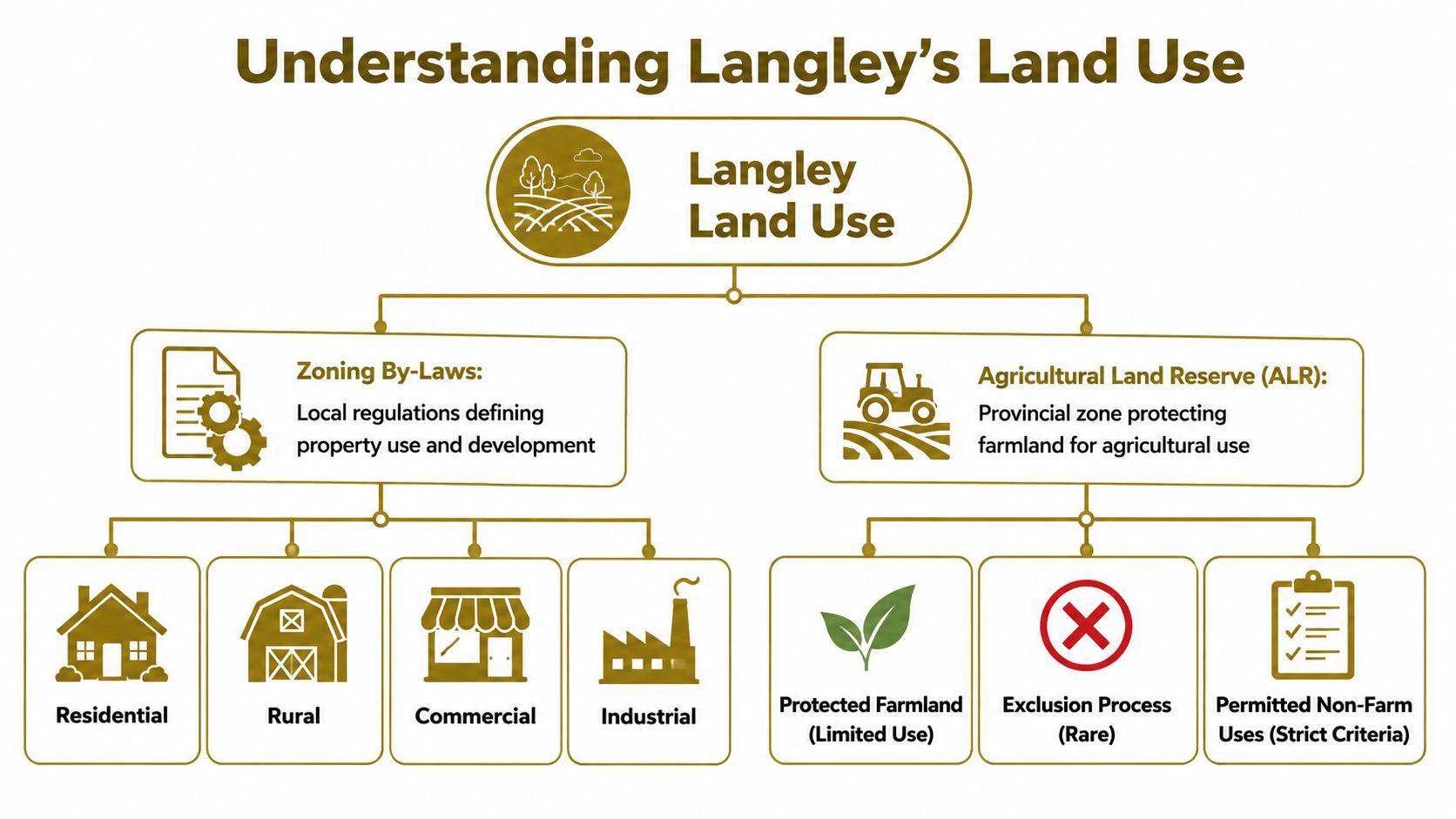
Think of the ALR as a second rulebook
The easiest way to explain the ALR is this: municipal zoning is one rulebook, and the ALR can be a second rulebook sitting on top of it. A property might look like rural residential land to a buyer, but if it's in the ALR, permitted uses can be narrower than expected.
That's why assumptions cause problems. Buyers see acreage and assume they can add another dwelling, sever off a portion later, run a non-farm business, or treat the parcel as flexible holding land. Sometimes the answer is yes. Often the answer is “not in the way you think.”
What to verify before you write
A serious acreage search should include direct questions about status and permitted use.
- ALR status matters first. Is the property fully inside the reserve, partially inside it, or outside it?
- Municipal zoning matters next. Local zoning categories shape setbacks, building form, lot use, and other practical restrictions.
- Actual intended use matters most. A property that works for one buyer's plan may be wrong for another even if both call it acreage.
Buyer warning: Never treat listing language as legal confirmation of what you can build, subdivide, or operate. Verify it with the Township and the applicable provincial framework before you remove conditions.
Why this changes value
The hobby farm buyer may accept ALR limits if the land supports agricultural or rural living goals. The development buyer may see those same rules as a hard stop or at least a major filter. The private-estate buyer may be comfortable with restrictions if the property already delivers the setting they want and no major changes are planned.
That's why two parcels that look similar from the road can command very different buyer interest. Regulatory flexibility has real value. Regulatory limits also have real value when they protect surrounding land from incompatible change. It depends on what the buyer needs.
For anyone buying rural property in British Columbia, the broader guide to rural and agricultural land ownership in B.C. is worth reading before you start making assumptions about future use.
What works and what doesn't
What works is treating zoning and ALR review as part of the first screening round. What doesn't work is falling in love with the property, building a future plan in your head, and only then checking whether the land allows it.
The best acreage decisions in Langley usually start with the question, “What is this parcel legally and practically capable of?” Not, “What would I like it to become?”
Essential Guide to Property Servicing and Access
Rural property has a habit of exposing assumptions. City buyers are used to turning on a tap, flushing a toilet, plugging in internet equipment, and never thinking much about the systems behind it. Acreage ownership doesn't always work like that.
When buyers ask me what to inspect first beyond the land use questions, I point to the same big three every time: water, waste, and access. If any one of those is weak, the property becomes more complicated to own, finance, improve, or resell.
Water and waste
Start with the water source. If the property relies on a well, confirm what kind of well it is, where it sits, and what records are available. Potability, reliability, and practical capacity matter more than a casual assurance that “the water's always been fine.”
Then look at waste management. Many acreage properties rely on septic systems, and buyers need to know location, age, servicing history, and whether the current system suits the way they plan to use the property. A system that works for a smaller household and no outbuildings may not fit a bigger renovation plan or expanded occupancy.
Access, frontage, and the road in
Legal access and physical access are not always the same thing. A driveway may exist, but buyers still need to verify whether it's properly supported by title, easement rights, or road frontage. In winter, in heavy rain, or during utility work, the difference becomes obvious.
Use this field checklist when you tour:
- Check the road relationship. Is access from a public road, a private road, or through an easement arrangement?
- Review where services run. Power, internet, and other connections can affect both cost and convenience.
- Look at the land in motion. After rain, where does water collect, and how does the driveway handle it?
A beautiful gate means nothing if the road, easement, or driveway setup creates a legal or practical headache.
A useful companion read is this piece on rural land access issues in B.C. real estate. It's a good reminder that access should never be treated casually in a rural purchase.
Don't skip the boring questions
The least glamorous questions often save the most trouble. Where is the septic field? Who maintains the road? Is high-speed internet actually available at the house, not just somewhere nearby? Can delivery trucks, trailers, and emergency vehicles reach the site comfortably?
Buyers who answer those questions early tend to avoid expensive surprises. Buyers who don't often discover that the property was easier to admire than to operate.
Financing and Budgeting for Your Acreage Purchase
Acreage financing is rarely as straightforward as financing a standard detached home in a typical suburban neighbourhood. Lenders usually look more carefully at land use, improvements, access, and the property's resale profile. The farther a parcel moves from “normal residential,” the more likely the file needs extra scrutiny.
That doesn't mean acreage is unfinanceable. It means buyers need to prepare differently.
Why the purchase price is only the beginning
The biggest budgeting mistake is treating the asking price as the whole financial story. With acreage, the true cost can include land-related due diligence, servicing review, legal work, ongoing site maintenance, and improvement costs that don't come up on a smaller city lot.
Buyers should also discuss Property Transfer Tax, possible GST implications on certain land purchases, and the carrying cost of a larger property with their accountant, lawyer, and mortgage professional. The exact treatment can depend on the property and transaction structure, so this is one area where generic advice can become expensive.
What lenders care about
Lenders usually get more comfortable when the property has a conventional residential component and fewer unusual variables. Raw land, unserviced land, or highly specialised acreage can lead to different terms, more questions, or a need for a larger equity position.
That's why early mortgage planning matters. A clean financing strategy helps buyers move quickly when the right parcel appears, and it reduces the risk of chasing a property that won't fit lender guidelines. If you need a broad primer before speaking with your broker, this guide to investment property loans gives useful context on how lenders think about non-owner-occupied and more complex real estate purchases.
Build two budgets, not one
I usually tell acreage buyers to build a purchase budget and an ownership budget.
The purchase budget should cover:
- Down payment readiness based on the type of property you're targeting
- Closing costs including legal and tax-related items
- Due diligence costs tied to inspections, review, and specialist opinions
The ownership budget should cover:
- Land maintenance such as fencing, drainage work, brush control, and equipment needs
- Utility and servicing realities that may differ from a typical in-town home
- Repair reserve for outbuildings, driveways, gates, wells, septic systems, or older structures
Buyers rarely regret being too prepared for acreage carrying costs. They do regret assuming rural ownership will feel like owning a larger backyard.
One useful early step is securing a clear mortgage pre-approval before you shop. On acreage, pre-approval doesn't answer every financing question, but it gives you a practical lane and helps your search stay grounded.
Your Due Diligence Checklist and Next Steps
Acreage buyers do best when they stop thinking in broad labels and start thinking in verification steps. “Acreage” is only the advertisement. The underlying decision sits underneath it: legal use, physical function, serviceability, access, financing, and long-term fit.
That matters even more in a market where inventory isn't uniform. A recent Langley acreage trend page highlights that the local land market is highly stratified by parcel type and use case, with dozens of new listings appearing regularly. The practical takeaway is simple. Buyers who assume every acreage listing is broadly comparable usually read the market poorly.
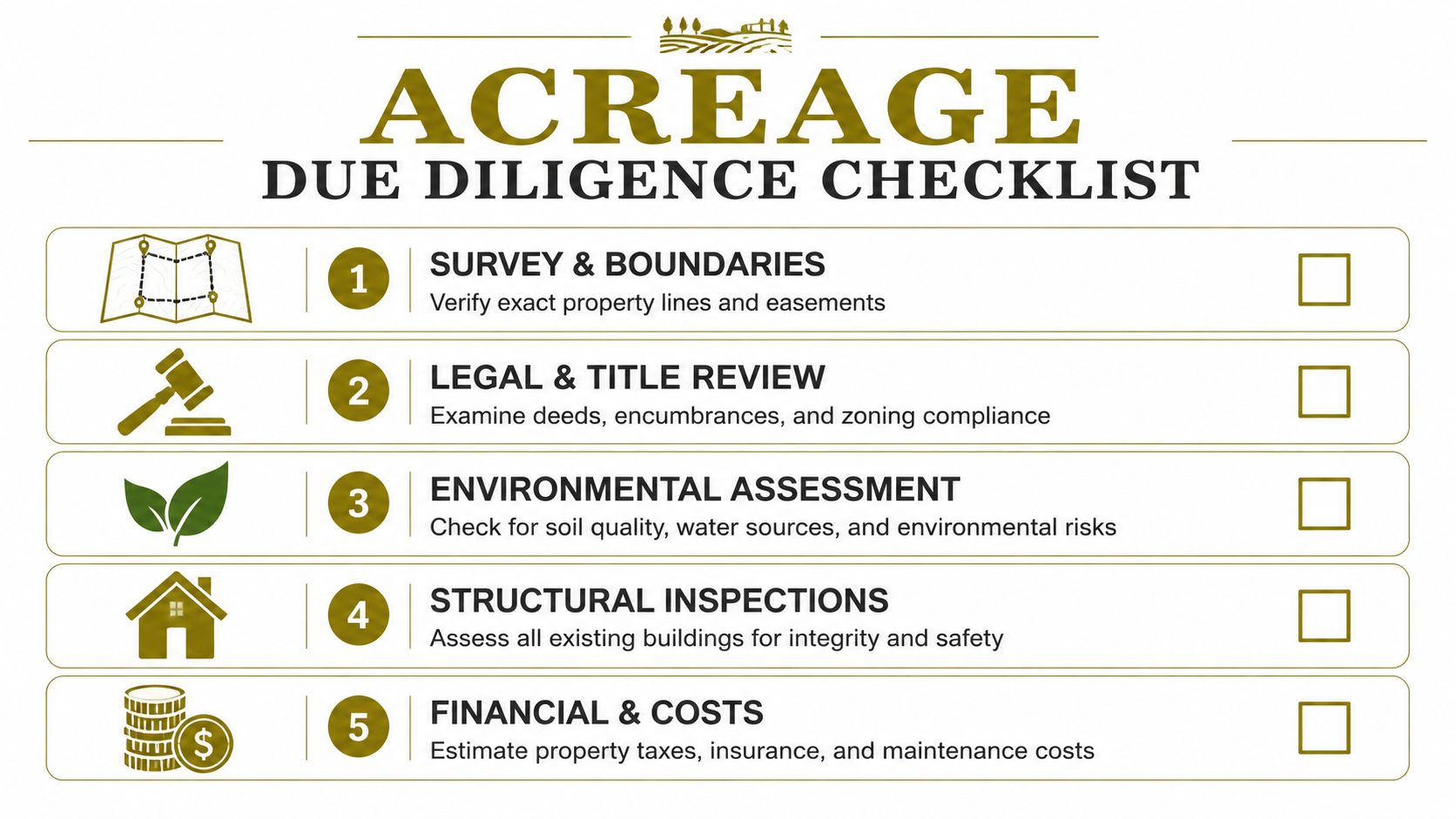
The core checklist
Before removing conditions, buyers should be able to answer these questions with confidence:
What type of acreage is this really?
Is it a hobby farm, a development-oriented parcel, or a private estate purchase?What can you legally do with it?
Confirm zoning, ALR status where applicable, setbacks, existing use, and any assumptions about added dwellings, farm use, or future changes.How does the property function on the ground?
Review water, septic, drainage, access, driveway condition, utility availability, and the practical usability of the land.What sits on title?
Check easements, rights of way, covenants, encroachments, and any restrictions that affect use or resale.Does the financing match the property type?
Make sure the lender, down payment strategy, and ownership budget fit the actual asset you're buying.
A simple way to avoid expensive mistakes
One of the best filters is to write your intended use on paper before you make an offer. Be blunt about it. “I want two horses and a shop.” “I want a long-term hold with frontage.” “I want privacy and no major land work.” Then compare the property directly against that written goal.
That approach works because it exposes mismatch quickly. The acreage might be attractive, but if it doesn't serve the use, it's the wrong property.
The right acreage isn't the one with the best photos. It's the one that still makes sense after the title review, the zoning review, the servicing review, and the financing review.
Final thought for Langley buyers
The best opportunities in Langley usually go to buyers who are clear-eyed from the start. They don't lump all land together. They know which of the three acreage paths they're on, and they investigate the parcel accordingly.
If you're searching for acreage for sale in Langley BC, treat the land as the primary asset and the house as one part of the package. That mindset alone will help you make better decisions.
If you're weighing a hobby farm, a development-oriented parcel, or a private estate purchase and want grounded advice from a Fraser Valley team, Royal LePage Brookside Realty Property Management can help you sort through the practical side of buying or selling real estate with clear local guidance.